Are You Better Off Now Than You Were Three Years Ago?

President Obama has been in office for about three years and six days, which begs the question: Do you feel better off now than you were three years ago?

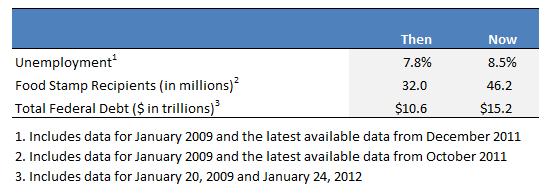
A cursory review of the statistics suggests that the country is not. Unemployment is higher. The national debt has increased by nearly 43% or $5 trillion dollars, and the number of Americans on food stamps has increased by 45% or 14 million people.

Source: BLS, USDA, US Treasury

What do you think?

Are you better off today than you were three years ago?

Posted in Finance and Economics, Policy, Politics | Tagged , , , | 6 Comments

Why I Will Not Vote for Newt Gingrich

Earlier this year I was spellbound by Newt Gingrich’s gift for debating. I was also fascinated by his skills as a brilliant political wonk.

Nevertheless, when he attacked the very foundations of capitalism by levying charges of class warfare against Mitt Romney, he lost me – completely. Continue reading

Posted in Business, Finance and Economics, Leadership, Policy, Politics | Tagged , , , | 30 Comments

Why Business Leaders Think America’s Economy Is Ailing

Last October I was among nearly 10,000 Harvard Business School alumni who completed an in-depth survey on American competitiveness. Harvard Business School released the results of this survey last week, and they are fascinating. Continue reading

Posted in Business, Education, Finance and Economics, Healthcare, Leadership, Policy, Politics, Taxes | Tagged , , , , , , , , | 16 Comments

Are Airstrikes Imminent in Iran?

According to Stratfor, a routine rotation of American aircraft carriers could place three carrier strike groups in the vicinity of the Persian Gulf; a fourth carrier strike group in Japan is within a week’s sailing distance.

This suspicious-looking placement of about thirty-six percent of America’s carriers coincides with a letter the United States sent Tehran last week. The letter purportedly warned Iran that any attempt to shut down the Strait of Hormuz would constitute a red line for the United States.

Despite this official explanation, there is a chance the letter conveyed a more deliberate and pointed message to the Iranians that may have read something like this:

“America’s only issue with Iran is its nuclear weapons program. If Iran does not cease and desist from pursing the development of nuclear weapons, the United States will deny it from acquiring this capability. If, in the process of disrupting Iran’s uranium enrichment pathway, Iran retaliates against the United States and its interests, it should be a proportionate response. If Iran decides to act disproportionately, it will face the full might and fury of the United States military.”

Another interesting data point is the sudden delay of a “massive joint anti-missile exercise” between the United States and Israel. American and Israeli officials confirmed off the record the “Iran factored into the decision.” However, neither country would specify how exactly Iran played into the decision. Instead, both countries noted that “the overriding factor had to do with preparedness for the exercise and Israeli budgetary concerns.” Lastly, the Chairman of the Joint Chiefs of Staff is also scheduled to meet with senior Israeli officials next week.

While the probability of an imminent attack on Iran is likely low, one might view all of these signals as a prelude to a precision airstrike on Iran’s nuclear weapons program over the next several months. Three carriers in the region with a fourth only a week away, are red flags that the United States may be gearing up for possible military action.

Aircraft carriers typically remain at sea for between six and nine months. It seems that Iran’s pursuit of nuclear weapons could end some time during that period via negotiation or violence. Unfortunately, I fear it will be the latter rather than the former.

Posted in Defense, Energy Security, International Security, Middle East, Nuclear Power, Nuclear proliferation, Policy, Politics, War | Tagged , , , , | 15 Comments

America’s Energy and Economic Policies Go Hand in Hand

Using History as a Portal to Our Future

Over two centuries of America’s  formal existence provides much perspective from which to view today’s world. The picture below just hints at a few of  these. Looking at the left portion of the picture,  in the late  1700’s,  life  looked  good even as we recognize  differences in  housing, which were much smaller and without many of the indoor, life-quality-enhancing features we enjoy today.  Much  of the energy it used came directly from human toil.  Nevertheless, the air of freedom was healthy to breathe and invigorating.

Source: Mark Sussman

Over the years, America’s freedoms, including the efforts of private businesses, helped build a nation that indisputably distinguished itself from all others. On the right side of the picture, we see a modern city, such as we might visualize when contemplating travel  to New York, Los Angeles, Chicago, or many others. But this isn’t an American city. It’s one in Malaysia. What’s the point here? Just this: around the world, people have aspirations to be like us, both in civic and material things. That is to say, our success (and our generosity) have wakened.  Citizens of other nations try to emulate us. That’s all to the good, but it also means we cannot rest on our laurels if we are to maintain the global leadership and prosperity of our past.

Today, we use much more energy per person than we did in the 1700’s.  This usage exacts a price on both our existing, natural fuels and our environment.  It also gives us:  freedom from much more burdensome toil; added light and warmth; longevity; easy transportation, communication and entertainment; and others. In a nutshell, our access to energy brings a much  higher quality of life.  Nevertheless, it also makes us aware that providing for our future energy needs is critical to our health, our travel, and our leisure time. So history urges us to look both backward and forward in time, and that’s the purpose of this article. Continue reading

Posted in Clean Energy, Clean Tech, Energy Security, Finance and Economics, Nuclear Power, Policy, Politics, Solar, Technology, Wind | Tagged , , , , , | 22 Comments

Private Equity: A Force for Good, or Evil?

Republican frontrunner Mitt Romney has been under a lot of pressure recently because of his private equity experience. Much of this negative media attention stems from certain assumptions about the nature of the private equity industry — assumptions that reflect preconceptions rather than reality.

In order to elevate the current debate to a more rational and balanced discourse, I decided to pen a very simple primer on private equity based on my previous experience investing in both venture capital and buyout firms. Like any industry, private equity has both positive and negative aspects. It can be a source of value creation or destruction, depending on the actions of a private equity firm’s general partners, the price these partners pay for an asset, the success or failure of the management teams these general partners put in place to run their companies, and broader market conditions beyond the general partners’ control.

To make many of these descriptions easier for readers to understand, it sometimes helps to use examples. As such, my primer will leverage the fictional companies of Meritocratus and Egalitarius. Continue reading

Posted in Business, Finance and Economics, Investing, Politics | Tagged , , , , , , , , , , | 14 Comments

Are Liberals More Educated Than Conservatives?

Update: Click here for the most recent statistics.

A surprising amount of anti-conservative bigotry on the web asserts that conservatives are inherently less intelligent than liberals. Admittedly, some prominent conservatives make statements that go against the mainstream scientific consensus on topics such as global warming and Darwin’s theory of evolution. That said, these examples do not mean that being a conservative automatically implies a lower IQ or education level than being a liberal does.

I decided to run the numbers to test this assertion, and it turns out it is not true. However, a far more interesting pattern emerges that confirms a theory I have always held, but had never taken the time to test. Continue reading

Posted in Business, Education, Policy, Politics | Tagged , , , , | 259 Comments

The Conflict over Iran’s Nuclear Program Update

On December 29th, I cataloged several incidents that occurred during the past two years, indicating that a covert war between the West (including Israel) and Iran was well underway. In recent days, several prominent American defense officials have begun signaling that the conflict is about to enter its next phase. This article updates the chain of events to include those that occurred between December 29th and January 12th. Continue reading

Posted in Defense, Energy Security, Finance and Economics, International Security, Middle East, Nuclear Power, Nuclear proliferation, Policy, Politics, Terrorism, War | Tagged , , , , , , , , , , , , , , , | Leave a comment

New York Times Editorial Board: Stop Hiding Behind Your False Objectivity and Endorse President Obama

Today, The New York Times editorial board published the most one-sided, biased, and unfair attack on the leading Republican contender. It was so partisan that it presented a textbook case of why conservatives must rely increasingly on foreign newspapers like The Economist to get objective news.

Now, before people point out that editorials are, by definition, opinions, I would counter that those who write them usually base their arguments on fact, or at least they present an informed point of view.

This editorial did neither.

Furthermore, opinion editorial writers tend to be individual citizens, and tend not to wrap themselves under the august mantle of an American institution.

So what was wrong with this editorial? Well, I simply do not know where to begin. For one, the opening line was rife with pure progressive snark:

“The more Mitt Romney pretends to empathize with the millions of Americans who are struggling in this economy, the less he seems to understand their despair.”

Pretends to empathize? Really? Does The New York Times editorial board have evidence for this assertion?

The more the liberal “elite” media pretend to speak for the American people, the more they betray their true colors. I expect overweening snark from Paul Krugman. At least I know where he stands. But The New York Times editorial board?

Really?

The editorial then maintains that more than a fifth of the “flailing” companies Mitt Romney purchased later went bankrupt. If the editorial board had done its homework or had bothered to speak with anyone who knew anything about the private equity industry, it would have learned that the average buyout fund has a failure rate in this range. The fact that it was not higher is a testament to the value that buyouts provide to the American economy in both saving companies and making them more efficient. Had Bain Capital not intervened, chances are that even more of these companies would have gone under, leading to even more job losses.

In its argument against voting for Romney (and its implicit endorsement for Obama), the editorial board cited only one Bain Capital transaction — an investment in which the company laid off 1,700 employees. Of course, the editorial board ignored a host of other Bain Capital transactions like Staples (a gain of 89,000 jobs), The Sports Authority (15,000 jobs), and Domino’s (7,900 jobs). While many have disputed the absolute numbers of jobs these companies may have created on Romney’s watch, it is indisputable that Romney’s investments in these companies ultimately resulted in the creation of successful and sustainable businesses.

But balance apparently matters little to The New York Times editorial board. In fact, the only thing this article lacked was the following statement:

“I am President Barack Obama, and I approved this message.”

Posted in Business, Finance and Economics, Investing, Leadership, Media, Policy, Politics | Tagged , , , , , , , | 10 Comments

I Love the Smell of Nepotism in the Morning

I think she meant “modicum.” Not emoticon. 😉

Posted in Media, Politics | Tagged , , | 7 Comments