Pundits on the left cite the economic prosperity and stock performance during the Clinton administration as evidence of the Democratic Party’s “superior” fiscal policies. Commentators on the right retort that the market did well during the Clinton administration despite his policies. They add that if Newt Gingrich’s 1994 Republican Revolution had not forced the President to balance the budget, the economic performance during that period could have been far worse. They then point to the economic record during the Reagan Administration and contrast it with Jimmy Carter’s.
Does the market really perform better when a particular party controls the White House? What about the Senate or the House of Representatives? Is it better for the market when a party controls both the legislative and executive branches of government? More importantly, could investors have outperformed the market by betting on a particular party?
I decided to buckle down and do the math. The answers are both surprising and complex, but a number of trends emerged.
Market Outperformed During One-Party Rule
When it comes to politicians, I tend to view them as incompetent unless they convince me otherwise. As such, I have always held the notion that a divided government, in which the President’s opposing party controls at least one house of Congress, is better for economic performance than the alternative. I held this view because in a divided government, nothing gets done. How can that be a good thing, you ask? Well, the only thing worse than a lazy and incompetent group of people is a group of industrious and incompetent people. They can do a heck of a lot more damage.
| Party Control of Executive and Legislative Branches |
| |
|
|
|
| |
S&P 500 |
Divided |
United |
| 60-year average |
8.5% |
7.2% |
10.6% |
| 40-year average |
8.3% |
7.5% |
10.1% |
| 20-year average |
8.7% |
6.7% |
11.7% |
| 10-year average |
1.7% |
-17.8% |
14.7% |
However, it turns out that my intuition proved to be wrong, at least over the time periods I observed. The 10-, 20-, 40-, and 60-year average returns all show that the market outperforms during a period in which one party controls both the White House and Congress and underperforms during a period of division. I do not understand why this is the case. I can only speculate.
Perhaps one-party control provides investors with more certainty over future fiscal and economic policies, whereas a divided government generates more uncertainty. One way to test this hypothesis would be to measure the S&P 500’s average volatility each year. If volatility were higher during periods of divided government, this observation might support this hypothesis.
Market Outperformed During Democratic Presidencies
It looks like the market performance of Bill Clinton’s two terms with the handicap of Jimmy Carter’s one outweighs that of Ronald Reagan’s two terms handicapped by the combined three-terms of Bush junior and senior.
| U.S. President |
|
|
|
| |
|
|
|
| |
S&P 500 |
Democrat |
Republican |
| 60-year average |
8.5% |
11.9% |
6.3% |
| 40-year average |
8.3% |
13.6% |
5.4% |
| 20-year average |
8.7% |
16.3% |
1.1% |
| 10-year average |
1.7% |
18.1% |
-2.4% |
Again I can only speculate as to why the market has outperformed under Democratic administrations. Federal policies sometimes takes years to work their way through the system, so it is possible that policies implemented in a Republican administration only began to have an impact during the next Democratic one. Maybe Democratic Presidents have, in fact, been more effective stewards of the American economy. I doubt this is the case based on what I believe to be ineffective liberal economic policies, but it is hard to argue with results. That said, the American economy is so large and complex, and has so many variables that affect it, that it is very different to conclude that its performance is primarily the result of a single President’s actions – whether they are Bill Clinton’s or Ronald Reagan’s.
Market Outperformed When Republicans Controlled Congress
Conversely, the market has outperformed when Republicans controlled the House or Senate and has done so consistently over 10-, 20-, 40-, and 60-year periods I profiled. The market has underperformed during Democratic Congresses. Again, I can only speculate what led to this result. Perhaps Republicans pass more business-friendly bills in Congress. Or maybe they are just lucky enough to control Congress when a Democrat is in the White House. Again, correlation does not imply causation and the American economy has far more variables that affect it then just Congressional legislation.
| U.S. Congress |
|
|
|
|
|
|
|
| |
|
|
U.S. House |
|
U.S. Senate |
| |
S&P 500 |
|
Democrat |
Republican |
|
Democrat |
Republican |
| 60-year average |
8.5% |
|
7.3% |
12.5% |
|
5.6% |
15.4% |
| 40-year average |
8.3% |
|
7.0% |
11.4% |
|
3.9% |
14.9% |
| 20-year average |
8.7% |
|
4.7% |
11.4% |
|
0.1% |
17.3% |
| 10-year average |
1.7% |
|
0.3% |
2.6% |
|
-5.9% |
13.0% |
Have Investors Made Money Pursuing These Strategies?
The short answer is probably not. The long answer is that investors did best over the past sixty years by ignoring politics. But wait, the average returns for Democratic administrations were higher than the market average. What gives?
Part of the answer lies in implementing a strategy based on investing in the market only when a particular party is in power. When that party leaves office, an investor would remove his or her money from the market and receive a 0% return for that year. Of course, one could invest that money in U.S. Treasuries, but I will save this additional complexity for another blog if it happens to change the answer of this analysis.
So now that we have an idea of how this strategy works, there are several strategies that a political junkie might purse. He could, for instance, only invest in the market when his favorite political party controlled the Presidency. Alternatively, he could choose to invest only when his party occupied the House or the Senate. Political cynics might pursue a strategy in which they invest in the market only if one or more houses of Congress are controlled by the President’s opposing political party.
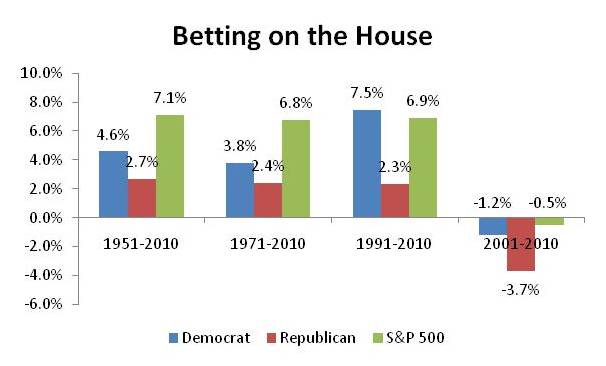
I ran the numbers for a number of these different strategies and compared the annualized returns an investor might realize on a $10,000 investment over a 60-, 40-, 20-, and 10-year time period. It turns out that in all but a few cases, the best strategy would have been to invest in the market and ignore shifts in political power. Another winning strategy would have been to take $10,000 and put it under a mattress from 2001-2010. At least the $10,000 would have been there at the end of the decade. Investing in the market would have turned that $10,000 into $9,526. Below are the annualized returns for a number of these strategies.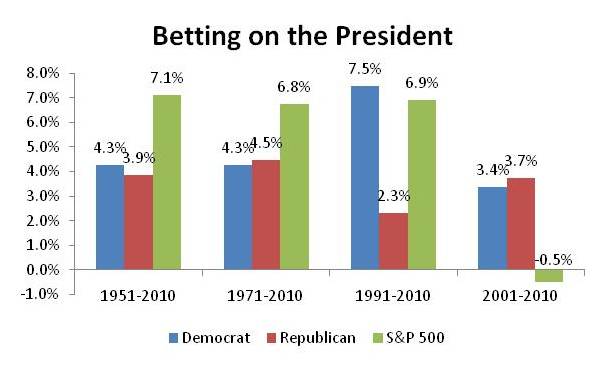


Why Didn’t Most of These Strategies Lead to Market Outperformance?
By now many may be wondering why the market outperformed during a Democratic administration, but investors could have only earned better annualized returns with this strategy from 1991-2010. The problem is that a Democrat has only been President in 24 of the last 60 years. During remaining 36 years when a Republican was President, the market was up in 25 of them with an average return of 16%. These years of positive performance outweighed the years of negative performance and would have netted out to a return greater than 0%, which an investor would earn during the years without a Democrat in the White House.
Investing During a Republican Senate is the Only Strategy that Outperformed the Market
This strategy is the only one that outperformed the market consistently over the last two decades. It is also interesting to note that investing during periods when Democrats controlled the House consistently outperformed a strategy investing during periods when Republicans controlled the House. However, this strategy only beat the market during the 20-year period from 1991-2010. Why this is the case, again I can only speculate.
Investing in Your Party Is the Best Way to End One
Investors are better off following key economic indicators that have more impact on stock fundamentals rather than chasing gusts of whatever foul stench the political winds blow their way.
It is important in passing to note that historical returns do not guarantee future performance. The above analysis only reviewed historical trends. It provides little, if any insight into what might happen in the future.







 Reflections of a Rational Republican