In Libya, the Hits Just Keep on Coming

While I correctly predicted that a more democratic government in Muslim countries like Libya would result in increased Islamic radicalism, I could not have imagined it might spell the beginning of an Arab apartheid regime.

Today, the New York Times reported that rebel leaders are pleading with their fighters to “avoid taking revenge against ‘brother Libyans’.” Apparently, the rebels are imprisoning anyone they believe fought as a mercenary for Colonel Qaddafi. It turns out the only evidence rebels need is the color of one’s skin. In other words, if you look like a sub-Saharan African, you must be a mercenary.

It seems Libya will join the list of African countries like Sudan and Nigeria, which are plagued by ethnic tensions between North African Arabs and sub-Saharan Africans.

Rebels are now rounding up sub-Saharan African migrants in “fetid, sweltering pens for as long as two weeks on charges that their captors often acknowledge to be little more than suspicion.” One human rights researcher, who visited the facilities noted, “It is very clear to us that most of those detained were not soldiers and have never held a gun in their life.” In one case, the rebel were holding a prisoner on allegations of witchcraft.

As for increased Islamic radicalism, reporters observed rebel captors drilling prisoners “at gunpoint in rebel chants like ‘God is Great’ and ‘Free Libya!'”

They say the road to hell is paved with good intentions.

It is a lesson President Obama would do well to learn.
Posted in Defense, Energy Security, International Security, Middle East, Nuclear proliferation, Policy, Politics, War | Tagged , , , , , , , , | 10 Comments

Labor Day Tribute: Why Unions Suck

In the 1930’s, when workers in San Antonio forced by the Depression into degrading pay and conditions organized to improve their plight, they set in motion a series of unintended consequences.  Their labor union, organized by authentic Communists, aimed to create a protected proletariat.  Their efforts were undermined by New Deal bureaucrats, who blew up the whole program with a simple innovation – a national minimum wage.

Employers, legally barred from maintaining degrading and abusive conditions, replaced most of the workers with machines.  Over the following decade, the number of workers dropped dramatically, while wages more than tripled, working conditions improved, and the industry evolved.

This was a fantastic outcome for everyone.  Yes, everyone.  The difficulty we have in understanding that fact helps explain why politicians still struggle to make sound economic policy. Continue reading

Posted in Business, Finance and Economics, Policy, Politics, Socialism, Taxes | Tagged , , , , , , | 4 Comments

Huntsman’s Jobs Plan a Good Start

Last week, the Huntsman campaign released an alternative to the President’s soon-to-be-released jobs plan. The plan includes four broad components including: 1) tax reform, 2) regulatory reform, 3) energy independence, and 4) free trade.

I broadly agree with most of Huntsman’s proposed policies. That said, I would fine tune some of his proposals.

Tax Reform

The bulk of Huntsman’s tax reform package focuses on lowering tax rates and simplifying the tax code. I broadly agree with both. Huntsman’s tax code simplification focuses on lowering income tax rates to three progressive tiers of 8%, 14%, and 23%, respectively. To make his plan revenue neutral, he proposes eliminating all deductions and credits.

I would amend the word “all” to “most”, as eliminating certain tax credits/deductions could actually harm the economy in the short-term, particularly in ensuring a housing recovery. The specific deduction to which I am referring is the mortgage interest deduction. Eliminating this deduction would reduce the incentive for people to purchase a home. As fewer people purchase homes, housing prices would continue to languish. In turn, consumers would continue to rein in spending, because the negative wealth effect of depressed housing prices.

Regulatory Reform

While I broadly agree with Huntsman’s proposals to rein in the excesses of independent agencies like the NLRB and, sometimes, the EPA, I disagree with totally repealing Obamacare and the Dodd-Frank Bill. While I agree that both pieces of legislation are job-killing, and ultimately increase prices for consumers, I think Huntsman should at least propose alternative legislation to replace these two policies, while retaining their better feature. For instance, he should provide an alternative for healthcare that contains the best of Obamacare (e.g., individual mandate, and permitting Medicare to negotiate for drug prices); gets rid of inane provisions, for instance, that require restaurants to provide healthcare for all of their hourly employees; and includes provisions that actually will help reduce healthcare costs, such as tort reform.

Energy Independence and Free Trade

I broadly agree with all elements of Huntsman’s Energy Independence and Free Trade policies. That said, I would add more provisions for energy independence. However, I will save those prescriptions for my forthcoming book.

Despite some of its flaws, the Huntsman Plan is likely the best one put forward thus far. Hopefully, the President offers something better.

That said, I’m not optimistic.

Posted in Business, Clean Energy, Clean Tech, Climate Change, Energy Security, Finance and Economics, Nuclear Power, Peak Oil, Policy, Politics, Smart grid, Taxes, Technology, Unions | Tagged , , , , , | 2 Comments

The San Antonio Pecan Workers’ Strike of 1938

In the early 20th century, San Antonio had become the center of a modestly lucrative industry – pecan processing.  Prior to the Depression, the business had started taking steps toward mechanization, but the country’s economic collapse began to reverse that trend.

By the early thirties, thousands of poor San Antonians, mostly Hispanic, were surviving on poverty wages working long hours shelling pecans by hand.  The business owners were making more money than ever, while mechanization halted, and poverty intensified across the city.

The situation in San Antonio attracted the attention of two different groups: Communist labor union organizers and Roosevelt’s new federal bureaucracy.

When I use the term “Communist” here, I’m not talking about the characters in a Glenn Beck episode.  I’m not talking about people who dress like Communists, or talk like Communists, or sat next to a Communist on a bus once.  Emma Tenayuca was a San Antonio native and Communist who was actually married to the leader of the Communist Party in Texas (that’s right, there was one).  She worked through the ‘30’s to organize the pecan workers in that city.

The classic Marxist union model for dealing with the workers’ economic problem was simple:  raise their “class consciousness” so that they could effectively organize as a unit;  secure higher wages through collective bargaining; then introduce other reforms that would prevent the workers from being fired or displaced.  It wasn’t just about wages or working conditions because the union had more worries than pay.  The union wanted to keep their power by preventing workers from opting out and by preventing owners from replacing workers with machines.

The Feds in this case, though generally friendly to unions, had a different priority – a blanket minimum wage.  They sought to put in place bureaucratic curbs that would create a kind of floor over the muddy bottom of American poverty.  A nationally standardized set of minimum working conditions were meant to change the incentives in the economy away from degradation and toward development.

After years of organizing and two prominent strikes, by 1938 Tenayuca’s union was able to achieve a few modest concessions from the business owners.  But her last major campaign was interrupted when the federal government finally imposed a minimum wage that would cover the workers.

What happened next is where the whole process gets really interesting. Continue reading

Posted in Business, Finance and Economics, Policy, Politics, Socialism, Technology, Unions | Tagged , , , , , | Leave a comment

Al Qaeda to Be Part of New Libyan Government

Ali Tarhouni, the deputy chairman of the rebels’ executive board announced today that he was appointing a Supreme Security Committee of civilian officials and militia leaders, as a prelude to forming a new Libyan government. That said, Mr. Tarhouni also announced that he would not replace the Tripoli Military Council, “a grouping of rebel militias that has participated in ousting the forces of Col. Muanmmar el-Qaddafi from the capital.”

As I predicted back in February, “democratic” revolutions in Middle Eastern countries trend toward increased Islamic radicalism. Iran, Lebanon, Gaza, and increasingly Turkey, are key examples of this trend.

Now it looks as if Libya will follow.  Leading Libya’s Tripoli Military Council is Abdel Hakim Belhaj. Belhaj is also one of the 21 members of Libya’s new Supreme Security Committee.

It turns out Mr. Belhaj was the emir of the Libyan Islamic Fighting Group, which was the second largest foreign contingent of jihadhists fighting American forces in Iraq. In other words, President Obama’s policy not only has increased the probability of a Middle Eastern nuclear proliferation spiral, but also has resulted in a Libyan government with al Qaeda elements.

With roughly 6,000 American deaths over a decade fighting al Qaeda, the fact that the President used any U.S. resources to accomplish this deployable state of affairs is both poor policy, and a slap in the face to American active military and veterans.

I guess the “responsibility to protect” only applies to America’s enemies.

Posted in Defense, Energy Security, International Security, Middle East, Nuclear proliferation, Policy, Politics, Terrorism, War | Tagged , , , , , | Leave a comment

Libya: Operational Success, Strategic Failure

Last week, Bloomberg’s Jonathan Alter posed a tantalizing question: “you think Obama’s been a bad president? Prove it.” More specifically, Alter challenged the president’s detractors to identify specific administration policy failures. On Monday, conservative David Frum responded to Alter’s throwing down the gauntlet with three examples of the President’s poor decision-making.

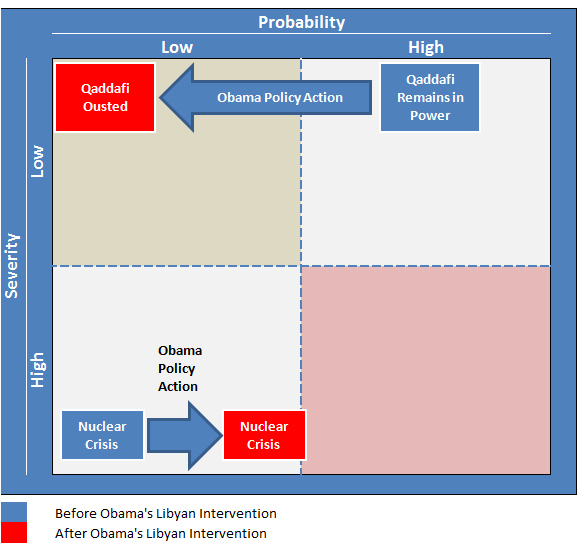
I came up with my own list of the president’s poor policy choices, which left-leaning bloggers have disputed. Of these decisions, Obama’s Libyan intervention may seem like his least obvious policy failure. So far, it appears to be an unmitigated operational success, achieved with far less blood and a lower price tag than the war in Iraq. That said, many on the left are confusing the current operational victory with the strategic validation of Samantha Power’s so-called “responsibility to protect“, which advocates military intervention on purely humanitarian grounds. The problem is that this policy sacrificed America’s vital interest of nuclear non-proliferation to achieve the limited strategic objective of ridding Libya of an unpleasant dictator.

Obama’s Intervention Increased the Probability of a Low Likelihood, but Extremely Catastrophic Event

Source: Sean Patrick Hazlett

Continue reading

Posted in Defense, Energy Security, International Security, Middle East, Nuclear Power, Nuclear proliferation, Policy, Politics, War | Tagged , , , , , , , , , , , | 6 Comments

Bush vs. Obama: Unemployment (August 2011 Jobs Data)

Change in Total Private Employment (in thousands), Source: U.S. Bureau of Labor Statistics

Update: Click here for the most recent jobs statistics.

As is customary on this site, on the first Friday of every month, I update the unemployment numbers so that I can compare the unemployment rate under President George W. Bush with the unemployment rate under President Obama at that time. The genesis of this ritual began when I felt compelled to respond to some left-leaning sites that were comparing Obama’s first two years and four months in office with Bush’s last and worst economic year (the above chart shows the most recent incarnation of this narrative).

Methodology Change

It is also important to note that I made a slight change in methodology for these charts. In the past, the president who was in office at the end of each month received credit for the jobs created or lost in that month. As such, President Bush received credit for jobs lost in January 2001, and President Obama received full credit for jobs lost in January 2009. Now, I am giving each president credit for the net jobs lost or gained for the fraction of the month he was in office. For instance, President Bush will now get credit for 61% of the jobs lost in January 2009 (i.e., 19 days divided by 31 days), and President Obama will get credit for the remaining 39%. President Bush will also only get credit for 39% of the jobs lost in January 2001.

Continue reading

Posted in Business, Finance and Economics, Media, Policy, Politics | Tagged , , | 26 Comments

Bush vs. Obama: Housing Starts

Source: U.S. Census Bureau

Since comparisons between Presidents George W. Bush and Barack Obama appear to be very popular these days, I have added yet another chart to the mix.

During the Bush’s second term, housing starts fell off a cliff. While they seem to have stabilized under the Obama Administration, they have not improved.

Annualized housing starts averaged roughly 1.6 million per month during the Bush Administration vs. about 572,000 during the Obama Administration. Since both Presidents were in power in January 2009, I included the 490,000 annualized housing starts in both of their numbers.

While Obama bears no responsibility for the low levels of housing at the beginning of his administration, it is clear that things have not improved over the last two and a half years since he took office.

Housing starts are an important indicator of economic health. Housing production generates a tremendous amount of economic activity that touches on multiple industries.

So far, things look anything but healthy.

Posted in Business, Finance and Economics, Policy, Politics, Taxes | Tagged , , , | 1 Comment

Solyndra: Another One Bites the Dust

After receiving a $535 million loan from the federal government, and about $1 billion in venture capital financing, California-based manufacturer Solyndra suspended manufacturing operations today, and laid off 1,100 employees. It also announced its plans to file for bankruptcy protection.

Solyndra was the first company to receive funds under Barack Obama’s highly publicized federal loan-guarantee program, in which government bureaucrats allocate funding to private companies. The company is also at least the second major government-subsidized solar company this month to declare bankruptcy. Massachusetts-based Evergreen Solar entered bankruptcy protection earlier this month, after closing its Massachusetts plant.

This bankruptcy is not really much of a surprise. If the government had bothered to review the company’s IPO filing in 2009, it would never have granted the company over half a billion dollars of tax payer funding. Below is an excerpt from my future book that explains why these two firms failed. Continue reading

Posted in Business, California, Clean Energy, Clean Tech, Energy Security, Finance and Economics, Policy, Politics, Solar, Taxes, Technology | Tagged , , , , | 5 Comments

Ron Paul’s “Galveston Model” for a New America

After Ron Paul complained that the news media wasn’t taking him seriously, he seized an opportunity over the weekend to demonstrate exactly why that is.  He went on a Hurricane Irene-inspired mini-rant, explaining that when it comes to disaster management, “we should be like 1900,” a reference to the great hurricane that destroyed Galveston.

In almost every way, Paul wants to take America back to an earlier time – no later than 1865, really.  His 1900 comment can be seen as a concession.

So, let’s take Paul seriously for a moment.  Should we respond to disasters in the way Galvestonians were forced to do at the turn of the prior century, or is there a more successful way? Continue reading

Posted in Business, Finance and Economics, Policy, Politics, Taxes | Tagged , , , , , | 3 Comments
