
Nothing says class like disrupting an event honoring Special Olympians.
You stay classy, Wisconsin Unions.
Nothing says class like disrupting an event honoring Special Olympians.
You stay classy, Wisconsin Unions.
Another important blogging insight is that a very small percentage of your posts will generate a disproportionate number of your page views. In other words, the number of page views per post exhibits the characteristics of a power law (sometimes called a Pareto) distribution rather than a Gaussian one like the bell-shaped normal curve most people encounter in basic statistics and probability.
A Pareto distribution is a special case of a power law distribution which follows the Pareto principle, also known as the 80/20 rule. This rule stipulates that “80 percent of consequences stem from 20 percent of causes.”
We see power law distributions everywhere we look. Movie revenues follow this pattern as do venture capital investments. We also see it in wealth distribution and population density. Apparently, we also see such a pattern in the relationship between page views and blog posts.
The pattern reveals itself in my own data. After four months of blogging, 8.4% of my posts accounted for 58.7% of my page views, which is consistent with a power law distribution. Below is a graphical display of this data with the percentage of posts and hits displayed by percentage of the total on the y-axis and the various buckets of hits by range. For instance, 22.9% of posts generated less than 10 hits, accounting for 2.3% of the total.

Page Hits vs. Posts Follows Power Law, Not Normal, Distribution, Source: ©Reflections of a Rational Republican
Other than providing an interesting factoid for cocktail parties, why is it important to know that blogging follows a power law distribution?
The answer is simple. If you can figure out which posts account for the majority of your page views, you can study what made these posts successful, and replicate it in future posts.
I examined what distinguished my top posts from the others and discovered that like a new movie, there are two ways for a blog post to be successful. In the movie business, some blockbusters pop on their opening weekends after a studio launches a massive promotion effort. The second way a movie can be successful is if it goes viral.
Remember the Blair Witch Project?
Similarly, you can get a quick pop in page views by providing a title for your post that lands a top spot on a major search engine, or you can generate content that goes viral. I have inadvertently done both.
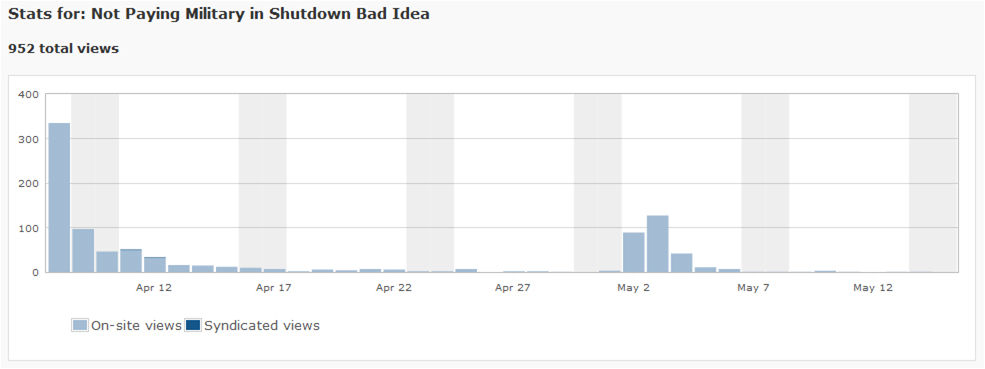
As you may recall from my “Title for Search When You Search for a Title: Ten Lessons From Four Months of Blogging (Part IV)” post, one way to generate outsized page views is provide your post with a search-friendly title that garners it prominent real estate on a search engine. The problem with this approach is that it may be good for a one-time boost, but it may not generate many hits over the long-run. You can see this effect clearly in the chart below.
Source: WordPress
However, if you are fortunate enough to stumble onto a topic that goes viral, you will likely generate page views for weeks, months, and hopefully, years.
While surfing the web, I noticed that liberal bloggers were showing the number of private sector jobs lost during 2008 (Bush’s worst year in office) and contrasting it with Obama’s first two-plus years in office. Obama’s employment record looks terrible, but compared to Bush’s last year in office, it appears to be moderately better.
So to help balance the debate, I gathered the data for Bush’s entire eight years in office, put it in a chart, and compared it to Obama’s two-plus years in office. I did not make any strong judgements on the numbers, I just put them out in the blogosphere.
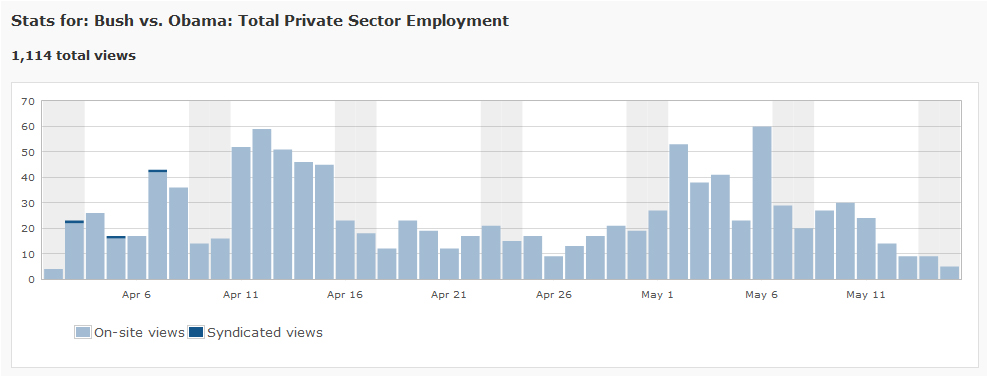
Soon other bloggers – both left and right – were linking to my site because my data was conveniently available in an intuitive and easy-to-understand format, and my post went viral.
As you can see from the chart below, this post still continues to get page views long after I posted it.
Source: WordPress
How can you write a post that will likely go viral?
Become an arms dealer and supply ammunition for “nerd fights” in the blogosphere.
The beauty of being an arms dealer is that you need not choose sides, you simply present publicly available data from disparate sources and display it in a visually appealing and intuitive way. The Economist does this better than any other news source, which is one of the reasons why that publication is so well-respected.
As long as wars are fought, you profit.
And fighting wars of ideas is a big part of what the blogosphere is all about.
So feed the beast and reap the reward.
One of my classmates spent a year teaching at a school in Zimbabwe before he attended business school.
One day, a student’s parent approached him and said, “You are a very bad teacher.”
Dumbfounded, he asked why.
He never expected to hear what the man had to say next. Continue reading
It is my pleasure to introduce ROARR contributor, Chris Ladd.
Chris is a Texan living in the Chicago area. He has been involved in grassroots Republican politics for most of his life. He started with precinct meetings during his youth in Southeast Texas and has continued with a college stint at the Texas State Capitol, years volunteering in state and local campaigns in the Houston area, and service as a precinct committeeman in suburban Chicago.
He watched with alarm as the Party in his home state grew more and more tolerant of extremes and intolerant of reason. The Republican Party is still the best fit for his politics, but it’s an increasingly uncomfortable home.
Chris graduated from Southwestern University in Georgetown, Texas with a BA in politics and economics and earned a law degree from the University of Houston. He works as a pre-sales engineer in the software industry.
Stay tuned for his first official post later today.
Source: The Economist
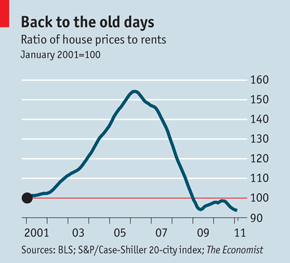
Back in 2005, The Economist published a very insightful analysis that examined the ratio of house prices to rent. The Economist concluded at the time that the ratio was out of whack, and that the housing market was, therefore, in a bubble.
The Economist was about one to two years early, but it was ultimately proved right.
Based on the analysis, I decided not to purchase a house in 2006 when I might have qualified for one of the notorious no documentation loans so prevalent at the time.
Thank goodness I followed The Economist‘s advice.
Now, according to The Economist, it seems that, in the aggregate, it is now cheaper to purchase a house than it is to rent one. There are a number of other positive signs that the national housing market is improving as well. For instance, foreclosures are down 17.7% in the first quarter from where they had been at the end of 2010, and mortgage rates have fallen back to historic lows.
If The Economist‘s track record is any indication, the magazine is likely right, but early.
Sixty-seven years ago today, 160,000 Allied troops, supported by 5,000 ships and 13,000 assaulted a 50-mile stretch of heavily fortified French coastline to wrest Continental Europe from the Third Reich. More than 9,000 Allied solders were killed or wounded, but the day ended with a beachhead established on the periphery of Nazi-dominated Western Europe.
Let us not forget the sacrifices that these soldiers, sailors, and airmen made to secure a global peace.
Because of their efforts, they rescued the world from tyranny and ultimately helped it avoid a global war for over six decades.
I have been trying to complete all the required paperwork for my personal LLC to do business in California for the past two months.
I still cannot open a bank account here, and likely will not be able to do so until my paperwork clears four months from now.
However, my awful experience pales in comparison to these hardworking Iranian immigrants in Southern California. Continue reading
Another way to generate traffic for your blog (and uncover unanticipated opportunities) is to leverage your personal and professional networks.
Using Facebook, LinkedIn, and Twitter, as I have discussed in a prior blog, can be instrumental in distributing content to your personal and professional networks. You can also use more traditional methods such as sending a mass email to friends and family. Of course, you must do it in a manner that your friends and family will not construe as spamming. If you must do it, do it sparingly.
You might also reach out to your university’s alumni network, especially if that network has a group tailored to the issues about which you care and write. I did precisely that in order to encourage people with whom I have shared similar experiences to visit my site.
Some time before the 2010 Congressional elections, several Harvard alumni created a group for Republican graduates of the university called the Harvard Republican Alumni Network (HRAN) and somehow I discovered and joined it. When these folks started this group, they asked that everyone briefly introduce themselves. I never did, but was happy to receive the emails and get updates for how Harvard Republican alumni were faring in various elections nationwide.
When I thought I had enough interesting content in my blog, I finally decided to make my introduction to HRAN and then left a link at the bottom of my email to a Thurston and Talbot post on “The Vast Right Wing Conspiracy.”
That day, my site received 205 page views, 127 of which derived from my Thurston and Talbot post. This leads me to believe that most of these page views came either from HRAN members or via their sharing of the link with others.
Furthermore, it turned out that one of the HRAN members was a contributor to and full-time employee of Breitbart. After reviewing my blog, he asked if I would be interested in contributing to one of the Breitbart sites and I chose Big Peace because of its international security focus.
The bottom line is that you never know what opportunities can spring from leveraging your network.
Last March, the National Labor Relations Board (NLRB) filed a complaint against Boeing for its decision to set up a non-unionized production line in South Carolina. The complaint alleges that Boeing is locating a second production line in that state to retaliate against striking union workers in Washington State.
Since 1989, there have been four strikes at Boeing’s Washington facility. The last strike lasted eight weeks and cost the firm $2 billion.
In 2009, Boeing invested $1 billion in a new factory in South Carolina, a right-to-work state, and hired 1,000 local workers. Had Boeing then laid off 1,000 workers in Washington State, the NLRB might have had a case.
However, Boeing actually increased its Washington workforce by 2,000. Continue reading


 Ross Douthat Charles Krauthammer


 Reflections of a Rational Republican