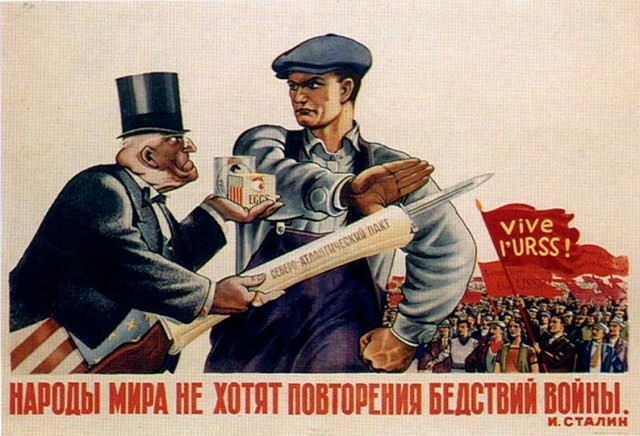
Source: Wikimedia Commons
“If you’re going to negotiate, you’ve got to have something to offer. We don’t.”
— Governor Scott Walker
I have avoided posting my thoughts about the recent protests in Wisconsin, because my personal reaction has been so visceral that I did not think I could do the topic justice. However, my recent post on The New York Times website has been generating so much traffic to my website, that it is impossible now for me to ignore it. So here goes nothing…
Every private company and public service that has been touched by unions has underperformed.
The airline industry is a disaster. American automobiles have ceased being competitive years ago, not because of bad “marketing”, but because America auto companies build inferior products. They build inferior products because much of the cost to produce these vehicles goes to support lavish union health benefits.
The reason American companies are off-shoring the labor force is that unions have priced their members out of the market.
Then there are the public unions. They organize together to elect politicians, who feed a never-ending cycle of support for pension and health benefits that have gone the way of the dinosaur in the private sector.
Public sector unions have gone far off the reservation. The following three examples from an article published last year in The Economist show how public sector unions have 1) rigged the system in their favor, 2) used tax-exempted union dues to fund the Democratic party, and 3) grown increasingly powerful in number to the point that seven state pensions are likely to go bankrupt by 2020.
Guarding Criminals; Raiding the Treasury
Take the California Correctional Peace Officers Association (CCPOA). In 2006, the average CCPOA union member made $70,000 a year, and more than $100,000 with overtime. They can also retire with 90 percent of their salaries as early as age fifty. The group’s lobbying resulted in a massive expansion in the number of California prisons. So much so, that 11 percent of California’s budget now supports the state’s penal system.
Buying the Boss
The American Federation of State, County and Municipal Employees (AFSCME) accounts for a whopping 30% of spending from pro-Democratic groups. According to the US News and World Report, Big Labor spent more private cash ($171.5 million) in the mid-terms than the Chamber of Commerce and American Crossroads combined ($140 million).
What is more concerning is that these donations come from labor dues. Since labor dues are deducted from union workers’ government salaries, they are not taxed. In essence, every time Big Labor donates to the Democratic Party, all tax payers do.
Budget Deficits and Public Sector Unions Go Hand in Hand
State budget deficits are spiraling out of control because unions have had their hands in the public trough for far too long. Our services and schools are worse tha ever, yet they cost more than ever.
Daniel DiSalvo has noted that in 2009, there were 7.9 million public sector members in unions versus 7.4 million in the private sector. One Northwestern University professor has argued that the situation is so bad that seven state pension funds will go bankrupt by 2020 including: Connecticut, Indiana, New Jersey, Hawaii, Louisiana, Oklahoma, and Illinois.
State Union Membership Inversely Correlated with Economic Health
By several important indicators, the percentage of employees that unions represent in a state is inversely correlated with economic health. The top twenty states with the highest rates of employees with union representation on average have high tax burdens, higher unemployment, higher per capita debt, and lower real GDP growth rates. They also voted disproportionately for Democrats in the last two United States Presidential elections.
The following chart shows these top twenty unionized states by the percentage of employees in that state that unions represent, the average debt per capita by state, and each state’s unemployment rate. Blue and red states represent those states that voted Democratic or Republican, respectively, in both the 2004 and 2008 Presidential elections. Purple states are those states that voted for a Democratic candidate in 2004 and a Republican candidate in 2008, or vice versa.
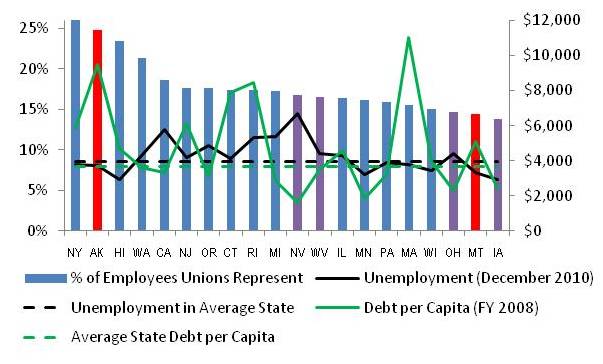
Union Representation vs. State Unemployment and Debt per Capita
Top Twenty Unionized States Vote Disproportionately Democratic
Fourteen of the top twenty most unionized states voted consistently for Democratic Presidents in 2004 and 2008. Of the four states that switched their votes in 2008, three of them switched from a Republican to a Democratic ticket.
Unemployment Higher in Unionized States
The average state unemployment rate for these twenty states is 9.2 percent, while the average state among all fifty states has an unemployment rate of 8.5 percent. National unemployment is higher at 9.4 percent because states with large populations like California that have unemployment rates of 12.5 percent raise the national average.
Debt per Capita Higher in Unionized States
The average state debt per capita for the top twenty unionized states is $4,753 versus the overall average state debt per capita of $3,660.
GDP Growth Lower in Heavily Unionized States; Tax Burden Higher
As the chart below shows, the average state’s GDP growth rate was -1.2% in 2009 versus an average of -2.0% among the top twenty unionized states. According to the Tax Foundation’s 2010 State Business Climate Tax Index, eight of these twenty states are in the bottom ten, and thirteen are in the bottom half. Five of these twenty states occupy the bottom five positions on the Tax Index and include from worst to best: New Jersey, New York, California, Ohio, and Iowa.
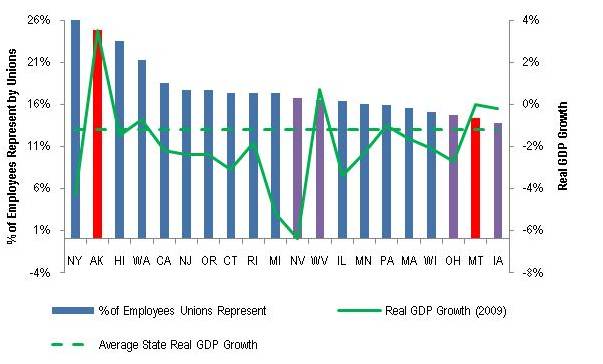
Percentage of Employees Represented by Unions vs. 2009 State Real GDP Growth
Unionized States Have Higher Projected Budget Shortfalls
The chart below shows the percentage of projected state budget shortfalls versus the percentage of the workforce represented by unions. Again, the top twenty unionized states have an average estimated budget shortfall of 17.5% versus the average state’s projected shortfall of 14.0%.
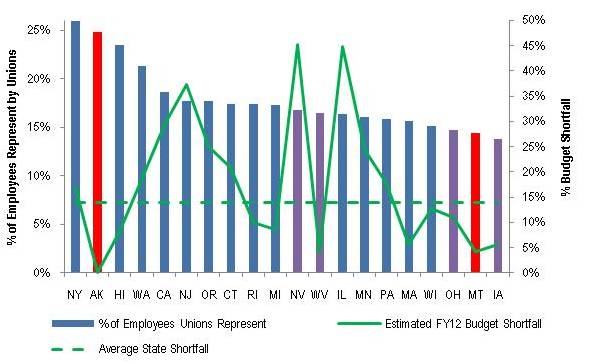
Percentage of Employees Represented by Unions vs. Projected Budget Shortfall
To be fair, these statistics are a snapshot in history. A more thorough analysis would look at trends over longer time periods. That said, I do not think the end result would change.
The implications of this analysis make intuitive sense. Rent-seeking by unions, particularly in the public sector, result in higher costs for the state. In turn, the state must raise taxes and assume more debt to finance union rent-seeking. These states also have the highest projected budget shortfalls. Because of high taxes and a heavily unionized labor force, it is no surprise that real GDP growth tends to be lower in heavily unionized states.
Another point is worth mentioning. Because politicians are the public sector’s equivalent of private sector management, unions fund candidates who will most likely support union rent-seeking. Hence, high Democratic representation in heavily unionized states.
The bottom line is that unions are bad for business and government. It is time someone took a stand against them.
Bravo, Governor Walker, for taking up this noble fight against the last vestiges of the red menace.
Chart Sources








 Reflections of a Rational Republican