Petroleum Prices and Peak Oil: Edging Towards a New Normal

Source: Reflections of a Rational Republican ©2011

“The beatings will continue until morale improves.”
— Unknown

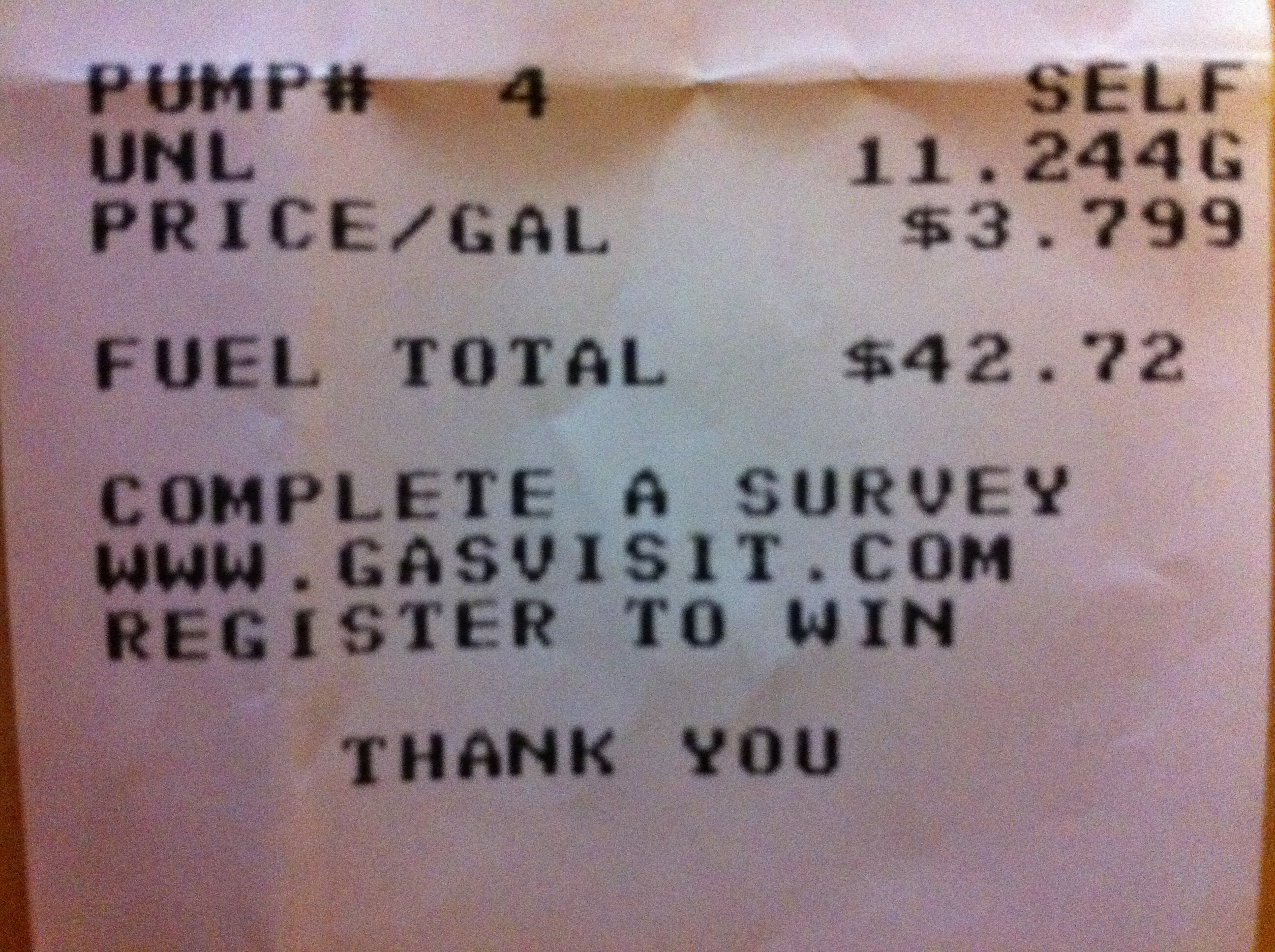
Today I filled up my fuel-efficient Toyota with 11.24 gallons of fuel at $3.80 a gallon.

And it’s only February.

I shudder to imagine what prices will be by the time driving season begins in earnest this summer.

With unprecented economic growth in emerging markets and consistent demand from the developed world, demand for crude oil continues to be high.

The fear is that, in the near future, the world will reach peak oil production. In fact, it is possible that we may already be there. Peak oil does not imply the world will imminently run out of oil, but it does suggest that production will begin an inexorable decline.

Some time before that point, the forces of supply and demand will make oil much dearer than it has been over the last hundred years. The United States reached peak oil production in 1970. Despite all new discoveries on- and off-shore, the United States has never reached this high water mark since. Granted, certain envirionmental policies may have slowed down the ability of oil companies to extract oil in particular parts of the country like ANWR in Alaska. But even if the government allowed drilling there, the estimated 10 billion gallons in ANWR are barely enough to provide the United States with slightly more than a year’s worth of consumption.

Furthermore, big oil companies are exploring farther off-shore and into deeper waters in the continental shelf to find oil, because most, if not all, of the on-shore super-giant oil fields have already been discovered. 

We probably will not know whether we have reached the peak until several years after the event. But there will be signs.

Over short time periods, oil can be a volatile commodity that has rapid price movements in response to geopolitical news and supply data. Over the long-term, however, it tends to be relatively stable as the forces of long-term supply rise to meet those of long-term demand.

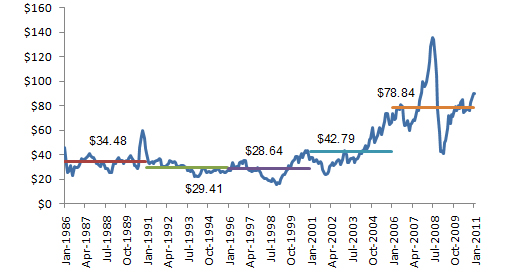
From 1986 to 2000, the price of oil averaged around $31 per barrel in 2011 dollars and hovered between a fairly tight price range. This all changed beginning in 2001. From January 2001 to December 2005, the average monthy price of oil jumped to nearly $43. From January 2006 to December 2010, the average nearly doubled to almost $79 per barrel.

WTI Crude Oil Prices in 2011 dollars, Source: U.S. Energy Information Administration, U.S. Bureau of Labor Statistics

The fact that oil prices continue to trend toward higher averages is a concerning one and will, no doubt, continue to exert pressure on our fossil-fuel intensive economy.

Oil is a nonrenewable resource. Once it is gone, it is gone.

Posted in Business, Clean Energy, Energy Security, Finance and Economics, International Security, Investing, Policy, Politics, Predictions | Tagged , , , | 10 Comments

Tortoises Trounce Solar Thermal!

You Looking At Me? Source: Photo by Beth Jackson: from National Park Service Image Library via Making Tracks

Normally, I reserve this blog for more serious topics where there is an intersection among clean energy, national security, and politics.

Oh wait, this post covers all three! Only, it’s not so serious.

The New York Times published a story yesterday that made me chuckle and also brought back some old memories. Apparently, one species of desert tortoise is threatening to hold up five multibillion-dollar solar thermal plants in the Mojave desert that could power more than two million homes.

I’m with the utilities on this one. I support them because I favor green energy policies over the rights of the mighty desert tortoise.

I also support the utilities, because a little under a decade ago, the spry desert tortoise was my adversary.

Me and my tank, Caligula - a name that quaintly reconciled my love for antiquity and my soldiers' love for porn

When I was stationed at the Army’s National Training Center, I used to participate in massive monthly war games involving hundreds of armored vehicles and thousands of troops. Each monthly war game cost about $10 million a pop.

But heaven forbid, if the mighty desert tortoise crossed paths with your M1A1 Abrams.

Why didn’t you just pick up the hard-shelled critter and help him on his merry way, you say? Well, desert tortoises sometimes get scared and urinate on themselves. Since they live in the desert, this reaction dehydrates the little guys and can be fatal.

So we were told. I have no idea if it is true, but it only magnified the mighty tortoise legend.

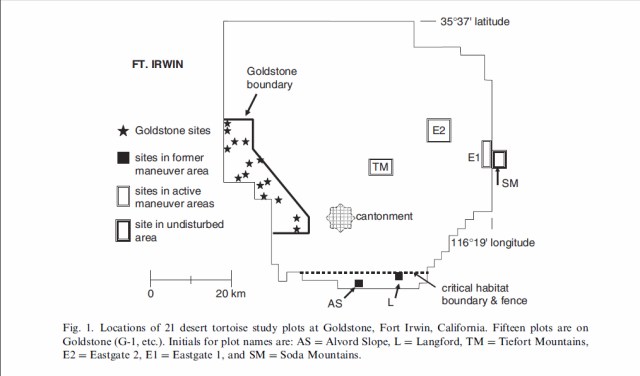
And then there was the tortoise fence that covered the southern boundery of the National Training Center (see below for a map of the National Training Center that shows the boundary). It is important to note that the National Training Center is about the size of the state of Rhode Island. Therefore, the tortoise fence covers a lot of ground (and probably cost a lot of taxpayer money to build).

The National Training Center, Source: Journal of Arid Environments 67 (2006) 165–191

Once, a lieutenant accidently crushed one during gunnery with his tank. The way the installation reacted, you’d think he pulled the legs off a child, urinated in church, and robbed a blind man. All in one day.

Whenever these critters were killed in training, everything stopped. Everything.

And there was hell to pay.

The eco-freak-out squad would soon be on the case to determine if the tortoise died from foul play.

Killing a tortoise was serious business. Penalties included (and still include) up to one year in prision and a $50,000 fine.

To get a sense of desert tortoise hysteria, take a look at this priority one military airlift operation to rescue over seven hundred desert tortoises.

I am not joking. This really happened. And you, the tax payer, paid for it.

Build the solar towers, I say! And send the dastardly tortoise away! 

Posted in Business, Clean Energy, Climate Change, Defense, Energy Security, Humor, Politics, Solar | Tagged , , , , , , , , | 5 Comments

Architecture of Anarchy

Source: Reflections of a Rational Republican ©2011

Civilization and anarchy are only seven meals apart
— Spanish proverb

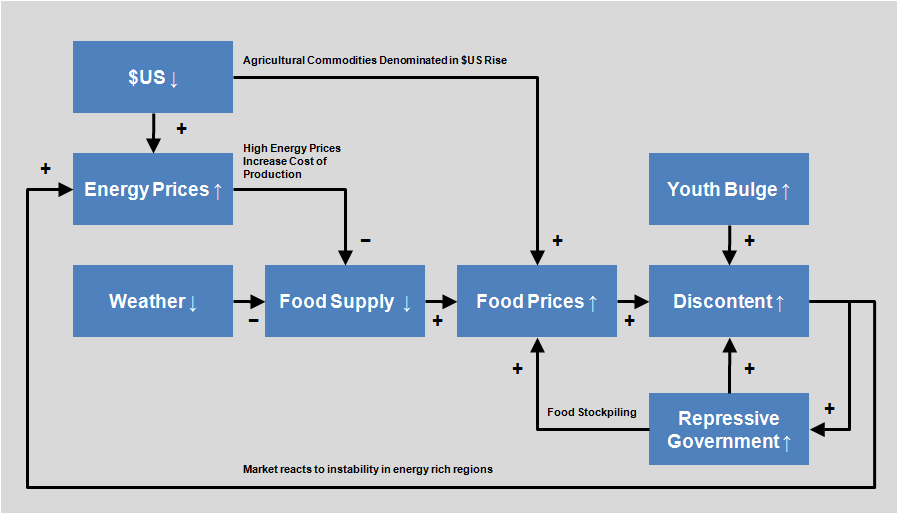
Instability is a positive feedback loop driven by weather, energy and food prices, currency fluctuations, repression, and demography.

Adverse weather conditions, in tandem with high energy prices and a weak U.S. dollar, can increase discontent in countries with repressive regimes and youth bulges. What is transpiring in the Middle East today seems to follow this pattern.

The problem with positive feedback loops is that they feed on themselves and spiral out of control. For instance, high energy prices contribute to high food prices. High food prices in energy-rich countries with repressive governments and youth bulges, lead to unrest. This unrest spooks global energy markets leading to further energy price appreciation. This price appreciation again feeds the cycle ad infinitum.

Try not to miss your next meal…

Posted in Business, Clean Energy, Climate Change, Defense, Energy Security, Finance and Economics, Food Security, International Security, Investing, Middle East, Policy, Politics, Predictions | Tagged , , , , , , , | 7 Comments

The Great Famine of 2011: Food, Fossil Fuels, and Fragmentation

Source: The Broken Telegraph

“Our people take pride in the fact that they are blessed with great leaders from generation to generation”

High-level North Korean official on Kim Jong Un succession

Poor Weather Reduces Crop Yields; Reduced Crop Yields Lead to Increased Prices…

Weather, food prices, fossil fuels and instability are all linked. Droughts in Russia, Canada, Ukraine, and now in China, as well as floods in Australia have made prospects for this year’s harvest for a number of agricultural commodities look dim. Consequently, prices have spiked for commodities like wheat and grain.

Food Prices, Unstable Demographics, and Repressive Governments Led to Unrest…

Unsustainable food prices for the poor, a youth bulge, and decades of repression and corruption, led to a cascade of unrest in the Middle East.

Unrest Leads to Further Stockpiling and Higher Oil Prices…

This unrest, in turn, is leading to stockpiling amongst the remaining despots, which raises the cost of these agricultural commodities. Compounding this problem is that this instability is causing jitters in oil prices because of the geopolitical risk associated with Middle Eastern instability.

Higher Oil Prices Lead to Higher Food Prices

Rising oil prices increase the cost of transporting food and running agricultural machinery, which ultimately result in further increases in the cost of food. Exacerbating these rising fuel prices is the worry that Saudi Arabia’s ability to reliably supply the world with spare oil capacity no longer seems assured.

The kingdom claims it can reliably supply the world with spare production capacity of 2 million barrels per day. That said, increasing Saudi consumption of its own oil has resulted in declining exports. According to Fortune:

“In order to simply match their 2005 export peak of 9.1 million barrels a day, the Saudis would have to pump 12.1 million barrels a day in 2011. That’s almost 10% above the kingdom’s highest output for a year.”

Source: BP via Fortune and CNN

Given that some of the most productive Saudi fields have been pumping for decades, many investors are skeptical that Saudi Arabia can continue to supply this spare capacity indefinitely.

If Saudi Arabia is unable to provide this spare capacity, oil prices will spike even higher and lead to another food-oil commodity super-cycle/death spiral.


Chinese Droughts Doom North Korea

Now, China’s drought in eight wheat-producing regions may result in that country exporting less food to its reclusive neighbor, North Korea.

For North Korea, this chain of events could not have come at a worse time as that country is in the midst of a delicate succession struggle. Making matters worse, countries that used to provide the North Koreans with food aid like the United States and South Korea, are turning their backs on the hermit kingdom after North Korea sank a South Korean naval vessel and fired artillery on South Korean civilians.

Who can blame the Americans and the South Koreans after years of North Korean threats and demands? After $2 billion and 15 years of food aid, the North Koreans still continue to divert food from civilians to support their military and the Korean people continue to suffer from malnourishment.

In addition to the global factors discussed above that will likely make it more difficult for the North Koreans to procure foodstuffs, North Korea’s agricultural sector has experienced major setbacks this year. North Korean food production has been “plagued by floods, an outbreak of a livestock disease” and one of the worst winters in six decades. The U.N. World Food Program has warned that its current food supply can only sustain operations in North Korea for one more  month. Dissident groups have even reported that members of the 1.2-million strong military are suffering from food shortages.

A Curious Change in North Korean Behavior

A tell-tale sign that the food crisis is starting to have a significant impact on North Korean food supplies is that the hermit kingdom has made the unusual step of asking foreign governments for food.

North Korea never asks for anything. It usually makes demands after detonating nuclear weapons, sinking ships, firing artillery shells at civilians, or firing long-range ballistic missiles into the sea.

This sharp change in North Korean behavior should be a cause for concern for the United States, China, and South Korea, as it might imply a pending collapse of the regime or lead to a desperate attack by the North on the South.

The Central Intelligence Agency may have missed the signs in Egypt, but there is no excuse for missing the signs in North Korea.

Hopefully, the United States, China, and South Korea will be able to negotiate a phased process of integration of North Korea into South Korea as soon as possible. Should these parties choose to ignore these signals, millions may die.

Posted in Business, China, Clean Energy, Climate Change, Defense, Energy Security, Finance and Economics, International Security, Investing, Middle East, Policy, Politics, Predictions | Tagged , , , , , , , , , | 4 Comments

February 21, 2011 Edition of Anything Goes Carnival of Politics is Up!

theSaltyBlogger is hosting the February 21, 2011 edition of the Anything Goes Carnival of Politics, and features my blog post on “Four Pillars of Spending Cuts for Deficit Reduction,” which provides recommendations for budget cuts to reduce the deficit.

Posted in Business, Defense, Finance and Economics, Healthcare, Policy, Politics, Social Security | Tagged , , , , , , | Leave a comment

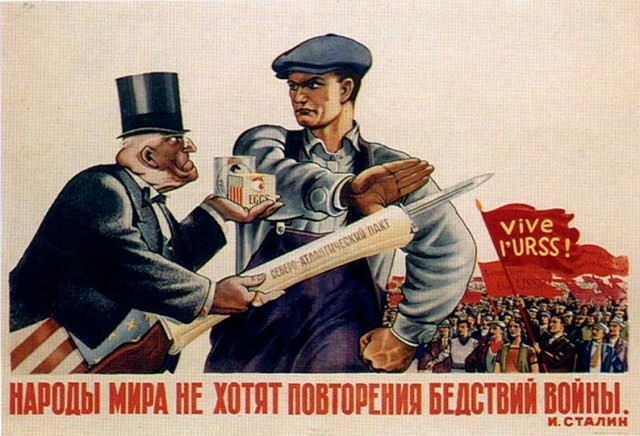
Rallying Against the Red Menace

Source: Wikimedia Commons

“If you’re going to negotiate, you’ve got to have something to offer. We don’t.”

Governor Scott Walker

I have avoided posting my thoughts about the recent protests in Wisconsin, because my personal reaction has been so visceral that I did not think I could do the topic justice. However, my recent post on The New York Times website has been generating so much traffic to my website, that it is impossible now for me to ignore it. So here goes nothing…

Every private company and public service that has been touched by unions has underperformed.

The airline industry is a disaster. American automobiles have ceased being competitive years ago, not because of bad “marketing”, but because America auto companies build inferior products. They build inferior products because much of the cost to produce these vehicles goes to support lavish union health benefits.

The reason American companies are off-shoring the labor force is that unions have priced their members out of the market.

Then there are the public unions. They organize together to elect politicians, who feed a never-ending cycle of support for pension and health benefits that have gone the way of the dinosaur in the private sector.

Public sector unions have gone far off the reservation. The following three examples from an article published last year in The Economist show how public sector unions have 1) rigged the system in their favor, 2) used tax-exempted union dues to fund the Democratic party, and 3) grown increasingly powerful in number to the point that seven state pensions are likely to go bankrupt by 2020.

Guarding Criminals; Raiding the Treasury

Take the California Correctional Peace Officers Association (CCPOA). In 2006, the average CCPOA union member made $70,000 a year, and more than $100,000 with overtime. They can also retire with 90 percent of their salaries as early as age fifty. The group’s lobbying resulted in a massive expansion in the number of California prisons. So much so, that 11 percent of California’s budget now supports the state’s penal system.

Buying the Boss

The American Federation of State, County and Municipal Employees (AFSCME) accounts for a whopping 30% of spending from pro-Democratic groups. According to the US News and World Report, Big Labor spent more private cash ($171.5 million) in the mid-terms than the Chamber of Commerce and American Crossroads combined ($140 million).

What is more concerning is that these donations come from labor dues. Since labor dues are deducted from union workers’ government salaries, they are not taxed. In essence, every time Big Labor donates to the Democratic Party, all tax payers do.

Budget Deficits and Public Sector Unions Go Hand in Hand

State budget deficits are spiraling out of control because unions have had their hands in the public trough for far too long. Our services and schools are worse tha ever, yet they cost more than ever.

Daniel DiSalvo has noted that in 2009, there were 7.9 million public sector members in unions versus 7.4 million in the private sector. One Northwestern University professor has argued that the situation is so bad that seven state pension funds will go bankrupt by 2020 including: Connecticut, Indiana, New Jersey, Hawaii, Louisiana, Oklahoma, and Illinois.

State Union Membership Inversely Correlated with Economic Health

By several important indicators, the percentage of employees that unions represent in a state is inversely correlated with economic health. The top twenty states with the highest rates of employees with union representation on average have high tax burdens, higher unemployment, higher per capita debt, and lower real GDP growth rates. They also voted disproportionately for Democrats in the last two United States Presidential elections.

The following chart shows these top twenty unionized states by the percentage of employees in that state that unions represent, the average debt per capita by state, and each state’s unemployment rate. Blue and red states represent those states that voted Democratic or Republican, respectively, in both the 2004 and 2008 Presidential elections. Purple states are those states that voted for a Democratic candidate in 2004 and a Republican candidate in 2008, or vice versa.
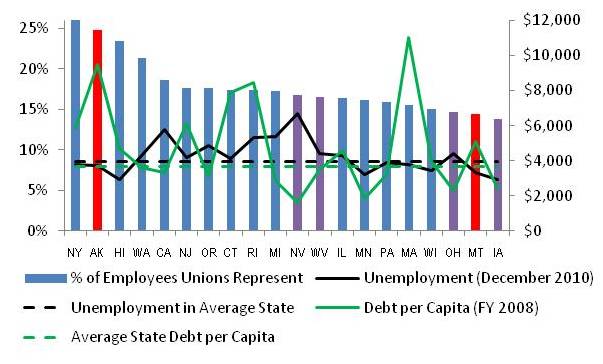
Union Representation vs. State Unemployment and Debt per Capita

Top Twenty Unionized States Vote Disproportionately Democratic

Fourteen of the top twenty most unionized states voted consistently for Democratic Presidents in 2004 and 2008. Of the four states that switched their votes in 2008, three of them switched from a Republican to a Democratic ticket.

Unemployment Higher in Unionized States

The average state unemployment rate for these twenty states is 9.2 percent, while the average state among all fifty states has an unemployment rate of 8.5 percent. National unemployment is higher at 9.4 percent because states with large populations like California that have unemployment rates of 12.5 percent raise the national average.

Debt per Capita Higher in Unionized States

The average state debt per capita for the top twenty unionized states is $4,753 versus the overall average state debt per capita of $3,660.

GDP Growth Lower in Heavily Unionized States; Tax Burden Higher

As the chart below shows, the average state’s GDP growth rate was -1.2% in 2009 versus an average of -2.0% among the top twenty unionized states. According to the Tax Foundation’s 2010 State Business Climate Tax Index, eight of these twenty states are in the bottom ten, and thirteen are in the bottom half. Five of these twenty states occupy the bottom five positions on the Tax Index and include from worst to best: New Jersey, New York, California, Ohio, and Iowa.
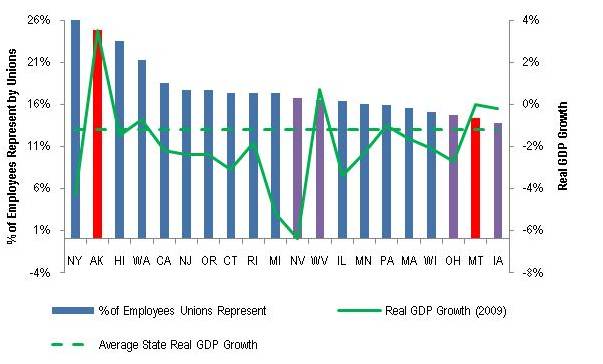
Percentage of Employees Represented by Unions vs. 2009 State Real GDP Growth

Unionized States Have Higher Projected Budget Shortfalls

The chart below shows the percentage of projected state budget shortfalls versus the percentage of the workforce represented by unions. Again, the top twenty unionized states have an average estimated budget shortfall of 17.5% versus the average state’s projected shortfall of 14.0%.
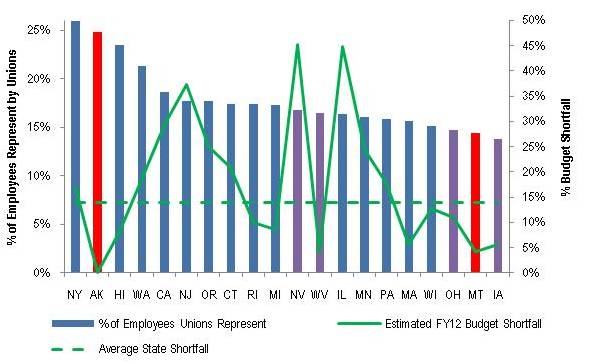
Percentage of Employees Represented by Unions vs. Projected Budget Shortfall

To be fair, these statistics are a snapshot in history. A more thorough analysis would look at trends over longer time periods. That said, I do not think the end result would change.

The implications of this analysis make intuitive sense. Rent-seeking by unions, particularly in the public sector, result in higher costs for the state. In turn, the state must raise taxes and assume more debt to finance union rent-seeking. These states also have the highest projected budget shortfalls. Because of high taxes and a heavily unionized labor force, it is no surprise that real GDP growth tends to be lower in heavily unionized states.

Another point is worth mentioning. Because politicians are the public sector’s equivalent of private sector management, unions fund candidates who will most likely support union rent-seeking. Hence, high Democratic representation in heavily unionized states.

The bottom line is that unions are bad for business and government. It is time someone took a stand against them.

Bravo, Governor Walker, for taking up this noble fight against the last vestiges of the red menace.

Chart Sources

Posted in Business, Finance and Economics, Policy, Politics, Unions | Tagged , , , , , | 30 Comments

Storms Scare Saudis

Earlier this month, I warned that the Egyptian revolution would have broader implications far beyond Egypt’s borders.

I said the most dangerous consequence of this revolt would be the spread of this revolution to other Arab countries like Saudi Arabia, who are responsible for providing the world with spare oil capacity.

All is quiet now, but public comments by members of the Saudi royal family indicate that they are growing increasingly nervous about events transpiring right on their doorstep in Bahrain, Yemen, and Jordan.

On Wednesday Prince Nayef bin Abdel Aziz said Saudi Arabia is “‘immune’ to the protests because it is guided by religious law that its citizens will not question.

This argument is not a very compelling one. Nor is it comforting. Prince Nayef presumes to tell us that the people of Saudi Arabia are so radical that they will endure food deprivation, repression, corruption, and lack of economic opportunity because of their belief in Islam.

If this is the case, Americans should be afraid because the Saudi Arabian people are even more radical than we feared.

Either way, Saudi protesters have called for demonstrations in all major Saudi cities on March 11.

It’s time to buy oil futures…

Posted in Defense, Energy Security, Finance and Economics, International Security, Investing, Middle East, Policy, Politics, Predictions | Tagged , , , , , , , , | Leave a comment

Climate Chain Reaction: From Egypt to North Korea

With poor harvests last year in Russia, Canada, and Ukraine, a recent heat wave in Argentina, and floods in Australia that destroyed much of that nation’s wheat crop, agricultural commodity prices have sharply increased over the past year.

The rising cost of food is likely the spark that ignited protests in Tunisia and Egypt. Wheat prices at the Chicago Board of Trade increased by 73% in 2010. Corn prices rose by 94%  over the same period.

According to Egypt’s agriculture ministry, the country imported 40% of its food in 2010, including 60% of its grain. Making matters worse, an insect infestation forced the Egyptian government to destroy 50% of its wheat supply.

In response to this instability, the last Middle Eastern sovereigns standing may start stockpiling wheat. Saudi Arabia, Algeria, and Jordan have already started hoarding this commodity as insurance against political instability. As these countries stockpile grain, they will have to import their supply from elsewhere.

Compounding this crisis is that eight wheat-producing regions in China are experiencing drought conditions. China is the world’s largest wheat producer and is responsible for about 18% of the world’s harvest. China is normally a net exporter of wheat, but this year it might not have the wheat to export. The United Nations is warning that China’s June wheat harvest may be lower than expected owing to drought conditions in China’s wheat belt. One local weather agency has suggested that in Shandong, the drought is the worst for that province in 200 years. If these regions do not get rain soon, China may potentially have to import wheat this year, which would put even more upward pressure on wheat prices.

With Chinese exports down and Middle Eastern countries importing more grain to stockpile, expect prices to skyrocket.

North Korea, which relies heavily on Chinese imports, and which has a population that is already suffering from chronic starvation, is likely to face unrest over elevated food prices. Since the early 1990s, China has accounted for nearly 90% of North Korea’s energy imports. Some estimates suggest that China also provides 45% of North Korea’s food.

A pending food crisis could not have hit North Korea at a worse time. The country is still in the process of managing a delicate transition of power from Kim Jong Il to  his son, Kim Jong Un. North Korea’s reckless sinking of the South Korean naval vessel that resulted in the deaths of 46 sailors, and its bombing of Yeonpyeong Island, have forced the South Koreans to dig in their heels and threaten disproportionate retaliation in the event of further North Korean aggression.

Even the smallest spark of trouble could ignite a conflagration on the Korean peninsula.

The crisis could lead to a boiling point that would give the North Koreans two options: Explosion in an attack against South Korea, or implosion in a popular revolt against the regime.

Only this time, the revolution will not be “Twitter-ized.”

Posted in China, Climate Change, Defense, Energy Security, Finance and Economics, International Security, Middle East, Policy, Predictions | Tagged , , , , , , , | 4 Comments

Iran: Obama Comes Out Swinging

Predictably, the Iranian government has called for the deaths of the two protest leaders. 222 members of Iran’s 290-member Parliament signed a statement that accuses the leaders of being “corrupts on earth,” a crime which carries a death sentence.

In my post yesterday, I suggested that the United States should do whatever it takes to push the Iranian regime over the edge. It looks like the President is taking steps in the right direction. In a recent Washington news conference, the President stated:

“I find it ironic that you’ve got the Iranian regime pretending to celebrate what happened in Egypt, when in fact they have acted in direct contrast to what happened in Egypt by gunning down and beating people who were trying to express themselves peacefully in Iran…Real change in these societies is not going to happen because of terrorism. It’s not going to happen because you go around killing innocents. It’s going to happen because people come together and apply moral force to a situation.”

Right on cue, the State Department today announced its policy to address Internet freedom. According to The New York Times, the agency plans to finance programs that “enable users to evade Internet firewalls,” and that provide “training for human rights workers on how to secure their e-mail from surveillance or wipe incriminating data from cellphones if they are detained by the police.”

Let freedom ring!

Posted in Defense, Energy Security, International Security, Middle East | Tagged , , , , | Leave a comment

Iran: Another Domino Teeters; America Should Shove It Over the Edge

Iranian Protestors in Tehran, Source: Associated Press via The New York Times

On the heels of my recent article on food prices and Middle Eastern stability, events in Iran are coming to a head. Riot police today physically beat protestors in major Iranian cities. The New York Times estimates that 20,000-30,000 demonstrators took to the streets today in solidarity with the uprisings in Egypt and Tunisia.

This instability is no surprise. Iran has all the classic symptoms of a country with a major demographic imbalance. According to the CIA, half of Iran’s population of nearly 77 million is under the age of 26, GDP per capita is $11,200 per year, unemployment is nearly 15%, and 18% of the population lives below the poverty line.

One could say that Iran is almost Egypt’s Persian clone. 52.3% of Egypt’s 84.6 million-person population is under 25, unemployment is at nearly 10%, and 20% of the population lives below the poverty line. The only key difference is that Egypt’s GDP per capita at $5,900 is slightly more than half that of Iran.

One other key difference is also worth noting: 68% of Iranians live in urban areas, while 43% of Egyptians do.

I have a theory that unrest in highly urbanized countries can turn ugly a lot faster and has greater impact on the whole of the country than it does in predominantly rural countries. As such, I think it makes sense that the Iranian unrest turned violent sooner. I also think it will spread faster than it did in Egypt.

The flip side of my urban/rural population theory is that urban revolts are much easier to put down than rural revolts. My view comes from simple intuition and military experience: Targets are easier to defeat when they are concentrated.

Americans know this from historical experience. The surge worked in Iraq precisely because the United States added more troops in a country that was 67% urbanized. It is proving much more difficult in Afghanistan because only 24% of the population there is urbanized, and those who live in rural areas occupy very rugged and inaccessible terrain. Vietnam was a difficult experience for similar reasons.

The bottom line is that this revolt will only benefit the Iranian people if the government allows it to. The only reason the 1979 revolution succeeded is because the Shah panicked and fled the country.

That said, the United States should still take every opportunity to kick the mullahs while they are down. Iran extended the United States the same courtesy in Iraq. Iranian operatives trained, fought with, and provided advanced improvised explosive devices to Iraqi insurgents in order to kill American soldiers.

The United States should publically encourage the unrest in Iran, while avoiding the endorsement of any specific opposition candidate. It should also be piping Voice of America broadcasts in Iran, covertly facilitating internet access for key dissidents, and providing material and weapons support to certain dissident groups who want to do something more than protest (making sure to avoid those with ties to terrorism).

Payback is a b****.

Posted in Defense, Energy Security, International Security, Middle East, Policy, Politics, Predictions | Tagged , , , , , | 1 Comment