Only those who have been to a California Public Utilities Commission (CPUC) hearing in San Francisco can fully appreciate the “health hearing” described in this recent article in Greentech Media. Many new technologies face criticism, but resistance to PG&E’s ongoing deployment of smart grids is starting to get pretty silly.
Here are some examples from the article:
-One individual allegedly died from smart meters, according to one witness. Granted, the witness admitted that the individual had cancer, but argued that smart meters accelerated the disease.
–Another person quoted Shakespeare and said that smart meters violated the U.S. constitution.[sic]
–Another analogized smart meter rollouts to the Nuremberg trials.
–Another witness said she felt anxiety and palpitations when visiting cities with smart meters.
–Another witness said that another person entered a home with a smart meter and felt sick. Then she put foil around the meter and felt 50 percent better.
While I have some concerns about the accuracy and reliability of smart meters (e.g., my family’s energy consumption allegedly tripled from 300 kWh a month to 900 kWh after switching from a traditional to a smart meter), I believe smart meters will ultimately be a positive development for improving energy efficiency. I believe they will help both consumers and utilities better optimize individual energy consumption and help spur a transition from centralized to distributed power generation.
Distributed power generation refers to power generated from multiple sources, in many cases via solar panels on someone’s home or on a commercial building. Centralized power generation refers to more traditional generating assets like coal power plants, which generate power from one central source. It is then delivered to various substations via a network of transmission lines.
Distributed power generation is cleaner, less dependent on foreign energy suppliers, and less vulnerable to cyber or physical attacks on critical infrastructure. Instead of infecting one central target with malware, a hacker must attack thousands of targets in a distributed system.
The transition to distributed power generation will also help spur the deployment of electric vehicles, which will also ultimately double as storage devices for solar energy generated during daylight hours.
Let’s just hope science trumps stupidity and suspicion.
Only those who have been to a California Public Utilities Commission (CPUC) hearing in San Francisco can fully appreciate the “health hearing” described in this recent article in Greentech Media.
Less than forty-eight hours after a horrible tragedy involving a deranged lunatic whose library includes the works of Karl Marx, Mr. Krugman has the gall to make a blatantly partisan attack.
Both parties are guilty of toxic rhetoric, even threats. For instance, were conservatives responsible for the Black Panther Party’s voter intimidation in Philadelphia in 2008? What about the left’s anti-military rhetoric, particularly Code Pink’s, and the 50 plus attacks on U.S. military recruiting stations since March 2003? How about Senator Harry Reid’s remarks that, “This war is lost,” in 2007 just before President Bush’s successful surge began in Iraq? The comments not only served to demoralize tens of thousands of troops in Iraq, but gave succor and hope to America’s enemies.
During a June 2008 Philadelphia fundraiser, the same city where there were later reports of Black Panthers members intimidating voters, Obama announced, “If they bring a knife to the fight, we bring a gun”.
Not to mention all the unsubstantiated assertions that George Bush “lied” to the American people about his belief that there were weapons of mass destruction in Iraq.
Then you have the left’s two old saws: accusations of racism and reductio ad Hitlerum.
Not to mention that anti-Bush political rallies were frequently peppered with signage equating the former President and his administration to the Third Reich.
You cannot have it both ways.
Mr. Krugman, at a time when this country is trying to come together, you seek to divide it. Please stick to economic analysis. Partisan poison is beneath a man of your substantial intellect.
Let’s face it. Both liberals and conservatives have been guilty of violent rhetoric over the past decade. We need to move past it, not wallow in another “opportunity” for political partisanship.
My thoughts and prayers go out to the family of Congresswoman Giffords for her speedy recovery. The cowardly act of attacking an unarmed Congresswoman who was spending her Saturday meeting with constituents is all the more outrageous because she was by any reasonable measure not a partisan. What is even more ironic is that Giffords is a fiscal conservative, strong advocate for gun rights, and clean energy promoter.
The level of partisanship in this country is becoming more irrational than ever. Moderate Democrats like Congresswoman Giffords are the type of people we need for this country to solve its fiscal crisis. Let’s hope she comes out of this experience stronger and more resolved than ever.
The Congressional Budget Office (CBO) has projected the healthcare law would shave $140 billion from the deficit over the next decade. This week, it suggested that repealing the law would add $230 billion to the deficit over the same period.
However, some early data has indicated that some of these initial projections appear to be wildly off the mark. David Brooks’ column yesterday suggested that “New Hampshire’s plan has only about 80 members, but the state has already burned through nearly double the $650,000 that the federal government allotted to help run the program.” It therefore appears that, in New Hampshire’s case, early costs appear to be coming in far ahead of projections. Economists Douglas Holtz-Eakin and James C. Capretta suggest that the CBO’s cost projections of $450 billion between 2014 and 2019 for people moving to public exchanges could be underestimating the ultimate cost by nearly $1 trillion.
Meanwhile the cost of healthcare continues to skyrocket. For instance, Blue Shield of California is currently seeking a 59% increase in premiums.
Massachusetts Monster or Miracle?
Some have cited the Massachusetts healthcare law as inspiration for the current federal one. However, there appears to be little evidence that the law has actually reduced costs. Healthcare spending now accounts for 37% of the state’s budget, up from 21% in 2000 (see “Medicaid Cost Crisis Looms for Bay State”). It is also worth mentioning that a Republican, not a Democrat, was governor when this law passed in 2006.
Adverse Selection and the Individual Mandate
In my opinion, one of the reasons costs are coming in much higher than anticipated is due to adverse selection. Adverse selection is an economic term that describes, in the case of health insurance, the tendency for the sickest customers to sign up for services. Without healthier customers, the health insurance business falls flat on its face. Hence the healthcare law’s individual mandate. For the law to work, healthier customers must subsidize the unhealthy ones – particularly those with preexisting conditions.
The bottom line is that the costlier customers are signing up early, while the healthier ones see no reason to sign up, especially in the current economic climate. If legal challenges to the individual mandate triumph, the law becomes moribund. Without a larger risk pool, it will be impossible for insurance companies to operate without drastic cost increases.
Make no mistake, healthcare reform is critical. Cost increases are becoming unsustainable. Just today, my wife went to the dentist and came back with a bill for $3,095, of which we were responsible for $835. I would have told them to keep my tooth. The key question is the degree to which government should be involved. Hopefully less rather than more.
Before the Congress gets mired in the fight to cut the deficit, it is critical that Americans know where the government spends taxpayer dollars and from which sources the government generates most of its tax revenue. Let’s face it. Any rational person will admit that cutting the deficit cannot be done through tax increases alone (the Democratic way) or entirely through budget cuts (the Republican way). There must be some combination of the two.
At some point, I will take a look at the revenue side of the tax equation. But for now, I will focus on areas where the government should make cuts. Some might argue that there is no reason to make cuts. In fact, cuts could jeopardize an economic recovery. In the short-term, I agree with this logic given how delicate the economy is today. However, the government needs to start making cuts as soon as one to two years from now because its growth is simply unsustainable.
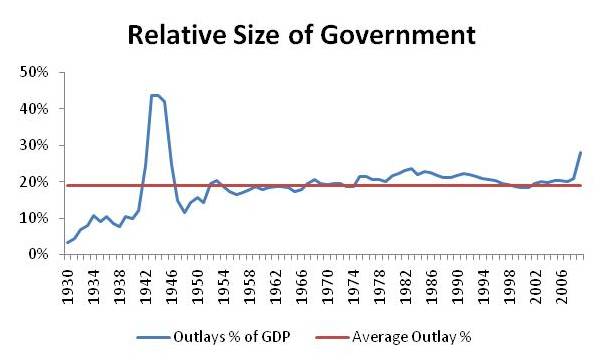
Don’t believe me? Below is a chart showing the percentage of government outlays as a percentage of GDP – a proxy for the relative size of the government to the size of the U.S. economy. Since 1930, the relative size of government was largest during World War II with the top three years being 1943, 1944, and 1945. Guess which year was the fourth largest? You guessed it: 2009.
Since 1930, the average government outlays as a percentage of GDP hovered around 19%. However, the chart below shows that this percentage is trending upwards.
Source: U.S. Government Publishing Office
What Programs Should Government Cut?
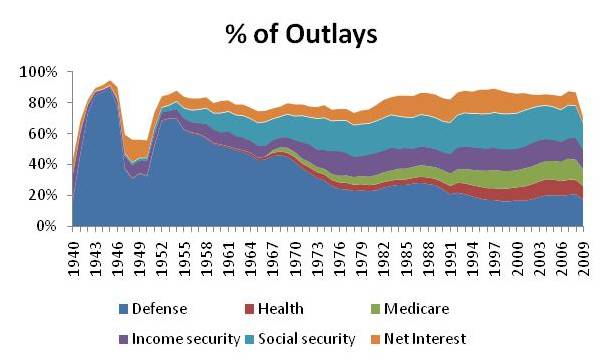
The simplest way to start is by looking at where the government spends most of our tax dollars. Where’s that? The short answer is social security and defense. In 2009, 17.3 cents of every federal dollar went into defense and 17 cents went into social security. For every dollar of GDP the U.S. economy produced, defense and social security each consumed 4.8 cents. Health, Medicare, income security programs (e.g., the Earned Income Tax Credit, welfare, SSI Disability, etc.), and net interest combined consumed an additional 36% of the federal budget in 2009. In total, these six items consumed about 70.4% of the federal budget in 2009. Any reasonable approach to balancing the deficit must include one or more of these items to have any meaningful impact.
Defense Declining as Share of Budget and GDP; Social Security Increasing
While the defense budget stood at a whopping $690 billion in 2009, its share of the budget is much lower than its historical average of nearly 37% since 1940. In contrast, social security’s share is higher than its historical average of almost 15% and it is rising. The charts below show the trend of these six major budgetary items as a percentage of federal outlays and GDP.
Source: U.S. Government Publishing Office
Source: U.S. Government Publishing Office
My Modest Proposal: Four Pillars of Spending Cuts
To achieve a rational policy on deficit reduction, the government must use a combination of tax increases and spending cuts. On the spending side, the government should focus on four areas.
1. Pay Down Debt
The most obvious way to address the budget deficit is to reduce interest payments. The best way to do that is by paying down debt. The problem is funding this pay-down. One way to fund it is to increase taxes. Another is to cut spending. Let’s assume a rational government does a mixture of both.
2. Reform Social Security
When social security made its first payouts in 1940, the retirement age was 65, but the average life expectancy for a 65-year-old man was 11.9 years. In 2010, the retirement age for Americans born after 1960 was 67. However, by 2007, the average life expectantly rose to 16.7 for men and 19.2 for women. At the very least, the retirement age should be indexed to 1940 numbers (“See Will Washington Dare Raise the Retirement Age for Social Security?”). For example, the government could reset it once every five or ten years for various age cohorts such that the average retiree has a life expectancy of ~12 years. In addition, there should be some form of an income means-test for receiving social security to prevent an unfair wealth transfer from poorer, younger Americans to older, wealthier ones. The current system just does not make any sense. For instance, according to the U.S. Census Bureau, only 3.8% of married couples under 35 had a net worth of $500,000 or higher, but 27.8% of couples ages 65 or older fit into this category in 2004. Why must a secretary subsidize the retirement of a CEO?
3. Review and Reform Healthcare
It is no mistake that Obama chose this issue as his marquis program in the first two years of his administration. In 2009, health and Medicare cost the government a combined $784 billion and constituted nearly 20% of the budget – more than either defense or social security. Medical costs continue to rise rapidly. The key question today is whether Obama’s cure for the problem is worse than the disease. Only time will tell.
The problem with the current policy is that the public has no idea what is in the law. Few experts can predict how it might work in practice. This probably explains why Obamacare is unpopular with a plurality of American voters. According to a November Pew Research Center poll, 48% of voters support repealing the healthcare law, 31% want to expand it, and 16% want to keep it as is.
The bottom line is that the 112th Congress should revisit the healthcare law, but in such a way that results in reduced costs for the government. Simply repealing the Act and then ignoring the problem is not a rational solution.
4. Reduce Defense Spending
I am a defense hawk and believe in a strong national defense. That said, the only way to move the country forward is through compromise. Given that defense is typically the first or second largest federal budgetary item each year, cuts must be made for any serious attempt to balance the budget to be successful. Fortunately, Defense Secretary Gates is already moving in this direction. He is meeting with Congressional leaders today to outline his plan for saving $100 billion over the next five years.
Let’s hope the new crop of politicians in Congress focus on reducing the deficit rather than jockeying for the next Presidential election. I have my doubts.
Yesterday, the Wall Street Journal published an article (see “A Chinese Stealth Challenge”) on the emergence of China’s new stealth fighter, the J-20, which looks suspiciously like the American F-35. Some experts have suggested that the Chinese aircraft appears it has “the potential to be a competitor with the F-22 and to be decisively superior to the F-35.”
J-20, Source: GlobalSecurity.org
It is probably no coincidence these two aircraft look so similar. China, has increasingly engaged in widespread cyber espionage on American firms and defense agencies by hacking into their computer networks. China has reputedly stolen classified information on the F-35 fighter by hacking into the computer networks of major Western defense contractors.
F-35, Source: Lockheed Martin photo/Tom Harvey
The most well known of these incidents is Operation Aurora, in which Chinese-based hackers broke into Google’s corporate network and stole the company’s intellectual property. On April 8, 2010, China Telecom “advertised erroneous network traffic routes that instructed U.S. and other foreign Internet traffic to travel through Chinese servers.” For about eighteen minutes, the Chinese routed all traffic for about fifteen percent of the Internet’s destinations through their servers. Some of these destinations included United States Government websites including those for the Army, the Navy, the Marine Corps, the Air Force, the Office of the Secretary of Defense, and the National Aeronautics and Space Administration, among others (see “War in the Fifth Domain: Are the Mouse and Keyboard the New Weapons of Conflict?”).
According to cyber warfare expert, Richard Clarke, officials have privately confirmed that foreign hackers, who are presumably state-sponsored, have already installed logic bombs on American electric grid control systems. For example, in 2009, Chinese hackers penetrated the American electric grid and left behind malware that could bring it down (see “War from Cyberspace”).
It looks like America’s military industrial complex may also be inadvertently benefiting the Chinese aerospace industry.
Having examined how the stock market performed under different political parties and Presidential administrations in “Time to Invest: Markets Outperformed during the Second Half of a President’s First Term” and “Think You Can Make Money Investing When Your Party is in Power? Guess Again”, I decided to turn my attention to unemployment. More specifically, what does the rate of unemployment look like under the stewardship of different political parties? In addition to how it looks, I was also curious how it changed under different political parties and Presidential administrations. Not surprisingly, the findings are similar to the results of my study on stock market performance.
Unemployment Was Lower Under Divided Government…
This result differs from stock market performance during periods when one party controls both branches of government. During these periods, the stock market outperformed, yet the unemployment rate was higher than average for the 40-, 20-, and 10-year periods I observed. It is important to note that the 60-year average bucked this employment trend with unemployment being lower than the average when one party controls both branches of government. However, I think it is safe to conclude that in recent history, the trend shows that divided government tends to preside over periods when there is lower unemployment on average.
Average Unemployment: Party Control of Executive and Legislative Branches
Total
Divided
United
60-year average
5.8%
6.1%
5.4%
40-year average
6.4%
6.3%
6.5%
20-year average
6.0%
5.6%
6.5%
10-year average
6.4%
6.0%
6.7%
Source: Adapted fromU.S. Bureau of Labor Statistics, U.S. House of Representatives, Whitehouse.gov
…But the Unemployment Rate Trended Negatively
More importantly, while unemployment appears to be lower during periods of divided government, divided government is bad for job creation. During periods of divided government, the unemployment rate increased on average for all the periods I observed, with the biggest increase registering an average of 1.3 percentage points in the first decade of the twenty-first century. This finding is consistent with my earlier finding that the stock market underperforms during periods of divided government.
Average Change in Unemployment: Party Control of Executive and Legislative Branches
Total
Divided
United
60-year average
0.1%
0.3%
-0.2%
40-year average
0.1%
0.2%
-0.1%
20-year average
0.2%
0.4%
-0.1%
10-year average
0.6%
1.3%
0.1%
Source: Adapted fromU.S. Bureau of Labor Statistics, U.S. House of Representatives, Whitehouse.gov
Both Republican Presidents and President Obama Presided Over Job Losses
There is no clear trend for average unemployment rates under either Republican or Democratic Presidents. Over the past 60- and 40-year periods, average unemployment was lower during Democratic administrations, but in recent history it was much lower under Republican ones.
Average Unemployment: U.S. President
Total
Democrat
Republican
60-year average
5.8%
5.3%
6.1%
40-year average
6.4%
6.1%
6.5%
20-year average
6.0%
6.0%
5.9%
10-year average
6.4%
9.9%
5.6%
Source: Adapted fromU.S. Bureau of Labor Statistics, U.S. House of Representatives, Whitehouse.gov
However, one trend is clear. Across all four periods I observed, on average, unemployment rates increased under Republican Presidents. I may be a Republican, but I’m a rational one. So I won’t hide the numbers. They are what they are. The only period that Democratic Presidents performed worse than Republican Presidents was during the last ten year-period, which included President Obama’s first two years in office. I am not surprised.
Average Change in Unemployment: U.S. President
Total
Democrat
Republican
60-year average
0.1%
-0.3%
0.3%
40-year average
0.1%
-0.1%
0.2%
20-year average
0.2%
-0.1%
0.5%
10-year average
0.6%
1.2%
0.4%
Source: Adapted fromU.S. Bureau of Labor Statistics, U.S. House of Representatives, Whitehouse.gov
Republican Congresses Presided Over Periods of Lower Unemployment
Average unemployment was consistently lower for both Republican Houses and Senates for nearly every period I studied. The only exception was the average unemployment rate for the 60-year period for Republican Senates, which was only one-tenth of a percentage point higher than the average.
U.S. Congress
U.S. House
U.S. Senate
Total
Democrat
Republican
Democrat
Republican
60-year average
5.8%
6.1%
5.0%
5.8%
5.9%
40-year average
6.4%
7.0%
5.0%
6.6%
6.1%
20-year average
6.0%
7.4%
5.0%
7.1%
4.8%
10-year average
6.4%
8.1%
5.4%
7.3%
5.1%
Source: Adapted fromU.S. Bureau of Labor Statistics, U.S. House of Representatives
Democratic Congresses Bad for Job Market; Republican Senates Good
Like Republican Presidents and President Obama, Democratic Congresses are associated with increases in unemployment. The trend was persistent throughout all four periods of observation and particularly bad in the last decade. In contrast, Republican Senates tend to be associated with decreases in the unemployment rate.
U.S. Congress
U.S. House
U.S. Senate
Total
Democrat
Republican
Democrat
Republican
60-year average
0.1%
0.1%
0.1%
0.2%
-0.1%
40-year average
0.1%
0.2%
-0.1%
0.3%
-0.2%
20-year average
0.2%
0.6%
-0.1%
0.7%
-0.3%
10-year average
0.6%
1.4%
0.1%
1.3%
-0.4%
Source: Adapted fromU.S. Bureau of Labor Statistics, U.S. House of Representatives
At this point I won’t speculate on why the numbers fall out the way they do. Are politicians responsible for unemployment? Of course they are. But there are also many other factors that impact unemployment that are beyond a government’s control.
The purpose of this blog is to arm people with the facts. Readers can generate their own conclusions about what the data shows, but at least they will have the facts.
To follow up on my previous post, “Think You Can Make Money Investing When Your Party is in Power? Guess Again”, I decided to look into how the market performed during different Presidential terms. It turns out that the stock market has historically outperformed during the second half of a President’s first term over the past 10-, 20-, 40-, and 60-year periods. The market did not simply outperform during these periods, it returned nearly two times the market average over the past 60 years and over ten times the market average over the past ten!
Fourteen of the sixty years I profiled were during the second half of a President’s first term. It is also important to note that for the purpose of this analysis, I considered President Ford’s and Johnson’s terms to be extensions of their predecessors given Kennedy’s assassination and Nixon’s untimely resignation that disrupted the normal course of a President’s typical term.
Why is this trend so persistent throughout history? I think the explanation is fairly straightforward. Of the four periods I examined, there is only one in which a President is solely focused on his reelection prospects – the second half of his first term. Any President who wants to keep his job will move heaven and earth to ensure the economy does well. The market even did well during Jimmy Carter’s last two years in his first and only term, averaging 19% versus an average loss of 5.2% during his first two years in office. Unfortunately for Carter, these numbers did not help his reelection prospects.
One of the most important things I learned as a military officer was to know my adversary. As such, I have always considered it essential to read and think about what the best of the political opposition has to say, give it credit where it is due, and criticize it when it seems irrational. It is only by this study of one’s opponents that one can truly defend one’s beliefs with well-considered and rational arguments.
What better way to do this than consider and critique the words of liberal Nobel laureate, Paul Krugman, who published an op-ed yesterday in the New York Times, entitled “Deep Hole Economics“? I sometimes find Krugman to make incredibly lucid economic points. Unfortunately, he also sometimes has a tendency to unnecessarily spew too much partisan bile, especially for someone so well-educated and distinguished.
In this op-ed, I think Krugman has it right regarding monetary policy and interest rates. Yet I think his comments on a 21st century Works Progress Administration (WPA) and supposedly “harmful” spending cuts miss the mark.
Krugman’s points on monetary policy and interest rates are valid concerns. I believe action on these two items to be a key litmus test of whether the new crop of Republicans are rationalists or reactionaries. Tea party furor would dictate that the Fed pullback on its quantitative easing policy, but sound economics (both right and left) dictates that the country ought to keep its monetary policy loose, at least for now.
On interest rates, I also fear that raising them in the near-term would be a disaster, which could likely lurch the country back into recession.
However, Krugman has it wrong on both his WPA recommendation and the danger of cutting spending. Historians are still debating whether FDR’s programs aided or worsened recovery from the Great Depression. Some believe that it was World War II, not FDR’s Keynesian fiscal policies, that got the country out of its rut. I tend to agree with this explanation and think yet another government-directed stimulus would likely fail. After all, the unemployment rate is two percentage points higher than it was when the nation implemented the last government-directed stimulus.
While I would partially agree with Krugman that cutting spending in the short term would generally be a bad idea given the U.S. economy’s current state, I think it should be a duty of Congressional Republicans to make deep intermediate and long-term spending cuts particularly in entitlement programs like Social Security and Medicare. Just yesterday, Senator Graham took the politically gutsy move of recommending that there be a means-test for Social Security and an adjustment in the retirement age on Meet the Press. After all, why should a younger, poorer generation transfer its wealth to an older, wealthier one? Does Warren Buffett really need the money?
One last point is worse mentioning about Krugman’s reference to a Sarah Palin presidency in 2012. I say this with all due respect. It is simply not going to happen. Contrary to popular belief, there are plenty of conservatives who do not support Mrs. Palin.









 Reflections of a Rational Republican