The Vast Right Wing Conspiracy

I decided to break from tradition and to publish something a little less serious. I put together this little video using a program called xtranormal. It is satire on what many left bloggers write and think about conservatives. Huffington Post served as my inspiration.

Enjoy!

Posted in Business, Clean Energy, Clean Tech, Climate Change, Energy Security, Finance and Economics, Food Security, Humor, Investing, Media, Middle East, Policy, Politics, Thurston and Talbot, Unions | Tagged , , , , , , , , , , , , , , , | 22 Comments

Saudis Shrug Off Day of Rage: Three Strategies to Suppress a Revolt Before It Starts

While the world was understandably distracted by Japan’s terrible earthquake and the tsunami in its wake, I have been monitoring one local Saudi woman’s blog to get a sense of how the March 11th Day of Rage progressed in Saudi Arabia.

Apparently, what was expected to begin with a bang ended in a whimper.

What is more interesting is how the Saudis effectively tamped out a popular revolt before it started.

So far, there have been two Middle Eastern models for dealing with popular revolts: crushing them or conceding to protestors by removing heads of state.

Let me be clear that I am not making any moral judgments here. I am only pointing out which tactics are most effective from a purely strategic standpoint in allowing Middle Eastern rulers to maintain power.

On the one hand, using force to suppress revolts appears to be the more effective of the two for maintaining power in the Middle East. Witness Saddam Hussein’s actions against the Kurds, his actions against the Shia after the first Gulf War, Hafez al Assad’s actions in Hama, and Libya’s actions against its rebels, which seem to allow that government to gain more ground with each passing day. Again, I am looking at things from a political rather than a moral standpoint and do not condone these actions.

In contrast, things did not go well for Egypt’s Mubarak or the Shah of Iran when both abdicated their posts rather than crushing the revolts.

The Saudi approach appears to offer an ingenious third way for Middle Eastern rulers to maintain power without massive bloodshed. It is devious, but effective.

The single most important lesson of Saudi Arabia’s Day of Rage is that the regime got in front of the problem before it happened.

In no particular order, the Saudi government employed the following three strategies to stop the revolt before it started.

1. Establish a Heavy Security Presence

Prior to March 11, 2011, the Saudis deployed their security forces throughout the country, particularly in the northeastern provinces where most of the Shia population resides. Saudi forces established checkpoints and roadblocks, and helicopters hovered overhead. Police even pulled over a BBC journalist because they caught her filming their activity on a mobile phone. The country was in complete lockdown. As a result, nothing happened.

2. Discredit Opposition Leaders

The Saudis effectively discredited opposition leaders in three ways: they co-opted prominent religious leaders to make statements discouraging the revolts, they insinuated that the revolts were inspired by the Iranians and/or radical jihadists, and they divided the protestors by implying that the Shia revolts were different from the revolts planned for everywhere else in Saudi Arabia (effectively exploiting Sunni fears about a widespread Shia uprising).

The Saudis also employed a sophisticated misinformation campaign that leveraged social media outlets like Facebook. Eman Al Nafjan writes:

“What started on a Facebook page as a call for the creation of a civil society with a list of demands including a constitutional monarchy and a call for public freedoms and respect for human rights eventually turned into a page where sectarianism was openly practised and Islamists were praised.”

An even broader implication of this campaign is that the state can also use new social media platforms to control its people more efficiently. This may be the first case in history in which a government actively used social media to spread disinformation versus China’s more passive attempts to deny access to it.

By the time the Day came around, “none of the prominent Saudis who drafted the petitions during the last few weeks openly supported the demonstrations,” probably because the government had been so thoroughly effective in distorting the movement into something these well-respected people could no longer support.

3. Bribe the People

When King Abdullah returned home in late February from his three months abroad at a foreign hospital, he unveiled a $36 billion social welfare package for the people, which included the creation of 1,200 new jobs and a 15 percent pay raise for all government employees.

Expect oil futures to fall on this news (they probably already have).

Posted in Clean Energy, Clean Tech, Energy Security, Finance and Economics, International Security, Investing, Middle East, Policy, Politics, Predictions | Tagged , , | 4 Comments

Smart Money Sells U.S. Treasuries

One of the world’s largest and most respected bond funds announced Wednesday it had reduced its exposure to U.S. government securities to zero in light of rising yields, which are inversely related to a bond’s value.

Given the right’s refusal to accept tax increases and the left’s refusal to reduce spending, this move is frightening, but no surprise. When the Fed stops buying U.S. Treasuries in June, it is questionable whether future U.S. Treasury buyers will still be willing to fund U.S. debt.

It looks like the market has voted on its assessment of the United States government’s financial health (not healthy). As yields continue to rise, financing America’s spending binge will become increasingly expensive. It is time to cut spending (and increase taxes), before our debtors force the country to take much more draconian measures.

Posted in Business, Finance and Economics, Investing, Policy, Politics | Tagged , , , , | 3 Comments

No Representation With Misrepresentation

In recent years both the right and the left have engaged in petty “gotcha” politics in which political operatives deliberately misrepresent themselves and goad their political opponents into making damaging statements that help these operatives score petty political victories.

While these tactics shed sunlight on the dark practices of bad people on both sides of the aisle, they are a disgusting and deceptive development in American democracy that threatens to divide the country further along political lines. They are unethical, misleading, and only lead to destruction.

Just ask NPR.

On the right, James O’Keefe struck again (he also posed as a pimp to expose ACORN) with his recent setup of Ronald Schiller. Mr. Schiller, a NPR fundraiser, made some questionable and politically charged comments during a conversation he had with O’Keefe’s undercover political operatives. These operatives deliberately misrepresented themselves as potential donors from a Muslim organization. The intent was to put NPR’s credibility in doubt by surfacing liberal bias at the publicly funded network. While they succeeded in this attempt, they did so by prodding Ronald Schiller to agree to their suggestive and anti-conservative statements. Now Vivian Schiller (no relation), NPR’s CEO, has resigned over the incident.

On the left, Ian Murphy, the editor of Buffalo Beast website, recently posed as billionaire David Koch in a call to Governor Walker. The call, which was an effort to discredit the governor, succeeded. In one particular moment of weakness, Murphy suggests that the governor plant “troublemakers” in the crowd of protestors, to which Governor Walker replied, “We thought about that. My only fear is that maybe the governor has to settle to solve all these problems.”

The problem with these tactics is that they start a destructive and unnecessary arms race between operatives on both the right and left, by encouraging both sides to outdo one another with further use of these underhanded tactics. In turn, this practice threatens to undermine the open and active debate that is part and parcel of our democratic system.

These tactics are crude, thuggish, and bad for our democracy and need to stop.

Posted in Media, Politics | Tagged , , , , , | 8 Comments

Decision Points: Good Read, Bad Style

Source: ©2011 Reflections of a Rational Republican

Decision Points is President George W. Bush’s personal account of the most consequential decisions that impacted his controversial presidency. Whether one likes President Bush or detests him, this book is a must read for any serious student of history.

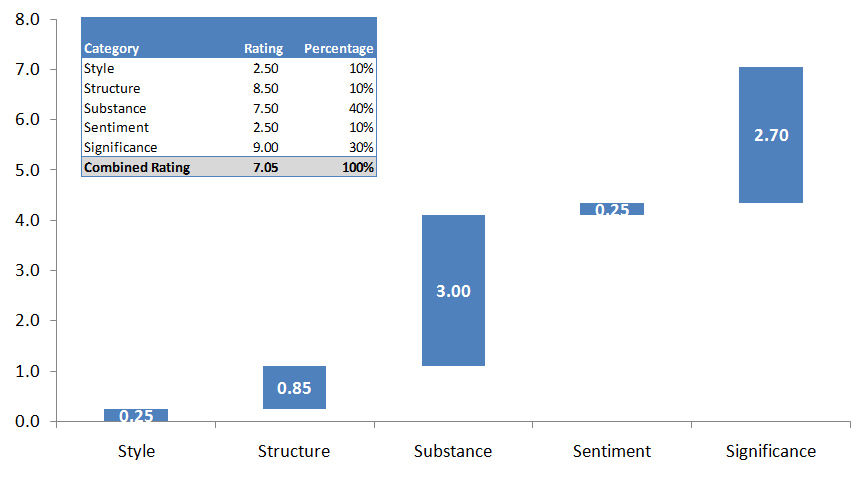
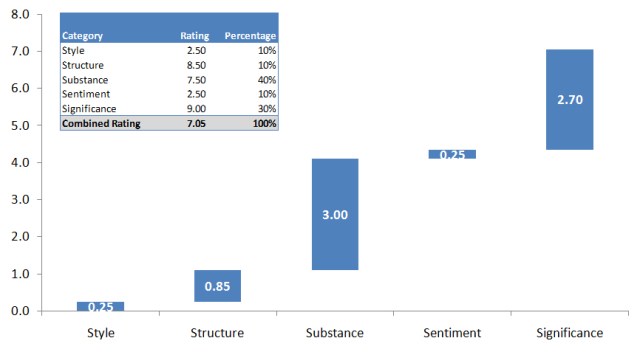
Style – 2.50

One thing that very much irritated me about Decision Points was its patrician tone. Despite the former President’s numerous attempts to provide examples otherwise, the tone and manner of the book consistently betrayed his patrician background and upbringing. Particularly annoying were his incessant references to the forty-first President of the United States as “Dad.” The book might as well have been written by Thurston B. Howell, III of Gilligan’s Island fame with his Northeastern establishment patrician tone and accent. The former President’s attempts to portray himself as an everyman utterly failed. For this unpardonable offense, I rate the book’s style a 2.5 out of ten.

Structure – 8.50

A lot happened during the eight-year tenure of President George W. Bush. It would therefore be impossible to cover every event and decision in enough detail to provide a comprehensive account of his presidency in just 477 pages. To solve this problem, the President organizes the book around only the most consequential (and controversial) events and decisions of his presidency, including 9/11, Katrina, Iraq, and the financial crisis. By focusing on only the most significant events, the President is able to provide more detail around them in a way that helps make the book much more interesting and pithy. Because of this organization, the book receives a rating of 8.5 out ten for structure.

Substance – 7.50

Given the President’s tulmultuous eight years, there was plenty of fodder for interesting stories. The President appeared to provide a fair and honest assessment of both his successes and failures (in my opinion). He also did not hesitate to name names when criticism was deserved.

In his section on Katrina, the former President provided a fair assessment of why the federal government was unable to react to the crisis as quickly as it should have. I recall at the time never hearing any reporters mention the Posse Comitatus Act of 1878 as a reason why the U.S. military could not intervene, and my being very frustrated that the mainstream media blamed the mess almost exclusively on the federal government. As Bush clearly lays out in his book, he legally could not send active duty troops to Louisiana without the governor’s authorization because of the Posse Comitatus Act of 1878.

The book also exposes the sheer incompetence of Governor Blanco during the crisis. Despite the President’s repeated attempts to encourage her to accept federal help, Blanco told the President she needed twenty-four hours to think it over. While President Bush could have invoked the Insurrection Act to overrule the governor, he did not do so for superficial political reasons. He wrote “If I invoked the Insurrection Act against her wishes, the world would see a male Republican president usurping the authority of a female Democratic governor by declaring an insurrection in a  largely African American city.”

While Bush later admitted that he should have sent federal troops to New Orleans without law enforcement powers sooner, he never considered invoking the Insurrection Act. I think his failure to do so was a mistake. In my view, the President should have overruled the objections of this incompetent governor and invoked the Insurrection Act, political considerations be damned.

In another interesting story, the President relates a tale about how a lone hen turkey standing in the middle of a road in Crawford, Texas convinced Crown Prince Abdullah not to rupture his country’s relationship with the United States. The fact that this absurd “sign from Allah” prevented a rupture in America’s relationship with one of the world’s largest oil suppliers is yet another reason why the United States desparately needs to reduce its reliance on foreign oil.

The President provides many other interesting anecdotes surrounding his key decisions. This  makes the book a worthwhile read. For this reason, I rate the book a 7.50 out of ten on substance.

Sentiment – 2.50

The book makes some references to Bush’s deep Christian faith. This unnecessary religiosity distracts from Bush’s political analysis and it failed to affect me on an emotional level. Therefore, I rate the book’s sentiment a 2.50 out of ten.

Significance – 9.00

Whether you like him or not, the decisions President Bush made during his eight-year Presidency will have far-reaching implications for twentieth-century history. For instance, in hindsight, will historians see Bush’s presidency as the high water mark of American power or will they consider it the first shock that would ultimately result in the democratization of the Middle East? Will they see the TARP program as a failure or as having saved the integrity of the financial system? For any future historian, the former President’s account of his decisions will be an essential primary source for the period. Therefore, the book rates 9.00 out of ten in terms of significance.

Overall Rating – 7.05
Source: ©2011 Reflections of a Rational Republican

The book’s overall rating is 7.05 out of ten, after assigning the appropriate weights to each item. The book is an interesting read if you are willing to suffer through the former President’s attempts to present himself as an everyman.

Posted in Book Reviews, Business, China, Defense, Energy Security, Finance and Economics, International Security, Media, Middle East, Policy, Politics | Tagged , , , | 2 Comments

Debunking Peak Phosphorus

U.S. Rock Phosphate Production vs. Price, Source: Adapted from USGS data

The media’s fascination with the prospect of peak oil has spread to another commodity — phosphorus. In Julian Cribb’s 2010 book, The Coming Famine: The Global Food Crisis and What We Can Do to Avoid It, Mr. Cribb highlights the 2007 work of Canadian physicist Patrick Déry, who applied the same analytical technique to world rock phosphate production that M. King Hubbert used to predict peak oil in the United States. Déry’s analysis suggested that the world reached peak rock phosphate production in 1989. Furthermore, the chart above demonstrates that the United States appears to have reached peak production long before that.

Curious, I decided to apply Hubbert’s analytical technique — so-called Hubbert Linearization — to the problem using more recent rock phosphate reserve and production data from the U.S. Geological Survey. What I found surprised me.

The Role of Phosphorus in Agriculture

Source: Adapted from Novozymes

Before delving into the details of my findings, it is important that I address why phosphorus is so important. The last century’s green revolution in food production succeeded because of the human application of mechanized equipment and systematic use of fertilizer on the farm. These two items drove tremendous leaps in agricultural productivity that helped sustain the world’s dramatic population increase in the twentieth century. One critical nutrient used in both fertilizer and animal feed that helped drive these crop yield improvements was phosphorus.

About ninety percent of industrial phosphorus makes its way to the agricultural industry. Of this ninety percent, animal feed accounts for about ten percent and fertilizer makes up the remaining ninety percent.

Perhaps because of a perceived peak in global rock phosphate production, prices have surged in recent years. But has the world really reached peak phosphorus production?

Applying Hubbert Linearization to Rock Phosphate Production

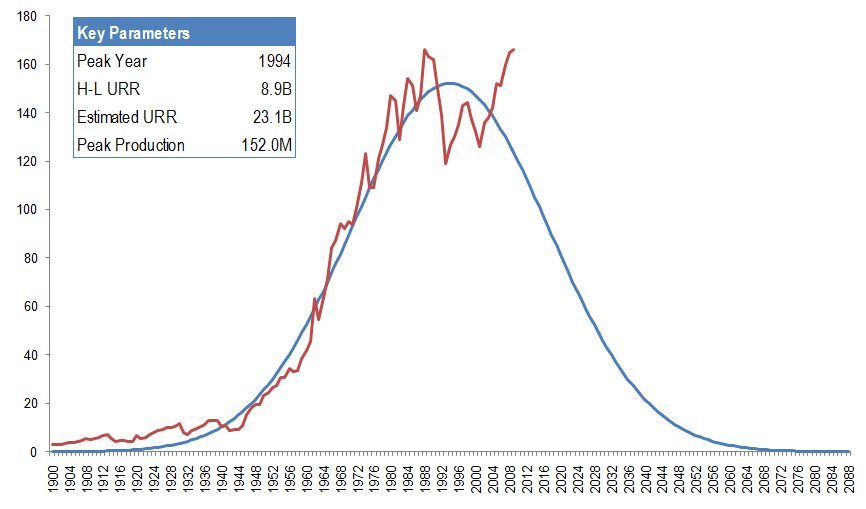
To answer this question, I first blindly applied the analytical technique to world rock phosphate production using data from 1900 to 2009. This technique provided a normal curve that suggests the world hit peak production in 1994 and that the ultimate amount of phosphoric rock ever recovered will be on the order of 8.9 billion metric tons. This number, the so-called ulimate recoverable reserves (URR) is supposed to equal the cumulative amount of phosphoric rock mined from 1900 to 2009 plus recoverable reserves still in the ground. My results are shown in the chart below.


Hubbert Linearization, Source: Adapted from USGS data, ©2011 Reflections of a Rational Republican

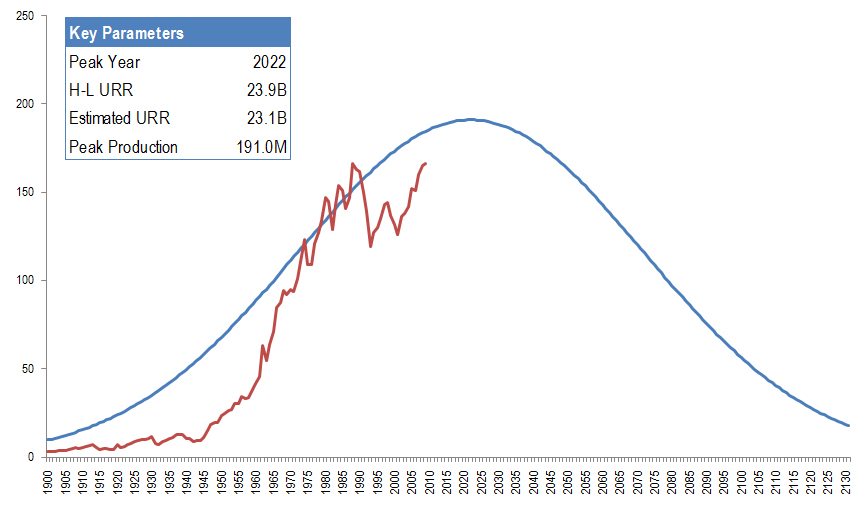
Here is the problem. The U.S. Geological Survey 2010 estimates indicated that there were 16B metric tons of reserves in the world in 2009. Adding this 16B in reserves to the cumulative amount mined globally since 1900 yields a URR of about 23B, a number over two and a half times higher than the 8.9B figure implied by the “best-fit” curve.

Backsolving for the 23B figure and applying the same analytical technique yields the following result, which implies a peak production year of 2022 and a URR of 23.9B. This curve clearly does not have as nice a fit as the prior one, but it roughly foots to U.S. Geological Survey reserve estimates.

Hubbert Linearization, Source: Adapted from USGS Data, ©2011 Reflections of a Rational Republican

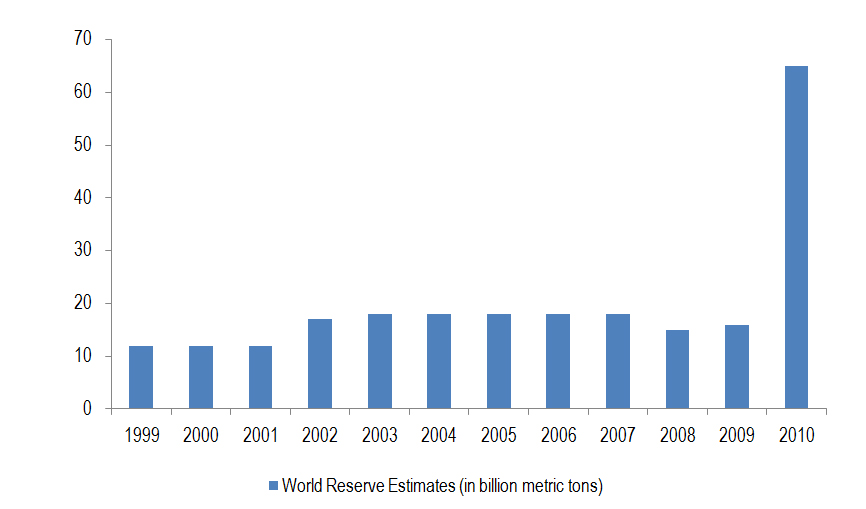
U.S. Geological Survey Quadruples Global Reserve Estimates in January 2011

USGS World Rock Phosphate Reserve Estimates, Source: Adapted from USGS

While peaking rock phosphate production in 2022 is better having reached a peak in 1994, it still would be a concern for global food production. However, in January of this year, the U.S. Geological Survey more than quadrupled its reserve estimates from 16B metric tons to 65B metric tons. Using this revision, I again ran a Hubbert Linearization. When I tried to match the URR to that implied by the U.S. Geological Survey’s estimates of 72B, the normal curve fell out of view. So I assumed that countries would not be able to mine all of these reserves economically and fit the curve for a URR of 33B. This extremely conservative estimate implies that phosphoric rock will not peak until 2038, which suggests that global production has not peaked nor will it be peaking any time soon.

Hubbert Linearization, Source: Adapted from USGS data, ©2011 Reflections of a Rational Republican

So the next time someone suggests that peak phoshorus is a looming concern, you can take comfort that the data does not seem to support their case.

Posted in Clean Energy, Clean Tech, Climate Change, Energy Security, Finance and Economics, Food Security, International Security, Media, Policy, Politics, Predictions | Tagged , , , | 31 Comments

Felling Pharaohs (Part VI): The Beatings Continue Because Morale Has Not Improved

Saudis Deploy Forces to Northeast in Preparation for "Day of Rage", Source: The Independent

A little over a month ago in the midst of Egyptian unrest, I warned that U.S. policy-makers should “be very afraid” of these developments because of their impact on crude oil prices.

Now that Libya is in flames, its oil output has fallen by at least one million barrels per day from 1.6 million since the uprising began. While this amount of production is small compared to total global production, it has nevertheless had an impact in pushing up crude oil prices. April crude oil contracts reached $106 per barrel on markets in Asia on Monday, and London futures contracts for Brent crude reached $117.20 a barrel.

Libya is not the only problem. The Saudi leadership is quietly holding its breadth for the upcoming March 11th “Day of Rage.” It is not only holding its breadth, it is deploying up to 10,000 of its security personnel to its northeastern provnces, where Saudi Arabia’s large Shia population dwells.

The key question now is: what will President Obama do if the Saudis massacre their own people? The United States’ reliance on the kingdom’s spare oil capacity is critical for its economic recovery and the prosperity of the American people. But is letting hundreds, if not thousands, of people get slaughtered worth this price?

This could be one of those key moments in a President’s administration when he must choose between the broader interests of humanity and America’s vital national interests.

I do not envy his choice.

Posted in Clean Energy, Defense, Energy Security, Finance and Economics, International Security, Middle East, Policy, Politics, Predictions | Tagged , , , , | 2 Comments

The Next Real Estate Bubble? Food Price Inflation Strikes in the Midwest

Source: The New York Times

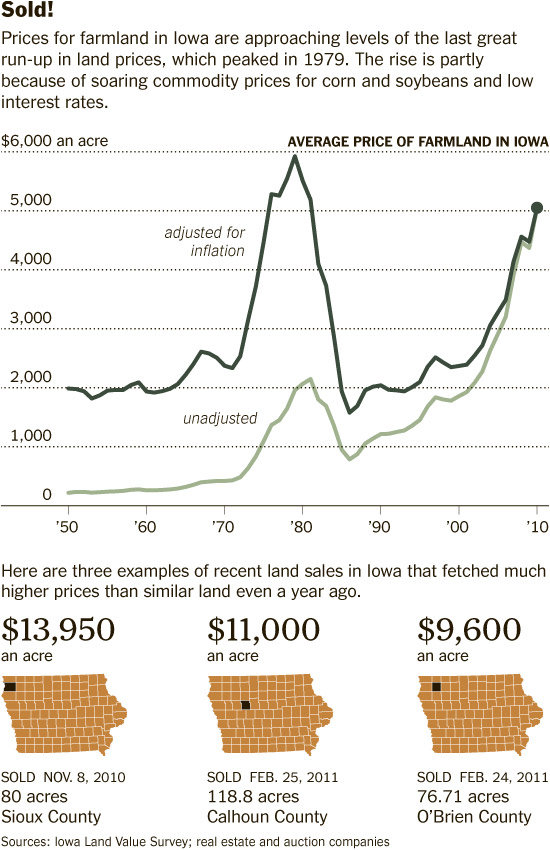
Today, The New York Times published an article on a potential real estate bubble in the Midwest.  This seems to be yet another effect that high oil prices are having on the economy. As I have frequently argued in previous posts, persistenty high oil prices will have a ripple effect on our economy. Now high food prices are leading to appeciation in Midwest farmland as the chart on the right so aptly shows.

Posted in Business, Climate Change, Food Security, Predictions | Tagged , , | Leave a comment

North Korea: Linking Fuel to Famine

I recently came across a book called Eating Fossil Fuels: Oil, Food and the Coming Crisis in Agriculture by Dale Allen Pfeiffer. In his book, Pfeiffer uses the North Korean famine in the mid-nineties as a cautionary tale about what can happen to a nation’s food production when that nation runs low on fuel.

Fossil Fuels Fuel Food Production

The basic thesis is as follows: Food production relies on fossil fuels to transport raw materials to the farm, to distribute products to global markets, to plant and reap crops via agricultural machinery, and to enhance crop yields via fertilizer (the nitrogen-based variety of which requires natural gas to produce). Without fuel, farm productivity declines–precisely what happened in North Korea.

Soviet Collapse Linked to North Korean Famine

After the collapse of the Soviet Union in the early nineties, North Korea’s access to imported fuel from the U.S.S.R. went away almost overnight. The state no longer had ready access to fuel, fertilizer, or agricultural machinery. According to North Korea’s own tally, 2.5 to 3 million people died in the subsequent famine from 1995 to March 1998.

While the North Korean government bears much of the blame for diverting fossil fuel resources from the fields to the military, the data tells a compelling story about how dangerously reliant our modern food production system is on fossil fuels.

Fuel Deficits Can Lead to Famine

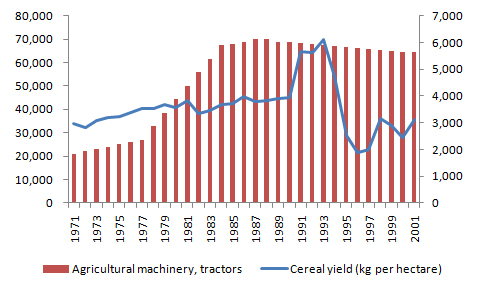
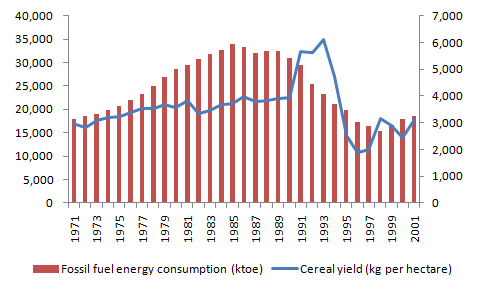
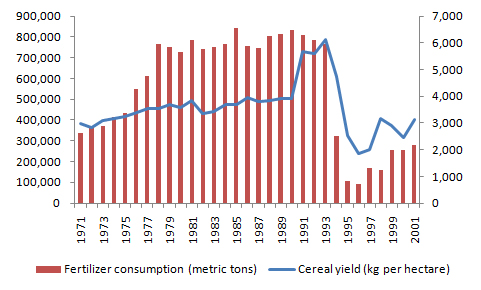
Pfeiffer’s book included one chart plotting petroleum consumption with agricultural production, which showed a strong relationship between the two variables. Pfeiffer’s chart was so compelling that I decided to plot several data points on North Korean fuel consumption and food production using the World Bank’s development indicators.

Tractor Inventory Started its Fall with the Berlin Wall

From 1962 to 1987, North Korea increased its tractor inventory. In 1988, the number of tractors stood at 70,000. After the fall of the Berlin Wall, from 1989 to 2007, the number of tractors in North Korea’s inventory declined at an average annual rate of 0.5 percent. North Korea’s tractors were getting old, but the state could not replace them. Subsequently, the government had fewer resources to apply towards food production.

Source: World Bank

Fossil Fuel Consumption Declined After Fall of Berlin Wall

Source: World Bank

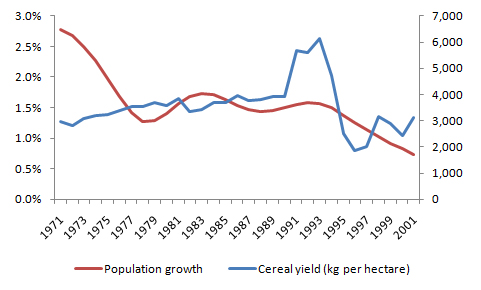
North Korean fossil fuel consumption declined at an average annual rate of 3.3 percent from 1989 to 2007. From 1992 to 1995, it declined by nearly 10 percent per year. During the same period, cereal yield also declined by an average rate of over 15 percent per annum.

Rapid Decline in Fertilizer Use Led to Sharp Drop in Yield

Source: World Bank

Of all the effects on North Korea’s cereal yield, the decline in fertilizer consumption appears to have had the most dramatic effect. In 1994, a 67.7 percent decline in fertilizer consumption was associated with a 46.7 percent decline in yield.

Fossil Fuel Starvation Leads to Human Starvation

Source: World Bank

The effect of these lower crop yields was a decline in the population’s growth rate. Since the famine of the mid-nineties, North Korea’s growth rate has never recovered. Granted, most countries are not as isolated or poorly managed as North Korea, but they can still learn from the North Korean experience. Modern food production requires fossil fuels to function. If societies continue to ignore this link and do not seek out ways to start decoupling fossil fuels from food production, they will continue to be at risk from the instability associated with high fossil fuel prices.

Posted in Climate Change, Energy Security, Finance and Economics, Food Security, International Security, Policy, Politics, Predictions | Tagged , , , , , | 9 Comments

Channeling Chris Christie: How to Handle Public Unions

“If what you want to do is put on a show and giggle every time I talk, then I have no interest in answering your question.”

— Governor Chris Christie

New Jersey Governor Christie lays out his case against public-sector-union overreach at a September 2010 town hall meeting.

He says what needs to be said. No further comment is necessary.

Posted in Healthcare, Policy, Politics, Unions | Tagged , , , , | 2 Comments