Food Fight: Instability May Beget Instability

In prior articles, I mentioned that one reason Egypt’s revolution happened now rather than in 2003 may have been due to a rapid increase in the price of food.

Last week’s edition of The Economist cited a Goldman Sachs report suggesting that the last despots left standing in the Middle East will likely subsidize oil for their citizens and stockpile food in response to the crisis. Jordan, Saudi Arabia, and Algeria are already starting to do so.

While these efforts may help Middle Eastern nations soften the blow of the next popular revolution, they may indirectly be inciting one somewhere else.

Stockpiling food will further increase food prices outside the region. In turn, rising food prices could serve as an accelerant for instability, and ripple throughout Africa and Asia.

In Africa, Nigeria, which is facing an upcoming election, and Sudan, which must manage a shaky division between its north and south, could be greatly affected by this trend.

China and India, which have already been suffering from a wicked bout of inflation, could also be impacted.

The greatest wildcard is North Korea, whose people have been starving for decades. Yet another food shock might push the country, which is already involved in a very delicate intergenerational power transfer and has engaged in reckless actions about South Korea, over the edge.

Let the ripples begin…

Posted in China, Defense, Energy Security, International Security, Middle East, Policy, Politics, Predictions | Tagged , , , , | 1 Comment

Channeling Luxor: Stable Egyptian Transition Not So Simple

On November 17, 1997, jihadists massacred a group of Swiss, British, and Japanese tourists enjoying the majestic sights of ancient Egyptian marvels at Luxor. The terrorists savagely butchered 58 tourists and 4 Egyptians with gunfire and knives. They mutilated many of their victims, especially the women, with machetes. They left a written statement in the body of a disemboweled victim. Counted among the victims was a five-year girl.

As the world emerges from the soporific haze of notions of Egyptian democracy, it is important to balance this idealism with a cold dose of realism. It is important to remember that Egypt is still in the midst of a region surrounded by and infested with both radical Sunni and Shia Islam.

It is also important to note that the Egyptians are not the only ones celebrating the revolution.

Hezbollah, the terrorist group and ruling party of Lebanon, issued a formal statement of congratulations to Egypt. In Hezbollah strongholds in southern Beirut, people set off fireworks and fired weapons in the air to celebrate. Ali Akbar Salehi, the Iranian Foreign Minister said, “We congratulate the great nation of Egypt on this victory and we share their happiness.

There is good reason for them to be optimistic. Egypt served as a stable bulwark against Islamic extremism. In one 2010 diplomatic cable, President Mubarak saw Iran as increasingly involved in attempting to destabilize the region:

“[Mubarak] now sees Tehran’s hand moving with ease throughout the region, ‘from the Gulf to Morocco.’ The immediate threat to Egypt comes from Iranian conspiracies with Hamas (which he sees as the ‘brother’ of his own most dangerous internal political threat, the Muslim Brotherhood) to stir up unrest in Gaza, but he is also concerned about Iranian machinations in Sudan and their efforts to create havoc elsewhere in the region, including in Yemen, Lebanon, and even the Sinai, via Hezbollah. While Tehran’s nuclear threat is also a cause for concern, Mubarak is more urgently seized with what he sees as the rise of Iranian surrogates (Hamas and Hezbollah) and Iranian attempts to dominate the Middle East.”

Egypt’s demographic crisis is another source for concern for whomever takes power. In a 2009 diplomatic cable from Cairo, President Mubarak complained that Egypt’s economy continued to suffer from the global economic crisis with Suez Canal revenues down 25 percent. He further lamented that exports, remittances, and tourism, were also down. He saw Egypt’s most serious internal problem as its “population growth at 1.3 million every year.”

Adding to these stresses were Egyptian expats who lost jobs abroad and returned to Egypt, swelling the ranks of the unemployed. 52.3% of Egypt’s population of 84.5 million is under the age of 25. Further aggravating these stresses was the increase in the price of food, particularly grain, the price of which increased 39% in 2010.

Hopefully the Egyptian military will be able to spearhead a stable transition. It will certainly have its hands full.

Posted in Defense, Energy Security, International Security, Middle East, Policy, Politics | Tagged , , , , | Leave a comment

Weimar Arabism Slouching Towards Islamo-Fascism

Today the Egyptian people are dancing in the streets. Tomorrow they may be drowning in blood. Hoping for a smooth transition is just that — hope.

And hope is not a method.

Every Middle Eastern country that has tried to institute democracy on its own has become increasingly Islamist from Iran to Algeria to the Gaza Strip. Even Turkey has, over time, shifted toward Islamism despite a constitution that demands secularism.

Egypt’s demographic situation is precarious with a population of 84.6 million, 52.3% of which are under the age of 25, an average GDP per person of $5,900, and with 20% of the population living below the poverty line. One can quickly see that Egypt’s problems will not be solved by any government, let along a fractious one. There simply are not enough jobs to go around in this country, let alone in Egypt.

When the Egyptian people grow increasingly frustrated with the new, less efficient government, the Muslim Brotherhood will be waiting in the wing to solve all their ills, much as Adolf Hitler provided the German people with his answer to the Weimar Republic.

With Egypt’s attention focused inward, external forces like Hamas will have more opportunities to smuggle weapons into Israel from Egypt, making Israel’s security situation increasingly untenable and regional stability more fragile.

Events in Egypt will likely progress in one of two ways: Fast Islamism or slow Islamism. The first way would be quick and violent. The second way would be slow and slightly less violent.

Either one is bad for regional stability.

Do not be fooled by the smiles and cheering. The honeymoon will end and the zero sum game for power will begin.

And radical Islam thrives in a power vacuum.

Posted in Defense, Energy Security, International Security, Middle East, Policy, Politics, Predictions | Tagged , , , , , , | Leave a comment

New Deal = No Deal: Framing Energy Policy Matters

Michael Kanellos at greentechmedia published an article today arguing that the President’s comparison to Sputnik with America’s dependence on fossil fuels is an imperfect one. He later suggests that the New Deal better fits the clean energy narrative.

I think he fundamentally misses the point. While some clean energy policies may be similar to those of the New Deal (the bad ones, in my opinion), not all of them are. For instance, the New Deal did not include a focus on basic scientific research. Like the Manhattan Project and the Apollo Program, current clean energy policy does.

More importantly, the point of the President’s Sputnik analogy was to unite and rally, not to find a perfect analogue for his current policies. Had the President compared his clean energy policies to the New Deal, half the country would have cringed and reflexively opposed him.

The fundamental problem with rallying people to support clean energy innovation is that America’s dependence on fossil fuels and the effects of climate change do not seem as immediate and menacing as Nazis dropping an atomic weapon on New York or Soviet eyes in the sky watching every American move from space.

Don’t get me wrong, when the party finally ends and people really start to feel the pain from crippling oil prices, skyrocketing food costs, and massive flooding, they will see the urgency. But by then it may be too late.

Framing the problem as an existential one, even if it is different than the threats confronting the nation before the Manhattan Project and the Apollo Program, is the only way the President can unite Americans on this issue.

Framing the issue as another New Deal would be a massive policy error. As a strong clean energy advocate with conservative views, I reflexively cringed when I read Michael’s comparison of current clean energy programs to the New Deal. Then I immediately thought about all the recent policy failures: Solyndra, Evergreen Solar, ethanol subsidies, and the appalling percentage of dollars in the government’s loan guarantee program for advanced vehicle development that went to shore up union jobs at Ford and Nissan North America (over 90%).

There have also been policy successes. My only point is that to get all Americans on board with clean energy development, frame the problem as an one of survival, not as one that half the country will see as another manifestation as socialism.

Posted in Business, China, Clean Energy, Climate Change, Energy Security, International Security, Policy, Politics | Tagged , , , , , , , , , , , | Leave a comment

Middle Eastern Instability and the Youth Bulge

The Economist published an interesting map this week that hints at one of the potential sources of Middle Eastern instability — the demographic imbalances in most Middle Eastern countries.

Arab League Demographics, Source: The Economist

As is evident on the map, over half the population in most Middle Eastern countries is under the age of 25. In a sluggish global economy, this imbalance drives instability as youth become disaffected when they are unable to find jobs. Chronic unrest also tends to rise when there is a youth bulge. Even the United States experienced significant unrest during the 1960s when baby boomers came of age.

Posted in Defense, Energy Security, International Security, Middle East, Policy, Politics, Predictions | Tagged , , , , | 2 Comments

Of Smart Grids and Cyber Warfare

Richard Clarke posted an interesting article today on the potential of cyber warfare to be the next major domain of war, much as sea power was in the 19th century, and air power, in the 20th.

The evolution of this new and cheap mode of war has broad implications that will ripple through the American economy in the decades to come. The most obvious and vulnerable area is the country’s electric grid.

The nation’s vulnerabilities to cyber attack are particularly relevant in the emergence of the smart grid, which is an effort to leverage information technology to provide utilities with better situational awareness and more efficient power distribution. The key question is whether the smart grid will open the electric grid to greater vulnerability or help reduce the number of targets by encouraging distributed rather than central generation.

On the one hand, smart grid technologies provide utility firms with greater situational awareness along the so-called last mile — the part of the electric grid that extends from a local substation to the home. This will ultimately make it easier for people to install solar and wind systems on or near their homes, and provide electricity back to the grid.

So-called distributed generation will make it more difficult for cyber terrorists to attack a single, centralized target like a coal-fired power plant, because power generation would be spread out amongst millions  of homes (targets).

On the other hand, adding more information technology systems to the grid provides cyber attackers with more ways to install malware into the electric grid.

In the near term, smart grid systems are likely to increase rather than reduce the risk of a grid shut-down. However, in the long-term, smart grid technologies will enable more distributed electric generation systems to penetrate the American power sector and reduce the number of large, centralized targets for cyber warriors.

Let’s hope distributed generation comes sooner rather than later.

Posted in Business, Clean Energy, Defense, Energy Security, International Security, Policy, Predictions, Smart grid | Tagged , , , , , , | Leave a comment

Felling Pharaohs: Be Afraid, Be Very Afraid (Part V)

Parts I through IV of this series show that the Egyptian crisis will have both regional and global consequences for the future of the Arab world and the global energy crisis. Given these stakes, what is America to do?

America’s Vital Interests

Before generating a list of actionable policy recommendations, it is useful to delineate what America’s vital interests are in the region. As callous as it sounds, the responsibility of the American President is to further America’s national interests above all else. It is the job for which the American people elected him.

Oil Price Appreciation, Source: The Economist

The overriding vital American national interest in this crisis is regional stability, not democracy. In fact, as I have indicated in prior posts on this crisis, Arab democracy will likely work directly against American interests.

Another vital interest is ensuring that oil and natural gas continues to flow from the region without disruption and that prices remain stable during the crisis. Thus far, prices have increased for Brent crude oil as the chart from The Economist shows on the right.

Policy Objectives

Now that America’s vital interests are clear, it is important to frame how America can ensure regional stability and energy security.

1. Reduce Unrest

America’s immediate priority is to ensure that Egypt restores order. Given that the Egyptian military is the largest and most stable organization in the country, the United States must support and advise the Egyptian military on tactical methods to restore order that minimize loss of life.

At the strategic level, American diplomatic statements must acknowledge the legitimate concerns of the Egyptian people and encourage a smooth and orderly resolution of the crisis.

2. Reassure Allies

In responding to the crisis, America must balance two competing interests. On the one hand, it must encourage a peaceful transition from Mubarak’s government to one that satisfies the majority of the Egyptian population.

On the other hand, America must not act so unilaterally as to give its allies the impression that it will abandon them any time the political winds change. Management of this process is especially important for Saudi Arabia and Israel.

Therefore, reassuring staunch political allies in the region is critical to American interests in regional stability and energy security.

3. Reinforce Energy Security

About five percent of the seaborne oil trade passes through the Suez Canal. Ensuring stability in Egypt and making sure it does not impact the free flow of energy resources is paramount. Preventing unrest from spreading to Saudi Arabia is also a national security imperative.

Given what is at stake, what are America’s policy options?

Option 1: Do Nothing

Doing nothing is always an option. The United States could stand above the fray and let the Egyptian people determine their own fate.

One risk in this scenario is the United States appears powerless to key regional allies like Israel, Turkey, Iraq, and Saudi Arabia. Another risk is that if Egypt descends into chaos, the Arab world will blame the United States for failing to act. America’s failure to respond to the crisis could also embolden more radical elements of the Arab Street to start unrest elsewhere, particularly in Saudi Arabia.

Based on these potential repercussions, doing nothing is a bad option.

Option 2: Delay

President Obama could encourage all Egyptian parties to be patient, while these parties work out details for a transitional government. The Egyptian military could serve as “adult supervision” to ensure an orderly transfer of power from Mubarak to the yet-to-be selected leaders of a transitional government.

American diplomats could make it very clear that the Muslim Brotherhood would have no role in the future government. If the two precedent failures of Hamas and Hezbollah going “legitimate” in Gaza Strip and Lebanon do not convince the Egyptian people that giving the Muslim Brotherhood a role in Egyptian politics is a bad idea, the threat of cutting off the country’s foreign aid might.

This option is the most probable one as it ensures the smoothest transition and maximizes stability.

Option 3: Deny

President Obama could reaffirm and support President Mubarak’s government.

The advantage of this approach is that it maximizes reassurance to America’s regional allies, namely Israel and Saudi Arabia, that the United States is firmly committed to the current regional order.

The disadvantage of this approach is that America’s reputation as the arsenal of democracy will ring hollow and America’s standing in the Arab world will take yet another blow.

Even more worrisome is that if the crisis escalates, the increasing stakes may require an active United States military commitment.

Option 4: Democratize Now

President Obama could wholeheartedly embrace the freedom agenda, demand that President Mubarak step down immediately, and encourage all Egyptian parties to form a transitional government and begin immediate transition to a democracy.

Of the four options, this one is the worst because it throws a leader who has been a loyal and staunch American ally for over three decades under a bus and it provides no guarantees of future stability. It also sends a signal to other American allies that the United States will abandon them at the first hint of trouble.

This option will likely maximize the opportunity for the Muslim Brotherhood to gain power.

What Must Be Done

Option 2, or delaying the transition to a democracy, is likely the best and most probable course of American governmental action because it ensures the smoothest transition, blunts the participation of a banned, terrorist organization from Egypt’s government, maximizes Egyptian stability, and minimizes the crisis’ negative impact on global energy security.

Posted in Defense, Energy Security, International Security, Policy, Politics, Predictions | Tagged , , , , , , , , , , | Leave a comment

Happy Birthday, President Reagan

Ronald Reagan, Source: Photo/Wikimedia

“There is one sign the Soviets can make that would be unmistakable, that would advance dramatically the cause of freedom and peace. General Secretary Gorbachev, if you seek peace, if you seek prosperity for the Soviet Union and Eastern Europe, if you seek liberalization: Come here to this gate! Mr. Gorbachev, open this gate! Mr. Gorbachev, tear down this wall!”

— President Ronald Reagan, June 12, 1987

I would be remiss not to mention that today would have been Ronald Reagan’s 100th birthday. Under his stewardship, he helped accelerate the economic collapse of the Soviet Union and reminded Americans about rugged individualism and the optimistic, can-do attitude that makes the United States the greatest democracy in history.

P.S.: To appease the anti-spam detectors at Technorati, I have included their secret decoder message: M6SF2DY2EKSW

Posted in Politics | Tagged , , , | 3 Comments

Felling Pharaohs: Be Afraid, Be Very Afraid (Part IV)

While the last three parts of this series focused on issues ranging from the immediate impact on Egypt to the far reaching potential for unrest to spread to key American energy suppliers, it has ignored the crisis’ implications for Israel.

This post fills that gap.

The bottom line for Israel is that its most stable border suddenly became a lot less so.

A Shaky Left Flank

If President Carter can claim credit for anything, it was cementing a peace between Egypt and Israel that has lasted over three decades. The Camp David Accords virtually eliminated the need for the Israeli’s to defend a third front in any future war with its Arab neighbors.

For his efforts, Egyptian President Anwar Sadat got the Nobel Peace Prize and a bullet from Islamic fundamentalists.

Today, that stability is at risk should more radical forces like the Muslim Brotherhood seize a greater share of power in Egypt. It seems the group is already starting to make its move. The Muslim Brotherhood announced Saturday that it would begin talks with Egypt’s Vice President Omar Suleiman “on the public’s right to protest safely and the possible exit of President Hosni Mubarak.

The Israelis are likely monitoring the situation with great interest as it will have a real impact on future troop dispositions and deployments on Israel’s southwestern border.

Energy Supply Disruptions

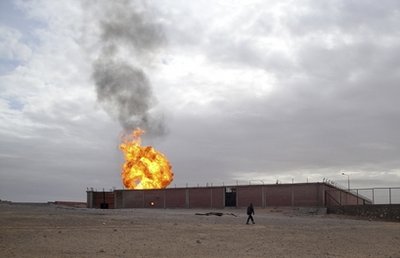
Yesterday, a gas pipeline exploded in the northern Sinai. While the press has identified no responsible party, the Egyptian military has reported that the detonation was caused by an explosive device, no doubt placed by an enemy of the Egyptian government.

Egypt Pipeline Explosion, Source: Associated Press

Pipeline security concerns Israel because natural gas generates 45% of its electricity. Egypt is Israel’s largest and only foreign supplier, accounting for 40% of the natural gas used in Israeli electric power generation. Israeli will likely find alternative sources of energy, but the disruption will still negatively impact the Israeli economy (see “Israel: Egypt Gas Pipeline Explosion Raises Energy Concerns“).

While the Cat’s Away, the Mice Will Play: Iranian Proxy Wars

The unrest in the Sunni world could not have come at a worse time for Israel. Events in Egypt have become a distraction from the more dangerous threats lurking on Israel’s northern front and in the Gaza Strip.

Still smarting after the Stuxnet computer virus destroyed Iranian nuclear centrifuges, and the mysterious bombings of two Iranian nuclear scientists, the Iranians are likely looking for ways to strike back at Israel.

Hezbollah’s recent resurgence and consolidation of power in Lebanon culminated in Prime Minister Saad Hariri’s turning power over in January to the same butchers who murdered his father in 2005. Hezbollah’s political entrenchment in Lebanon provides the Iranians with a free hand and a well-trained and ruthless proxy army to strike back at the Israelis.

Hezbollah, Source: Hussein Malla/Associated Press

On January 1st, I predicted a border war between Hezbollah and Israel in 2011. The unwelcome distraction of Egyptian unrest on Israel’s southern left flank will likely preoccupy some portion of the Israeli military’s attention, allowing Hezbollah more freedom of movement to strike in the north.

A military confrontation is now more likely than it was at the beginning of 2011.

Since the 2006 war with Israel, Hezbollah has been steadily building up its missile arsenal. Military officials have indicated that Hezbollah now possess some 50,000 rockets, 10 Scud-D missiles, and 40 to 50 Fateh-110 missiles that can range most targets in Israel, including Tel Aviv. This new arsenal dwarfs the some 4,000 missiles Hezbollah fired at Israel in 2006.

Hamas may also judge that now is the best time to strike while Israel’s attention is focused on Egypt, with Iranian helpers eager to provide weapons, training, and advice.

America should brace itself for another cycle of Middle Eastern instability.

What is America to do? Tune in for Part V of this series tomorrow to find out.

Posted in Defense, Energy Security, International Security, Politics, Predictions | Tagged , , , , , , , | 2 Comments

Felling Pharaohs: Be Afraid, Be Very Afraid (Part III)

Blame Bush

In its recent edition, The Economist credits former President George W. Bush for encouraging Arab democracy. I think he deserves blame.

Given the volatility inherent in radical Sunni Islam, it is not in America’s interest to encourage a freedom agenda in the Arab world. While President Bush ardently believed that one important rationale for invading Iraq was to spread democracy to the Middle East, the dominant reasons were to ensure the free flow of crude oil and to eliminate Saddam’s weapons of mass destruction.

So where then will Arab democracy lead?

Weimar Arabism Leads to Islamo-Fascism

Arab democracy will likely lead to disaffection amongst the people, because it will not translate into economic results. The structural impediments in the Egyptian economy and its population demographics are simply too overwhelming to expect a divided electorate to achieve a national consensus before the people again turn against the government.

Even the United States has been unable to deliver jobs fast enough to its citizens before they voted out the controlling party in recent mid-term elections.

Future frustration amongst the Arab populace will likely culminate in a Sharia dictatorship much as Germany’s Weimar Republic led to a Nazi dictatorship.

Some believe such an outcome is inconceivable given that Egypt has an educated and secular middle class. However, people forget that Germany also had a prosperous and educated middle class, yet Nazism still took root in that nation in the 1930s.

Mark my words: Egypt’s unrest will not end well for anyone, especially if the Muslim Brotherhood gains power.

Posted in Business, China, Defense, Energy Security, International Security, Politics, Predictions | Tagged , , , , , , , , , | Leave a comment