Strife in the Sinai: Is Egypt’s and Israel’s Peace at an End?

“The Egyptians do not accept what has happened, and it means that Israel should take care. If they continue their behavior toward the Palestinians and the peace process, it means that the situation will escalate more.”

Mohamed Bassiouni, a former Egyptian ambassador to Israel

In February, I predicted that Egypt’s democratic revolution would lead to a rise in regional instability, particularly between Egypt and Israel.

This past week, the two countries’ three-decade peace experienced a major setback after Israeli warplanes inadvertently killed three Egyptian security personnel in the Sinai. The warplanes were responding to Gaza-based militant attacks that killed eight Israelis earlier this week. Continue reading

Posted in Defense, Energy Security, International Security, Media, Middle East, Peak Oil, Policy, Politics, War | Tagged , , , , , | 11 Comments

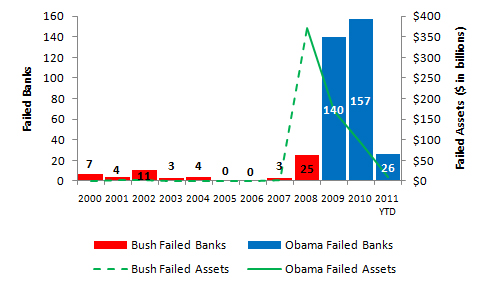
Bush vs. Obama: Failed Banks

Source: Adapted from FDIC data

Yesterday, I compared the number of bankruptcy filings under the Bush and Obama administrations.  Because of a significant change in bankruptcy law in 2005, I concluded that it would be very difficult to do an adequate apples-to-apples comparison.

Today, I decided to look at the number of banking institutions that failed under each administration. I also examined the total amount of failed assets. Continue reading

Posted in Business, Finance and Economics, Policy, Politics, Taxes | Tagged , , , , | 4 Comments

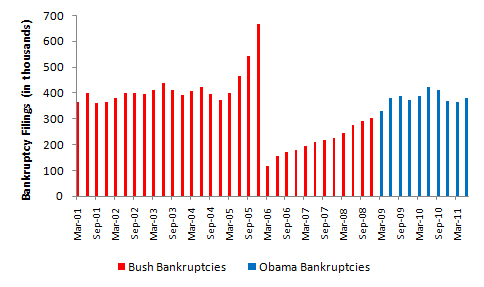
Bush vs. Obama: Bankruptcies

Source: Adapted from the United States Courts website

Since comparisons between Presidents George W. Bush and Barack Obama appear to be very popular these days, I have added another chart to the mix.

I was curious if there were any major differences between the number of bankruptcy filings during the Bush and the Obama administrations. I decided to focus on bankruptcy filings, because I thought they would rise during periods of economic stagnation, and fall during periods of strong economic growth. However, a cursory glance seems to show that bankruptcy fillings do not appear to have a particularly strong correlation with weak economic growth.

However, the spike in bankruptcy filings in the December 2005 quarter appears to reflect the last mad dash of people filing for personal bankruptcy before a law that Congress passed in October 2005 took effect at the beginning of 2006. As such, it was far easier for people to declare bankruptcy before 2006 than it was after.

The average number of quarterly bankruptcy filings averaged roughly 343,000 during the Bush Administration vs. about 381,000 during the Obama Administration, even though it is now much more difficult for individuals to file for personal bankruptcy.

If one only includes bankruptcy filings after 2005, President Bush’s average falls to roughly 216,000 vs. 420,000 before the change in U.S. bankruptcy law.

Therefore, the significant change in bankruptcy law during this period makes it very difficult to do an adequate apples-to-apples comparison between the Bush and Obama administrations.

So it seems the jury is still out on this one.

Posted in Business, Finance and Economics, Policy, Politics, Taxes | Tagged , , , , | 2 Comments

Another Strike from Unionized Employees in a Declining Industry

“You can deal with the name calling, you can deal with the picket lines, but it’s crazy when they’re an inch from your face screaming that they’re going to kill you and your family.”

Verizon manager, who refused to provide his name in fear of retaliation

According to Megan McArdle at the Atlantic Monthly, some 45,000 members of the Communications Workers of America (CWA) are striking against Verizon. So far, the CWA has allegedly engaged in behavior that would be the envy of a third world revolutionary. The FBI is currently investigating some 90 allegations of sabotage on Verizon landlines since the strike began on August 7, 2011. Two of these lines served a hospital and a police station. Continue reading

Posted in Business, Finance and Economics, Media, Policy, Politics, Socialism, Unions | Tagged , , , , , , , , , , | 16 Comments

Regulatory Uncertainty in the Obama Administration: Part III

Source: Adapted from the Heritage Foundation, BEA, Yahoo! Finance

So far, I have published two articles showing examples of how the Obama administration’s policy uncertainty has had a negative effect on the economic recovery. In the first piece, I showed four high level examples of how Obama administration policies have negatively impacted the economic recovery. In the second  piece, I noted that private sector growth sharply decelerated following the passage of the Patient Protection and Affordable Care Act (PPACA) of 2010.

The macroeconomic, top-down analysis of the second article did not convince some readers that the passage of the PPACA had a negative impact on job growth. This article takes a bottoms-up approach, by reviewing Congressional testimony about the impact of the PPACA on business owners. Continue reading

Posted in Business, Clean Energy, Clean Tech, Finance and Economics, Healthcare, Media, Nuclear Power, Policy, Politics, Taxes, Technology, Unions, Wind | Tagged , , , , , | 10 Comments

Game Theory for Middle Eastern Dictators

Source: Photos from BBC

Towards a Dominant Strategy

In “Saudis Shrug Off Day of Rage: Three Strategies to Suppress a Revolt Before It Starts“, I argued that there are two archetypal models for a dictator to deal with popular revolts in the Middle East: crush them or concede to protestors by leaving office. In the second model, sometimes the ruling class “encourages” a dictator to leave. Continue reading

Posted in Defense, Energy Security, International Security, Mathematics, Middle East, Policy, Politics, Predictions, War | Tagged , , , , , , , , , , , , , , , | 9 Comments

Regulatory Uncertainty in the Obama Administration: Part II

Source: U.S. Bureau of Labor Statistics, Heritage Foundation

Last week, I published an article showing four examples of how the Obama administration’s regulatory uncertainty has had a negative effect on the economic recovery. In that piece, I noted that private sector growth sharply decelerated following the passage of the Patient Protection and Affordable Care Act (PPACA) of 2010.

The most common criticism was that the private sector job growth’s sharp deceleration primarily reflected sluggish GDP growth due to lackluster demand. Some further argue that compared to sagging demand, the effect of the PPACA’s passage was immaterial.

While I would agree that weak demand was primarily responsible for the continued job growth deceleration by early 2011, the data does not appear to support this thesis during the first two quarters of 2010. This period had the two highest GDP growth rate-quarters during Obama’s presidency. Continue reading

Posted in Business, Clean Energy, Clean Tech, Finance and Economics, Healthcare, Media, Nuclear Power, Policy, Politics, Taxes, Technology, Unions, Wind | Tagged , , , , | 22 Comments

Freedom of Expression Fallacy: BART Right to Suspend Cell Service to Avert Dangerous Protest

“It was a recipe for disaster… The fact that they started to
conspire to commit illegal actions on the station platform was our concern. I asked myself: If my wife, mother or daughter was on that platform, would I want them to be in that situation?”

-BART Deputy Police Chief Benson Fairow, as quoted in The San Francisco Chronicle, August 13, 2011.

As I discussed last month, I have little sympathy for protestors who disrupt mass transit during rush hour. I support the right of individuals to express their views in front of City Hall or other venues where they do not interfere with the rights of other citizens. Climbing on top of subway trains during the evening commute, and forcing the shutdown of the country’s fifth-busiest rapid transit system is not an appropriate way to make one’s point.

When BART officials learned that the “No Justice, No BART” group was planning to again disrupt operations last Thursday by “[using] mobile devices to coordinate their disruptive activities and communicate about the location and number of BART Police,” they decided to switch off the underground cell phone network BART owns and controls.

Naturally, liberals are crying foul, threatening a lawsuit, and pressuring the Federal Communications Commission to investigate.

This outrage would be perfectly understandable if BART officials had electronically jammed another service provider’s cell network. But, they did not. They did not even “ask  cell phone providers to shut down towers near stations.” It turns out that “BART owns and controls  the wireless network strung through its subways, and BART police ordered it  switched off.”

That’s right, protestors are demanding that BART provide a service at its own expense that enables malcontents to organize protests that deny service to customers. The end result is that BART suffers financially.

Someone please explain to me how this logic makes any discernible sense?

Posted in Business, California, Crime, Finance and Economics, Media, Policy, Politics, Terrorism | Tagged , , , , , , , | 7 Comments

The President Who Cried “Recovery”

“You can only talk about ‘things are going to get better’… for so long and be a cheerleader for so long before it has to actually happen. And that’s the role of policy, not communications, is to actually make things better.”

Matt McDonald, NPR’s Morning Edition, August 11, 2001.

I could not believe my ears yesterday morning when listening to this segment on NPR. It was actually a fairly critical segment on President Obama’s constant cheerleading about the state of the economy, despite firm evidence to the contrary.

That said, I actually think the segment was a bit too hard on the President. After all, when speaking to the American people, should President Obama urge them to lower their expectations like President Carter so infamously did? Of course not.

However, I appreciate NPR’s effort to provide more balanced coverage of the President.

Posted in Business, Finance and Economics, Media, Policy, Politics, Predictions | Tagged , , | 4 Comments

Conservatives Blamed for British Barbarism

It was only a matter of time before these animal-like wards of the state blamed conservatives and the “wealthy” for their own barbaric behavior.

After over thirty years and billions of pounds on social welfare programs, this is what London has to show for it.

Posted in Business, Crime, Finance and Economics, International Security, Media, Policy, Politics, Social Security, Socialism, Taxes, Unions | Tagged , , , , | 11 Comments