Catching a Falling Knife: The Hazards of California Real Estate

Source: Adapted from zillow.com

When I returned to the San Francisco Bay Area in July 2006, real estate prices were absurd. At the time, I had also saddled myself with a massive amount of school loans. That said, no-doc loans were all the rage, and I probably could have secured a hyper-expensive mortgage. Instead, I elected to pursue a more rational path, and resolved to buy a house after an earthquake.

Then the financial crisis came along, and I decided this event was probably the best opportunity I would ever have of owning a home in Northern California.

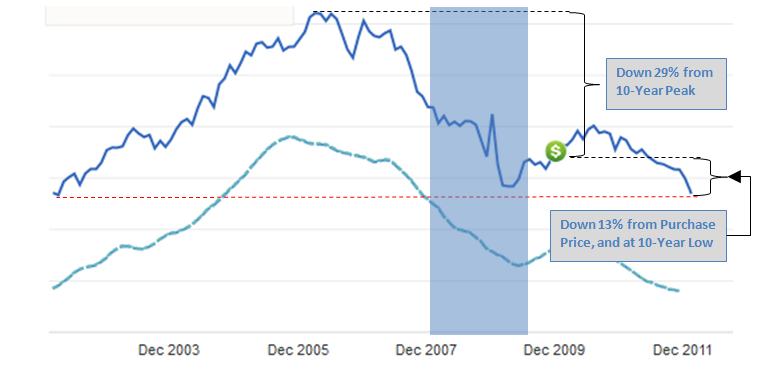
In December 2009, I purchased my first home at what was a 29% discount to the home’s all-time high.

I thought I was a genius as I watched my home’s value rise nearly 8% on Zillow.com in just seven months. Because of the leverage provided by my mortgage, my home equity value rose by an astonishing 30%.

Then the housing recovery faltered, and my home’s value declined by nearly 13% from my initial purchase price, where it now stands at a 10-year low. My mortgage debt magnified this decline, and now my initial home equity declined by a whopping 50%.

Fortunately, I still have positive home equity, the estimated rent I could charge for my home is about 13% greater than my current mortgage payment, and the economy appears to be picking up. Furthermore, because of other savings and investments, the hit to my home equity had a less dire impact on my net worth. I also asked the local tax assessor to reappraise my house to reflect the decline in the local housing market, which ultimately saved me a ton of cash.

On the bright side, if the local housing market ever returns to peak levels, my 50% loss would turn into a near tripling of my initial investment. Furthermore, while my market timing wasn’t perfect, I at least avoided 77% of my home’s decline from the peak. While I doubt this market will ever return to those peak levels in the next decade, I also doubt it will remain at 2002 prices forever.

What this personal example shows is how the leverage inherent in the housing market can very easily create or destroy wealth. Since most people have most of their wealth tied up in their homes, even small price fluctuations like mine can have a dramatic impact on one’s home equity and, ultimately, net worth.

When people see their net worth decline substantially, they rein in spending and increase savings. If their home equity turns negative — that is, they own more on their homes than their homes are worth — they have an economic (though not moral) incentive to walk away.

Hopefully, macroeconomic trends improve, and help drive a sustainable increase in housing prices. This housing recovery would give people their confidence back, and they likely would start spending again, creating a virtuous economic cycle.

Posted in Business, California, Finance and Economics, Investing, Mathematics, Policy, Politics | Tagged , , , | 2 Comments

Where Are the Carriers?

Over the last few weeks, Stratfor, a global intelligence site, has provided updates on the approximate location of the American carrier fleet. According to Stratfor’s estimates, two carriers are operating in or near the Persian Gulf, another is operating in the Pacific near the Philippines, and two others are under way in the Atlantic Ocean. Four other carriers are non-deployable, and two are in their home ports.

The locations of these carriers are a key indicator of potential U.S. military activity, and could be key harbingers of a future American strike on Iran’s nuclear program, should the President decide to order one. Two carriers have been in the vicinity of the Persian Gulf for several weeks now, and a third passed through the region in early January.

Military analysts will be continuing to keenly observe U.S. aircraft carrier deployments to determine the likelihood of American action against the Iranians.

Posted in Defense, Energy Security, International Security, Middle East, Nuclear Power, Nuclear proliferation, Policy, War | Tagged , , , , | 15 Comments

Is Fracking Causing the Mystery Disease in Le Roy, New York?

Today, I learned that eighteen individuals in LeRoy, New York have been suffering inexplicably from a strange neurological disorder that caused them to develop “uncontrollable twitching and verbal tics.”

No one seems to be able to explain the root cause behind these behaviors, but I had a wild theory. I was curious where LeRoy, New York was located. When I checked, I was not surprised to find it was in Western New York, an area of high fracking activity.

So I decided to do some more research. Where there any shale deposits in LeRoy? Continue reading

Posted in Business, Energy Security | Tagged , , , , , , , , , | 28 Comments

Bush vs. Obama: Unemployment (January 2012 Jobs Data)

Change in Total Private Employment (in thousands), Source: U.S. Bureau of Labor Statistics

Update: Click here for the most recent jobs statistics.

On the first Friday of every month, I update the unemployment numbers so that I can compare the unemployment rate under President George W. Bush with the unemployment rate under President Obama at that time. The genesis of this ritual began when I felt compelled to respond to some left-leaning sites that were comparing Obama’s first two years and four months in office with Bush’s last and worst economic year (the above chart shows the most recent incarnation of this narrative).

Continue reading

Posted in Business, Finance and Economics, Media, Policy, Politics | Tagged , , , | 130 Comments

Congress Finally Does Something Right

Last November, I alerted readers to the hypocrisy that “members of Congress are not subject to insider trading laws, despite having access to far more material, non-public information than the average American, or, for that matter, the typical hedge fund manager.”

The Senate made a move to end this glaring loophole by passing an insider trading ban for Congress and administration officials today by a 96-3 vote. The Senate sent the bill to the House, which would consider the legislation next week.

Who could have possibly voted against this bill? Continue reading

Posted in Finance and Economics, Investing, Leadership, Politics | Tagged , , | 3 Comments

Will Israel Attack Iran This Spring?

U.S. Defense Secretary Leon Panetta indicated today that Israel is considering a strike on Iran’s nuclear program as early as this spring. A Washington Post reporter asserted Panetta believed “there is a strong likelihood that Israel will strike Iran in April, May or June before Iran enters what Israelis described as a ‘zone of immunity’ to commence building a nuclear bomb.” He further maintained that the United States had cautioned the Israelis against such a move in order to allow international sanctions more time to convince the Iranians to back away from their nuclear program.

Given the level of increased rhetoric on Iran amongst top administration officials, as well as recent carrier and special warfare deployments to the region, there seems to be a bit more going on here that what appears on the surface. Continue reading

Posted in Defense, Energy Security, Middle East, Nuclear proliferation, Peak Oil, Policy, Politics, War | Tagged , , , , , , | 17 Comments

The Disadvantages of Growing up Wealthy

Now that I have your attention, I think it is fair to state up front that there really are few disadvantages to growing up wealthy. You never have to worry about finding a job or joining the military to pay for college. Your dad’s friend helps you get your first cushy summer internship at his law firm. Your dad’s other friend helps you secure a prestigious position at a major technology company after college where every employee but you has a 3.9 GPA in engineering from MIT or Stanford. You never get laid off because the firm at which you work could lose your father’s business. You get to take cool vacations like hobnobbing with your daddy’s economist friends in Davos, and then taking a detour to ski the Alps.

Despite these advantages, there is one disadvantage that will always follow those who have had wealthy childhoods, no matter where they go: Continue reading

Posted in Business, Finance and Economics, Leadership, Politics | Tagged , , , , | 17 Comments

Oakland Occupy Protestors Show Their True Colors

The First Amendment is one of the hallmarks of the U.S. Constitution. Americans ought to have the legal right to express themselves and their grievances against the government. This right is fundamental, and the government ought to protect it.

Burning the American flag is a protected right under the First Amendment. Those who burn it have every legal right to do so. However, burning a prominent symbol of American prosperity and greatness is unnecessarily provocative and unhelpful in gaining sympathy for the protestors. Furthermore, it is insulting and demeaning to the tens of millions of American veterans and current service members. Moreover, it leads many to draw conclusions (fairly or unfairly) about those who burn the flag – namely, that the flag-burners hate America and all it stands for.

Not surprisingly, the thugs from the Oakland Occupy movement burned the American flag before they broke into Oakland’s City Hall, as if to underscore whom they truly represent – listless anarchists.

After all, why else would one burn an American flag?

Warning: The following video contains some profanity

Posted in California, Crime, Media, Politics | Tagged , , , | 36 Comments

Marginal Tax Rates And Recessions

Source: NBER, Citizens for Tax Justice via Tax Policy Center via The Center for American Progress

A Reflections of a Rational Republican reader suggested that I attempt to debunk or challenge the notion from two posts (see “Rich Peoples Taxes Have Little to Do with Job Creation” and “The Myth of the Lower Marginal Tax Rates“) at the The Center for American Progress that suggest higher marginal tax rates are associated with more job creation and economic growth.

Given the amount of data crunching involved and a number of other priorities, I have not yet had a chance to construct a detailed argument against the above claim, though I have several ideas about how to show that these periods of economic growth are likely earlier in the twentieth century when the United States was either at full productive capacity because of war, or it had less economic competition as economic competitors struggled to rebuild their economies. Furthermore, earlier in the century, the government spent a larger share of tax revenue on programs that were more conducive for economic growth such as defense and infrastructure spending vs. a budget today that has a far greater share of tax dollars allocated for entitlement programs and debt service.

In other words, the Center for American Progress reports take the numbers out of their historical contexts and assume that correlation implies causation. Alas, I will save this argument for another day, once I gather the appropriate data to prove (or disprove) my hypotheses.

However, the aim of this post is to share some results of my research that yielded nothing conclusive either way, but are nonetheless interesting.

One of my early hypotheses about why high GDP and job growth are associated with periods of high marginal tax rates, is that governments would tend to lower tax rates during periods of low GDP and job growth. As such, one would expect lower marginal tax rates during these periods. In other words, the Center for American Progress report has the causal relationship backwards, and seems to imply that lower marginal tax rates led to low GDP and job growth, when it should be the other way around.

To test this hypothesis, I plotted the marginal tax rate over the past 100 years against all the recessions over that period. Unfortunately, at first glance I could not see any discernible pattern between recessions and tax rates. That said, there may be a relationship between recessions, tax rates, and the President’s party. For instance, a cursory look at the data may indicate that marginal tax rates rise during and after recessions in which a Democrat is the President, while they fall during and after recessions in which a Republican is President. For instance, they rose under Presidents Wilson, Roosevelt, and Clinton, and fell under Reagan and George W. Bush. That said, they fell under Kennedy and even Obama, and rose under George Bush, Sr., so the relationship is murky at best.

Regardless, out of curiosity, I would like to solicit any thoughts about patterns readers might see in the data.

Posted in Business, Finance and Economics, Policy, Politics, Taxes | Tagged , , , , , , | 32 Comments

More Signs of an Upcoming Confrontation with Iran

Yesterday, the Washington Post reported that “Navy officials acknowledged that they were moving with unusual haste to complete the conversion” of “an aging warship” the Navy “had planned to decommission into a makeshift staging base for the commandos” so it could send the ship to the Persian Gulf by early this summer. The converted warship would serve as a floating base that “could accommodate smaller high-speed boats and helicopters commonly used by Navy SEALs.”

More importantly, a Navy spokesman suggested that the “mothership” would support mine-clearance ships. Such ships would be a necessity in any operation against Iran, particularly if Iran mined the Strait of Hormuz. In 1987, the Iranians did just that. Furthermore, U.S. Navy Seals, Marines, and Army personnel operated from similar floating platforms in the Gulf to contain Iranian aggression against civilian vessels carrying crude oil.

The anticipated timing of the warship’s delivery to the region suggests that the Obama administration is planning for something as early as this summer. In the meantime, expect the Iranians to continue their diplomatic dance that has successfully confounded the Western world since at least 2003.

Posted in Energy Security, International Security, Middle East, Nuclear Power, Nuclear proliferation, Policy, Politics, War | Tagged , , , | 13 Comments
