What’s Your Economic Outlook?

The New York Times published an interesting interactive tool today allowing users to provide their opinions on the American economy. The tool then plots each user’s position amongst a group of one hundred other random people, based on their relative optimism or pessimism on four different categories.

The tool also allows users to sort responses by age, sex, and employment status. The results are fascinating, especially when you sort responses by employment status, sex, and age.

I’ve included my responses to three of the four categories below. I’d like to say that I’m optimistic about the economy. Unfortunately, I am not.

On Upcoming Spending Plans

Source: The New York Times

On Next Year’s Economy

Source: The New York Times

On the Next Generation’s Job Prospects

Source: The New York Times

I look forward to hearing your responses, if I did not already thoroughly depress you.

Posted in Business, Finance and Economics, Media, Policy, Politics, Technology | Tagged , , , , | 7 Comments

Bureaucratic Blundering Behind Debit Fee Debacle and Health Premium Hikes

Financial Foolishness

Earlier this week, Bank of America announced plans to charge customers $5 each month on accounts that make at least one debit card purchase in a given month. The bank itself cited recent regulations as the primary reason for the increase.

According to the Wall Street Journal, a Bank of America spokeswoman announced that, “The economics of offering a debit card have changed with recent regulations.” Other banks like Wells Fargo, J.P. Morgan, Regions Financial Corp., and Sun Trust Banks are also experimenting with similar fees.

The regulation in question is the Durbin amendment to last year’s Dodd-Frank financial regulation overhaul legislation. The Durbin amendment caps the fees merchants pay for processing debit card purchases at 24 cents per transaction (vs. the current average of 44 cents). Javelin Strategy and Research estimates that this ill-considered rule could cost banks $6.6 billion annually.

It is probably no coincidence that Bank of America is also seeking to trim $1.5 billion in quarterly expenses, primarily through 30,000 layoffs between now and 2014. Bank of America publicly acknowledged that the cost of the Durbin rule alone would reduce the bank’s debit card fees by $475 million in just the fourth quarter of this year.

Nice work, Congress.

Incidentally, this bureaucratic blundering was also a bipartisan effort with 17 Republican Senators supporting the amendment.

What is amusing about this amendment is that it has absolutely nothing to do with regulating derivatives and other exotic financial instruments that had a big part in precipitating the crisis. What it does show is that when government steps in to “solve” one problem, it causes a host of new ones that ultimately harm consumers.

Healthcare Hooliganism

Heathcare insurance premiums increased an average of 9% this year, a dramatic jump compared to last year’s increase of 3%.  To all but the most wild-eyed of the progressive movement, this fact should be no surprise.

In fact, it was preordained.

When government passed a bill that added an additional 45 – 50 million uninsured Americans, required insurers to provide lots of additional free treatments and services, and guaranteed that people would have to spend very little out-of-pocket for their health decisions, costs were certain to rise.

One study by consultancy Aon Hewitt attributes 1.5% of premium bumps in 2011 to the reform law, which is fairly close to the White House’s own estimates. Of course, the law impacts some healthcare markets worse than others. For instance, estimates suggest that the bill will have resulted in a 5% premium increase in the individual market.

Passing excessive and ill-considered regulations have dire consequences, and the market is now beginning to see these impacts.

So much for jobs.

Posted in Business, Finance and Economics, Healthcare, Media, Policy, Politics, Socialism, Taxes | Tagged , , , , , , , , , | Leave a comment

Class Warfare Has Consequences

“I have found incredible success in raising money for Gov. Romney…We are raising the guy a fortune from people who are disaffected by what the president is doing”

— Hedge fund executive Anthony Scaramucci as quoted in the Los Angeles Times

Since President Obama’s scapegoating of the “rich”, many of his former Wall Street donors have become noticeably reticent in recent weeks.

The President’s team recently struggled to fill 100 seats for $10,000 a head at a recent fundraiser in Manhattan hosted by the Oracle of Omaha, Warren Buffett.  This lack of donor interest is even more shocking given that “recent fundraisers in Hollywood and New York have gone for $35,800 a pop.”

Meanwhile, Mitt Romney seems to have had no problems raising money from Wall Street professionals, selling out a “breakfast fundraiser at the exclusive Essex House hotel [on] Tuesday.” In fact, Romney “raised $4.9 million before June 30 of this year, nearly twice what Obama” did, and Romney is only one of many Republican hopefuls, not even the party nominee. Goldman Sachs employees, who supported candidate Obama heavily in 2008, have donated six times as much money to Romney’s campaign as they have to Obama’s.

While demonizing the “rich” may please his proletarian footsoldiers, his recently lackluster fundraising results may have alienated his cash cows.

Posted in Business, Finance and Economics, Leadership, Policy, Politics, Socialism, Taxes | Tagged , , , | 34 Comments

Berkeley Bake Sale: Reasonable or Racist?

This past Tuesday, the Berkeley College Republicans sponsored a bake sale on campus that sold cupcakes at different prices based on ethnicity. Whites had to pay the highest prices at $2 per cupcake, while Native Americans received the lowest prices at 25 cents.

The group staged the event to mock a Berkeley student government resolution supporting SB 185, a bill the California legislature passed that would allow state universities to “consider race, gender, ethnicity and national origin of admissions applications.”

The bill is controversial because California citizens banned affirmative action via a ballot measure known as Proposition 209 in 1996. Therefore, SB 185 may be unconstitutional.

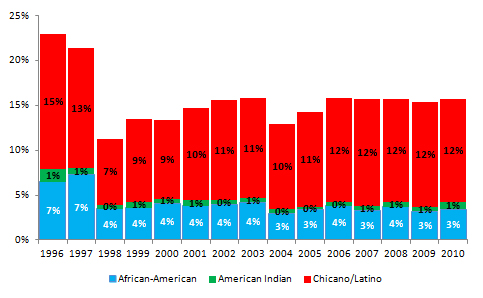
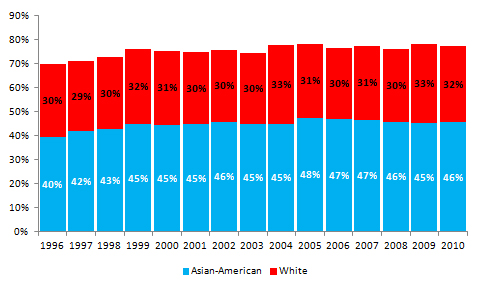
Since Californians banned affirmative action, enrollment of African-American, Latino, and American Indians has dropped meaningfully at the university.

Fall Admissions by Ethnicity, Source: University of California at Berkeley

Fall Admissions by Ethnicity, Source: University of California at Berkeley

The key question is the following:

Was the event racist and in bad taste, or was it justified based on the passage of an equally, if not more, offensive bill?

I look forward to hearing a lively discussion. I have included the following videos to provide some additional background information.

Posted in California, Education, Media, Policy, Politics | Tagged , , , , , | 1 Comment

Rick Perry’s Republican Class Warfare

“As the son of tenant farmers, I can promise you I wasn’t born with four aces in my hand.”

– Governor Rick Perry to Iowa GOP activists, not-so-subtly referencing Mitt Romney’s claim that Texas’ success had more to do with low taxes and a robust oil and gas industry than with Rick Perry’s leadership.

As if President Obama’s plan to transfer more wealth from the most productive part of society to the least productive weren’t enough, one Republican presidential candidate is engaging in his own form of class warfare.

In an email sent to Perry supporters last month, Perry’s aides noted that Mitt Romney had a net worth of more than $190 million. The note also reminded readers of Romney’s insensitive gaffe in June that he was “also unemployed.”

So what?

While it is true that Mitt Romney was born into a wealthy family, he used his own talents to forge his own successful career in business and politics. He distinguished himself at Harvard Business School, graduating as a Baker Scholar. He also earned a J.D., cum laude from Harvard Law School. He founded Bain Capital, a successful private equity firm in Boston, Massachusetts. Romney further brought great credit to himself by turning around “an Olympics mired in controversy and saddled with debt” as President and CEO of the Salt Lake Organizing Committee. Lastly, he served as a successful governor of Massachusetts.

I don’t like that Mitt Romney comes from a privileged background. I like him despite this fact. Continue reading

Posted in Leadership, Media, Politics, Texas | Tagged , , , , , , | 2 Comments

Obama’s “Buffett Rule”: Good Politics, Bad Economics

Pleasing the Proletariat

Obama’s call for increasing taxes on the wealthy is playing well with the ever-expanding ranks of the proletariat. According to a September 15-18th Gallup poll, 66% of respondents favored increasing income taxes on individuals earning at least $200,000 and families earning at least $250,000.

The results of this poll make a lot of sense as one would expect resentment from an ever-growing underclass. According to the U.S. Census Bureau, the nation’s poverty rate rose to its highest level last year at 15.1%. 46 million people- roughly the combined populations of California and Virginia – were officially poor, and the median income dropped by more than two percent to $49,445. The poverty rate among African-Americans and Hispanics is even worse at about 27% for each group.

Of course, President Obama’s response comes straight out of the Democratic playbook – attempting to raise those at the bottom up by dragging down those at the top. The Soviets tried this radical approach before, and the Russian people are still recovering from the ensuing wreckage.

Few become wealthy through being excessively frugal. Most do so because they find ways to increase their incomes by providing a valuable product or service to free markets. Similarly, the only sure-fire way to get the country out of the current economic morass is through tried-and-true economic growth.

Sadly, empirical evidence suggests that taxing the rich actually reduces GDP growth. Continue reading

Posted in Business, Finance and Economics, Mathematics, Policy, Politics, Taxes | Tagged , , , , , , | 50 Comments

Press Recession Mentions Presage Recessions

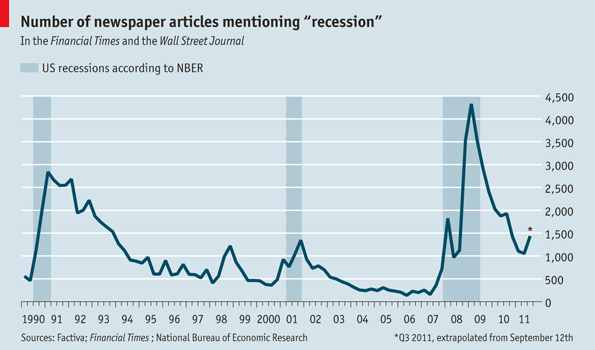
Source: The Economist

The Economist‘s Daily Chart blog publishes a lot of creative and fascinating charts each week. A little over a week ago, the blog published the chart above, which tracks the number of articles in the Financial Times and the Wall Street Journal that mention the word “recession.” Since 1990, as mentions of the r-word rise, so does the probability that the nation is in a recession.

As the chart above shows, it appears that the country is heading into one, or may well already be there.

Posted in Business, Finance and Economics, Policy, Politics, Predictions | Tagged , , , | 3 Comments

What Are Your Personal Brand’s Triggers?

I discovered another fun application this week called the F Score Brand Personality Test via Sally Hogshead’s book, Fascinate: Your 7 Triggers to Persuasion and Captivation. My favorite Canadian blogger recommended the book as a good way to help develop my blog’s brand. Hogshead identifies seven triggers: power, trust, mystique, prestige, vice, alarm, and lust. She believes that each “trigger leads to a different style of communication, and a different type of relationship.” The better people hone their personality’s fascination triggers, the more effectively they can deliver their messages.

The application administers a brief test that asks users 28 questions about their personalities. The application scores their answers to determine “which fascination triggers [they] naturally apply, which others [they] should consider, and how to refine them to become more persuasive.”

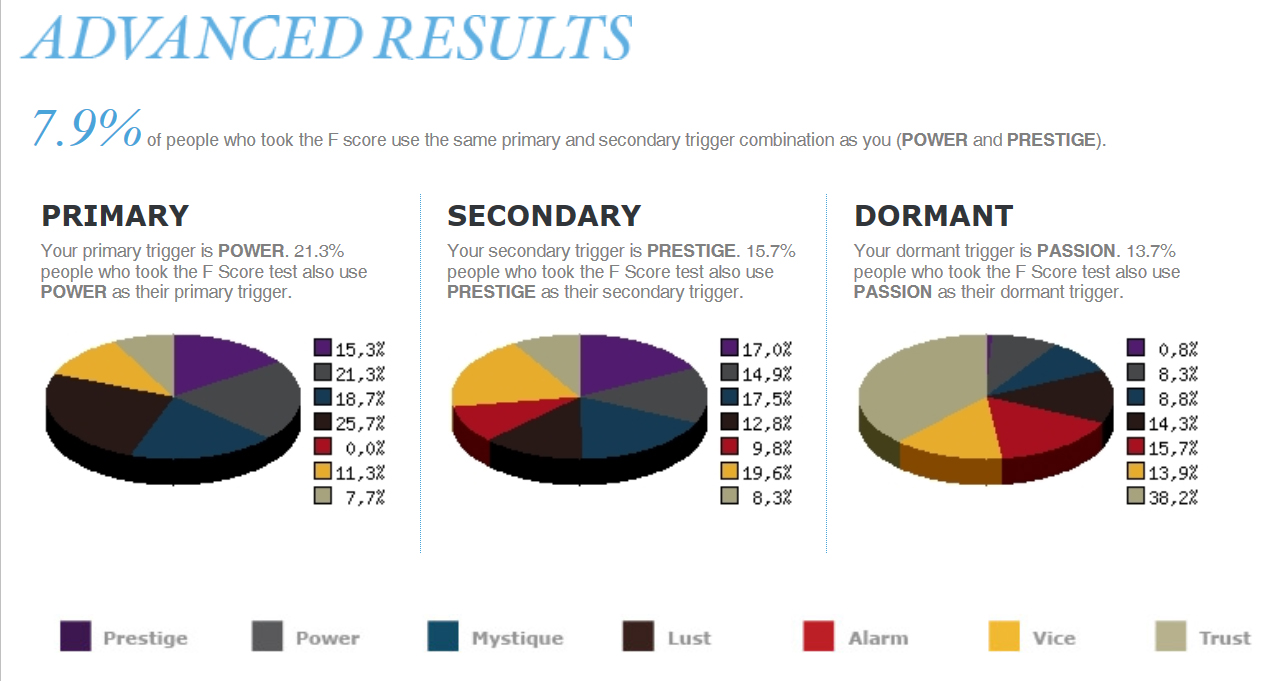
My primary and secondary triggers were power and prestige, respectively. My dormant trigger, the one I’m least likely to apply in my personality and behavior, is passion. Interestingly, according to Ms. Hogshead, having passion as a dormant trigger indicates that one’s “style of interaction tends to be more intellectual than ‘warm and fuzzy.'” Someone with this style prefers “to approach challenges rationally and methodically, rarely making decisions based on gut instinct.”

Hogshead has three videos that briefly describe these triggers:

Power

Prestige

Passion

There must be something to her methodology, because it describes my blog to a tee. Below are more detailed results.

Source: sallyhogshead.com

I encourage folks to take this “fascinating” test and post them on this site.

Posted in Blogging, Business, Media | Tagged , , , , , | 10 Comments

An Employer’s Perspective on Jobs and Regulations

Peter Schiff’s Congressional testimony last week provided more support to the argument that excessive government regulation stifles job creation. Agree or disagree, Mr. Schiff’s testimony is certainly entertaining.

Posted in Business, Finance and Economics, Policy, Politics, Socialism, Taxes | Tagged , , , | 6 Comments

Obama’s Partisan Debt Reduction Plan

The President released his debt reduction plan today. Based on its contents, it is clearer than ever that he is more concerned about his reelection prospects than solving the nation’s economic and fiscal woes.

President Obama again leads with his tiresome demonization of the “evil rich.” His plan notes:

“These measures include cutting tax preferences for high-income households,  eliminating tax breaks for oil and gas companies, closing the carried interest loophole for investment fund managers, and eliminating benefits for those who own corporate jets.”

I am fine with the president eliminating tax breaks for oil and gas companies so long as he also does away with wasteful programs that allow the government to make investment decisions that benefit party loyalists. An egregious example of this is the $535 million Solyndra default.

However, the President’s conspicuous singling out  of depreciating assets like corporate jets and carried interest from investment fund managers appears to be baseless scapegoating (more on that later). I suspect he is highlighting them only because he thinks it will play well in Peoria.

The plan seeks to reduce the deficit by a total of $3 billion from now until 2021. Of course, it claims $1.044 trillion that was already going to result from the American drawdowns in Iraq and Afghanistan. If one removes this number from the President’s plan as well as the debt service payments paid of $413 billion, one can get a better sense of the real proportion of deficit savings from spending cuts and tax increases.

The President’s plan contains $320 billion in Medicare and Medicaid cuts, as well as $257 billion in mandatory savings. It doesn’t touch Social Security, but it punishes active military personnel and military retirees who sacrificed at least twenty of the best years of their adult lives by cutting their medical benefits by at least $21.8 billion. This “savings” nets out to $130 billion after one deducts President Obama’s $447 billion jobs bill.

In contrast, the bill provides for $1.534 trillion in tax increases, which overwhelming “punish” high income households (over 81% of the revenue generated is from individual income and estate taxes). And if you believe that the government can raise this much money from only people making more than $200,000 a year, expect an unpleasant reality check should President Obama win the next election.

Unsurprisingly, the other headline terms that the wealth redistributors frequently use in their talking points are mere drops in the bucket. Eliminating special depreciation rules for corporate jets represent only 0.3% of the total proposed revenue increase. Closing the carried interest loophole for “evil” investment fund managers represents a meager 0.8%.

The bottom line is that the President’s deficit proposal consists of 8% spending cuts and 92% tax increases. Just because he put lipstick on his plan does not make it any less of a partisan pig.

Posted in Business, Finance and Economics, Policy, Politics, Social Security, Taxes | Tagged , , , , , , , , , | 13 Comments