Friedman Blames Israelis For Consequences of Arab Spring

Thomas Friedman appears to be attempting to distance himself from the disastrous consequences of all the columns on the Arab world he wrote over the past few years. These op-eds predicted the “wonders” of democracy would miraculously bring hope and rationality to the Middle East. This weekend, Friedman had the gall to blame the Israelis for not better accommodating millions of Arabs who would happily pursue a second Jewish Holocaust were the Israelis not so competent at defending themselves.

He begins his column breathlessly with:

“I’ve never been more worried about Israel’s future. The crumbling of key pillars of Israeli’s security — the peace with Egypt, the stability of Syria and the friendship of Turkey and Jordan — coupled with the most diplomatically inept and strategically incompetent government in Israel’s history have put Israel in a very dangerous situation.”

He elaborates further:

“Israel is not responsible for the toppling of President Hosni Mubarak of Egypt or for the uprising in Syria or for Turkey’s decision to seek regional leadership by cynically trashing Israel or for the fracturing of the Palestinian national movement between the West Bank and Gaza. What Israel’s prime minister, Bibi Netanyahu, is responsible for is failing to put forth a strategy to respond to all of these in a way that protects Israel’s long-term interests.”

Friedman may indeed worry about Israel’s future; however, his idealistic notions of democracy leading to puppies and butterflies for everyone in the Arab world were at best naive. Continue reading

Posted in Defense, Energy Security, International Security, Middle East, Peak Oil, Policy, Terrorism, War | Tagged , , , , , , , , | 15 Comments

The Road to Oblivion Is Paved with Noble Liberal Intentions

Recently, I had the opportunity to watch one free night of cable during a brief hotel stay, and decided to tune in to Fox News. When I heard a commentator railing against a provision in President Obama’s jobs bill that “would make it illegal for employers to run advertisements saying that they will  not consider unemployed workers, or to refuse to consider or hire people because  they are unemployed,” I was skeptical. So I decided to check the proposed legislation’s actual text.

It turns out that some well-intentioned but sadly misguided individual did, in fact, add such a nonsensical provision. Continue reading

Posted in Business, Finance and Economics, Policy, Politics, Socialism | Tagged , , , , , , | 6 Comments

Living Laffer

Tonight, I flew into New York for business. On the way to my hotel, I had a long, illuminating conversation with my taxi driver, who also happened to be a small business owner.

It wasn’t long before John (not his real name) started complaining about the costs of running his business in a city as expensive as New York. For example, my 30 minute ride from JFK was over $60. He was particularly upset about New York’s taxes and revenue enhancement programs like traffic cameras. To him, the city seems to have installed traffic cameras at nearly every corner, in order to squeeze as many dollars from its citizens as possible.

He also complained about high regulatory costs. To operate a cab in New York, the city requires taxi owners to purchase a medallion. The city limits the number of medallion holders to 13,000 (according to John). This limit prevents the market for taxis from collapsing. Otherwise, the barriers to entry are so low that prices would drop to a point where few would find it profitable to run a taxi business. Or so the city would have people believe. Of course, consumers would likely pay far less without the rationing. However, this point is an argument for another day.

According to John, medallions are going for $705,000 apiece – more than the cost of most residences.

Curious, I asked him how much revenue he earned a month. He said about $9,000. I then asked him how he could afford a $705,000 medallion. He responded that he only paid $335,000 when he bought his several years ago. To pay for it, he took out a loan. He now pays $3,600 each month in principal and interest – more than most Americans pay for their mortgages.

I quickly did the math in my head. If New York is remotely as bad as California, he would lose about half his revenue to state, local, and federal taxes. So, he would have about $900 each month for food, gas, and rent, after taxes and debt service.

I asked him how he managed to keep his business from collapsing. His answer was priceless:

“If you had paid me in cash, I wouldn’t have reported the transaction.”

It appears there is something to the Laffer curve after all. If government taxes people too highly, revenue will start to decline as people exploit more loopholes or bypass the system altogether.

Posted in Business, Finance and Economics, Policy, Politics, Taxes | Tagged , , , | 9 Comments

Arab Spring Fallout: Egyptian Mob Overruns Israeli Embassy

In February, I predicted that Egypt’s democratic revolution would lead to a rise in regional instability, particularly between Egypt and Israel. Late last month, I argued that Egypt’s transition to democracy was entering an extremely unstable phase, after thousands of protestors surrounded the Egyptian Embassy; the Egyptian government then announced that it would be recalling its ambassador from Tel Aviv (the decision was later reversed).

This past weekend, an Egyptian mob “scaled the walls of the Israeli Embassy to tear down its flag, broke into offices and tossed binders of documents into the streets.” It was not until protestors beat up an Israeli employee that the Egyptian military finally intervened. During the melee that lasted several hours, the mob used “hammers and broken poles to break through sections of the wall” surrounding the Israeli embassy. They then used “ropes attached to cars to pull away sections. By the end of the night, the wall was virtually demolished.” Continue reading

Posted in Defense, Energy Security, International Security, Middle East, Policy, Politics, War | Tagged , , , , , | 2 Comments

9/11 in Numbers (Part III): How Have Things Changed?

Since 9/11, the government and most individuals are in weaker financial health, government has aggressively expanded, and the United States appears to be in a weaker position as a global superpower. That said, the United States still remains unmatched militarily, and still has the highest GDP on the planet.

Weaker Financial Health

Since 9/11, America’s financial health has deteriorated. Its credit rating has declined from AAA status to AA+. Debt as a percentage of GDP has risen from 32.5% to 72%, and total debt has nearly tripled from $5.8 trillion to $14.7 trillion. The U.S. went from running a 1.3% surplus in FY2001 to a 10.9% deficit in FY2011.

The average American has also experienced a real decline in income. In 2001, the median income in constant 2009 dollars declined from $51,161 in 2001 to $49,777 in 2009. Meanwhile, the price in constant dollars to attend a four-year college has grown by 28% from 2001-02 to 2009-10.

Americans investing in the stock market lost money in real terms from 2001 to 2011, with the S&P 500 growing at a compound annual growth rate of 0.55% in nominal terms.

Despite popular opinion, aggregate income distribution has remained roughly flat from 2001 to 2009. In 2001, the top 5% of families earned 21.0% of the country’s aggregate income. In 2009, that number dropped slightly to 20.7%. Furthermore, the United States’ Gini ratio (a measure of inequality) increased by only 1.8% from 0.435 to 0.443.

Bigger Government

By most measures, there has been a dramatic expansion of the federal government since 9/11. In FY2001, government represented 18.2% of GDP. By FY2011, it had grown to 25.3% of GDP, primarily driven by a massive expansion of both military and entitlement programs. The defense budget nearly tripled from FY2001 to FY2011, and the total number of active military personnel grew by 3.6%, as the United States fought three wars simultaneously. Food stamp participation also nearly tripled from 17.3 million to 45.2 million people. The number of Social Security recipients also increased by over 50% from 2001 to 2011. Finally, the number of Medicaid participants increased 47% between 2001 and 2010, with a projected further 5.4 percent increase in 2011 according to a recent report by the National Association of State Budget Officers.

The United States Remains a Superpower with Diminished Capability

Not only has the U.S. government’s fiscal health diminished, but also the country’s broader economic situation has weakened. While the United States has increased its debt by 154%, its GDP has only grown by 45.5%.

The United States has also ceded certain elements of prestige. For instance, in 2001, the United States had 4 space shuttles. Today, it has none. Its nuclear arsenal included over 6,000 warheads in 2001. Now, it likely has less than 2,000. Meanwhile, the world added one new member to its nuclear club during the past decade bringing the total number of nuclear powers to 9.

A comprehensive chart outlining many of these key differences is included below:

Posted in Business, China, Clean Energy, Clean Tech, Climate Change, Defense, Energy Security, Finance and Economics, Middle East, Nuclear Power, Peak Oil, Policy, Solar, Taxes, Technology, Wind | Tagged , , , , , , , , , , , , , , , , , , , | Leave a comment

9/11 in Numbers (Part II): Climate and Energy

Since 9/11, climate data appears mixed, while energy consumption in the United States has undergone a notable amount of change.

Climate

Measures of climate change present a mixed picture for the United States. While the average global monthly concentration of carbon dioxide has increased by over 6% from 368 ppm to 391 ppm from September 2001 to June 2011, greenhouse gas (GHG) emissions in the United States have actually declined by 3.4% from 2001 to 2009, the latest date for which this information is available. That said, the decline in American GHG emissions is likely due to reduced economic activity associated with the financial crisis in late 2008.

Energy

Since 9/11, the United States appears to have been moving in the right direction in terms of increasing its energy independence. It is less dependent on the OPEC oil cartel, and has increased its share of energy consumption from geothermal, solar, and wind resources. That said, its investment in clean base load power generation from nuclear energy has changed very little. While the United States has increased its energy consumption from nuclear power plants, it still has the same number of nuclear power plants now as it did at the beginning of the decade. Additionally, crude oil and gasoline prices have increased precipitously, and offshore drilling activity is down sharply.

Since 9/11, energy consumption in the United States showed the following trends:

  • Crude oil prices have more than tripled
  • Gasoline prices have more than doubled
  • Petroleum imports from OPEC have declined by over 18%
  • The number of offshore oil and gas rigs in operation has declined by over 75%
  • The United States has not built a single new nuclear power plant
  • Wind energy consumption is over 13 times what it was in 2001
  • Solar energy and geothermal energy consumption are up over 70% and 29%, respectively.

A comprehensive chart outlining many of these key differences is included below:

Posted in Clean Energy, Clean Tech, Climate Change, Energy Security, Middle East, Nuclear Power, Peak Oil, Policy, Solar, Wind | Tagged , , , , , , , , , , , , , | Leave a comment

9/11 in Numbers (Part I): The U.S. Military

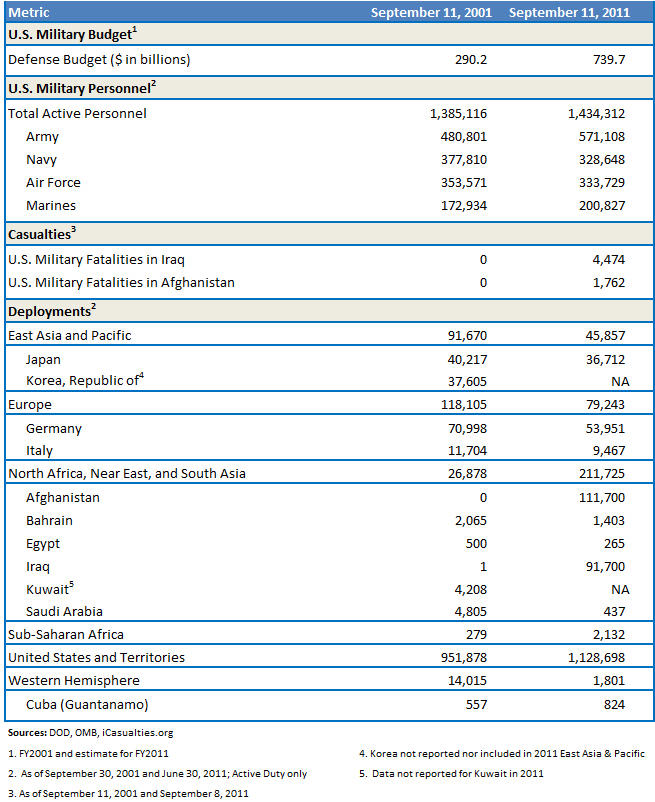
Since 9/11, the United States military has changed in several fundamental ways. Here are just a few of them:

  • The Defense budget grew by 155% from FY2001 to FY2011
  • The number of active military personnel increased by 3.6%
  • The Army and Marine Corps grew by 18.8% and 16.1%, respectively
  • The Navy and Air Force shrank by 13.0% and 5.6%, respectively
  • The U.S. military suffered a total of 6,236 fatalities from September 11, 2001 to September 8, 2011 in Iraq and Afghanistan
  • The number of U.S. military personnel in Europe shrank by 32.9%, but increased by 687.7% and 664.2%, respectively, in North Africa/Near East/South Asia, and Sub-Saharan Africa
  • The number of U.S. troops stationed in Saudi Arabia, from which 15 of the 19 hijackers originated, declined by 90.9%

A comprehensive chart outlining many of these key differences is included below:

Posted in Central Asia, Defense, Energy Security, International Security, Middle East, Policy, Terrorism, War | Tagged , , , , , , , , , | Leave a comment

President Obama’s Jobs Speech: Marxism Redux?

Scapegoating one group of people to convince the rest to follow your self-destructive policies blindly into oblivion is the way of demagogues. President Obama’s speech tonight teetered dangerously on the edge of this technique.

I was hoping the President would boldly announce a tax-repatriation holiday for American corporations in exchange for increased hiring in the United States. Given that American corporations hold roughly $1 trillion overseas, such a measure would potentially be a boon for hiring. Alas, the President’s economic team ruled it out, and the country missed out on a huge and cheap opportunity to drive job creation.

I was also expecting the President would call for the reduction of the one of the highest corporate tax rates in the world in exchange for eliminating tax loopholes. Fortunately, he did include some version of this proposal. That said, I will reserve my judgement until the President releases the full details.

However, the meat of the President’s proposal boiled down to one theme:

Wealth redistribution.

This twisted economic ideology has left little but misery the world over, from Russia’s Bolshevik Revolution to the Stalinist purges in the 1930s to China’s brutal cultural revolution. It is a failed ideology that consigned millions of human beings to hopelessness and abject misery.

The President’s speech often seemed to offer little but bitter and partisan class warfare. It harkened back to the days when Marxists issued rallying cries to their ideological and “noble” red-shirt proletariat to unite against the “evil” bourgeois corporatists.

Did President Obama really intend to call for a naked wealth transfer from one group of Americans to another, in the name of “fairness”? Never mind that the “scapegoats” already bear the vast majority of America’s financial burdens. Never mind that this is the same policy this administration has been pursuing with little success for the last two and a half plus years.

And this line is just priceless, because it is an outright lie:

“This isn’t political grandstanding. This isn’t class warfare. This is simple math.”

Mr. President, you’ve lost me.

Posted in Business, China, Leadership, Policy, Politics, Socialism, Unions | Tagged , , , , , , , | 46 Comments

Why Texas Governors Don’t Go to Prison

Rick Perry’s aide gave a beautifully roundabout answer to a recent question about the blatant quid pro quo that marked his reign as Governor.  The spokesman explained, “There’s never been any wrongdoing substantiated.”

Nor will there be.  Remarkably, Perry’s probably done nothing illegal in his tenure.  One of the benefits of living in a state with hardly any rules is…well, it’s hard to break the rules.

The unique system of payola that makes Austin run is not only legal, it is startlingly public.  A politician in Texas can, and for all practical purposes really must, franchise himself to a set of well-financed individuals or interests, and become their representative in Austin.  It is how the system is designed to work. Continue reading

Posted in Business, Finance and Economics, Leadership, Policy, Politics, Texas | Tagged , , , , | Leave a comment

Music During 9/11

People have a tendency to develop emotional memories after a particularly traumatic event. Sometimes they are able to repress these memories, only reminded of them after hearing a sound or a song that brings them back.

While I was fortunately spared the worst effects of 9/11, these events were a time of great uncertainty in my life. At the time, I was the executive officer of Alpha Troop, 1st Squadron of the 11th Armored Cavalry Regiment, and my unit’s primary responsibility was to train American brigades for combat operations. Tens of thousands of soldiers and officers I had trained over the prior two-year period would soon be going to war.

During the time, I experienced only two emotions: anger and melancholy. I decided to revive these memories in anticipation of 9/11’s tenth anniversary by including some links to music that was popular at the time, and that reflected my mood. Continue reading

Posted in California, Defense, Energy Security, International Security, Media, Middle East, Policy, Politics, Terrorism, War | Tagged , , , , , | Leave a comment