Bush vs. Obama: Unemployment (May 2011 Jobs Data)

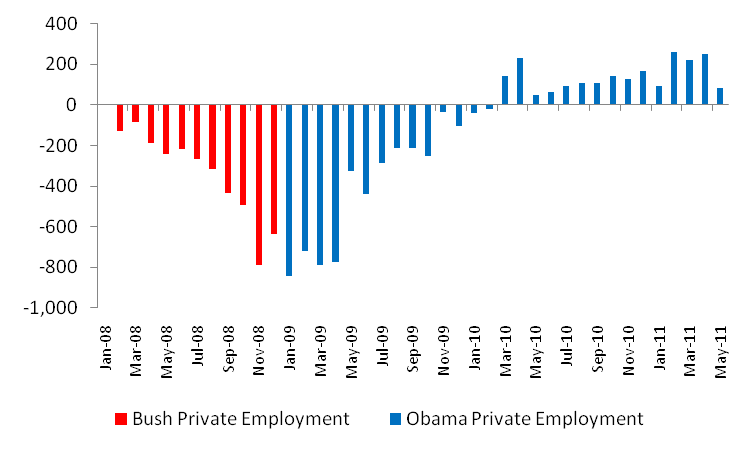
Change in Total Private Employment (in thousands), Source: U.S. Bureau of Labor Statistics

Update: Click here for the most recent jobs statistics.

I posted an article last month that compared the unemployment rate under President George W. Bush with the unemployment rate under President Obama at that time. I felt compelled to publish this article because some left-leaning sites were comparing Obama’s first two years and four months in office with Bush’s last and worst economic year (the above chart shows the most recent incarnation of this narrative).

In light of yesterday’s jobs numbers and the fact that both liberals and conservatives have been using my charts in flame wars, I decided to continue the tradition and post an update. Continue reading

Posted in Business, Finance and Economics, Media, Policy, Politics | Tagged , , | 240 Comments

Romney Is Officially In

Yesterday, Mitt Romney officially declared his candidacy for President of the United States.

Because the Republican Party has traditionally supported the candidate it presumes has “paid the most dues”, it is likely that Romney will secure the Republican nomination.

On the one hand, Romney has some attractive qualities. For one, he looks Presidential. He also has decades of experience turning around businesses. For an economy with 9.0% unemployment, this expertise will be a valuable asset in the general election.

On the other hand, Romneycare has been a complete disaster. After the program’s implementation, healthcare costs now consume more than 30% of Massachusetts’ budget. Romney also has a well-earned reputation as a flip-flopper, which he will likely find hard to shake in the general election.

I would wish Romney luck if I thought it might help. But I don’t.

Posted in Business, Healthcare, Media, Policy, Politics | Tagged , , , | 5 Comments

War Experiments Follow-up

Nearly two weeks ago, I tried a brief experiment to test Eli Pariser’s contention from his recent book, that Google’s use of 57 signals to personalize someone’s search results leads to a filter bubble.

I also promised to include a second post with more results from readers. Below are their screenshots along with those posted on Saturday.

I also included some shameless plugs for their blogs.

Enjoy!

Continue reading

Posted in Blogging, Business, Media, Politics, War | Tagged , , , , , , , | 6 Comments

Take Advantage of the News Cycle: Ten Lessons From Four Months of Blogging (Part VI)

Understanding the news cycle is critical for any blogger because potential readers are more likely to come to a blogger’s site if it offers content on a hot topic. As such, an important part of your blogging strategy should focus on generating content relevant to a trending news topic.

How do you find out what’s trending? Continue reading

Posted in Blogging, Business, Education, Mathematics, Media, Predictions, Writing | Tagged , , , , , , , , | 6 Comments

Political Typology

I discovered another fun application on the Pew Research Center website last week that is very similar to the Political Compass. The application administers a brief test that asks users a host of political questions. It then classifies them in one of 9 categories. Here are my results:

Source: Pew Research Center

I encourage folks to take this test and post the results on this site.

Posted in Business, Finance and Economics, Media, Policy, Politics | Tagged , , , , , , | 31 Comments

Remembering Jay on Memorial Day

The cross-currents of individual lives can be interesting things. Through time we each follow our own paths. On occasion, these paths intersect unexpectedly with those of greater men and women.

During my life, my path crossed several times with one of my generation’s finest.

I met Jay in high school. He was a serious, quiet, and determined person. He was also one heck of an athlete, leading my high school soccer team to the State Championship as its all-star goalie.

Opting for a more serious life dedicated to service, Jay applied for and received an appointment to the United States Military Academy at West Point.

After we graduated from high school, I never considered that my path might cross with Jay again during my military career.

But alas, the military community is a small one.

When Jay arrived at the National Training Center, I was happy to see him again.

Life has a funny way of timing things. Coincidentally, our daughters were born a day and one room apart in the same hospital ward.

During my last year of military service in the 11th Armored Cavalry Regiment, I was thrilled to learn that Jay would command Echo Troop, Alpha Troop’s sister company, where I had served as an executive officer.

I knew the soldiers of Echo Troop well. At the National Training Center Alpha and Echo Troop served together every month as a Soviet-style Motorized Rifle Battalion. We ate together and we trained together.

Before leaving the high Mojave desert forever, I came to see Jay one last time to make sure he knew what great soldiers he would command.

It was the last time I would ever speak to him.

Twenty months later, while sitting in the comfort of a business school classroom in Massachusetts, I learned that Jay would not be returning home to his family.

Exemplifying the principle of leadership by example, Jay was personally inspecting a vehicle at a traffic control point in Iraq when a vehicle-borne improvised explosive device detonated.

He died on April 29, 2005.

Jay was a quiet and serious officer who cared deeply about his soldiers and his country. His integrity, loyalty and selfless service were impeccable. He made the ultimate sacrifice so that others may live in freedom and for that we all owe him a great debt.

Jay, I still sorely miss you.

Posted in California, Defense, Energy Security, Middle East, Terrorism, War | Tagged , , , , | 6 Comments

Warming up to Huntsman

In the absence of any more compelling Republican candidates, I am finding myself warming up to Jon Huntsman.

Why? Continue reading

Posted in Business, China, Climate Change, Finance and Economics, Media, Policy, Politics, Taxes | Tagged , , , , , | 6 Comments

Western Strike on Iranian Nuclear Sites More Likely

Earlier this week, The New York Times reported that the International Atomic Energy Agency (IAEA) possesses evidence that the Iranians worked on nuclear triggering technology.

This technology has only one purpose: to set off a nuclear weapon.

More importantly, the inspectors concluded that Iran has started recovering from the Stuxnet cyber worm that infected its nuclear program two years ago. The country is now producing “low-enriched uranium at rates slightly exceeding what it produced before” the attack.

The IAEA also has evidence that Iran conducted “studies involving the removal of the conventional high explosive payload from the warhead of the Shahab-3 missile and replac[ing] it with a spherical nuclear payload.”

Now Western intelligence estimates Iran is at least a year, and most likely, several years away from assembling a nuclear weapon.

With American forces drawing down in Iraq, the United States is in a much better strategic position to deny Iran nuclear capability. Furthermore, there is widespread Arab support for a strike on Iran’s nuclear infrastructure, especially among the Gulf Arabs.

Additionally, the Israelis will likely continue to push for military action on the basis that a nuclear-armed Iran would pose an existential threat to Israel.

Whether it is the right policy or not, I fear that the conditions are ripe for action against Iran in the next several years.

Only time will tell.

Posted in Defense, Energy Security, International Security, Middle East, Nuclear Power, Nuclear proliferation, Policy, Politics, Terrorism, War | Tagged , , | 4 Comments

More Ridiculousness from Right- and Left-wing Punditry

Earlier this week, liberal radio show host and MSNBC pundit Ed Schultz called right-wing darling Laura Ingraham a slut on his radio program.

Above is his apology followed by his original on-air comments.

The contrite groveling to which Schultz must subject himself seems a bit much, but I guess it is par for the course in an overly politically sensitive environment. Continue reading

Posted in Business, Media, Politics | Tagged , , , , | 11 Comments

California Releases 130,000 Prisoners Each Year: An Expert’s Perspective with Special Guest Jesse Jannetta

Sean invited me to share what perspective I have on the implications of Monday’s Supreme Court opinion requiring California to reduce its prison population by 33,000 (or 46,000, depending on which justice’s numbers you accept).

This is a personal blog post, and the opinions expressed here are my own and not those of the Urban Institute.

As a starter, I recommend Michael Gerson’s column in this week’s Washington Post. You could come to different conclusions about whether the Supreme Court did what it needed to do, but there’s little question that it was the California Legislature’s failure to do what it needed to do that obliged them to weigh in on the prison crowding issue. Gerson did a good job elaborating on this point.

Much of the commentary on the potential impact of the decision conflates prison population reduction with releases. Even the lower of the two numbers the justices flagged is big enough (there are 35 states that don’t have 30,000 people in their entire state prison system) that some number of early releases are going to be part of their strategy to reduce population. But much of the prison population reduction may come from incarcerating people in places other than California prisons. CDCR (California Department of Corrections and Rehabilitation) has already seen its adult institutional population fall by nearly 20,000 since 2006: over that same period, California went from a couple hundred to 10,000 inmates held in other states (Arizona, Mississippi and Oklahoma).

The recently passed “public safety realignment” plan (AB 109) would allow for holding sentenced felons in county jails for up to three years, as opposed to the previous limit of one year. It will not go into effect until the Legislature creates a community corrections grant program to assist with implementation, which has yet to be done. There are counties that have excess capacity in their jail systems (like Orange); others would presumably have to figure out how to drop their current population to make room.

Still, there are going to be some releases that will happen earlier than they would in the absence of overcrowding. This should be understood in the context of the 130,000 releases from prison that happen in the normal course of business in California. Practically everyone in prison gets out eventually, and the status quo for the people getting out now is pretty bad. CDCR Secretary Matthew Cate noted that crowding prevents the delivery of programming and contributes to inmate idleness. Crowding does this directly by forcing CDCR to have people sleeping in space where programming could be done, and indirectly by contributing to violence and disorder within facilities. In the aftermath of such incidents, inmates are locked down in their cells and can’t do anything. This is the situation from which huge numbers of prisoners are returning to the streets every day, right now.

If you’re wondering why the number of releases is nearly equal to the entire California prison population, about half are people re-released after a return for parole violations. Parole violators can’t be returned for more than a year, and the average time in prison for a parole violator is less than five months. A subset of parolees get sent back for violations over and over, and these “churners” eat up a substantial number of prison beds. This is why one strategy has been to make it impossible to return some parolees to prison by placing them on “non-revocable parole.”

The thing I’ll be watching in California is how, and whether, the state is able to resolve the tension between the mandate to reduce population and the reluctance to assume responsibility for risk management decisions. Prison (and jail) beds in California are a scarce resource, which requires thoughtful decisions about how they should be used. An illustrative example of how difficult this is to do in practice is the first case that came up for “medical parole” (i.e. letting people out who are incapacitated by medical ailments). How incapacitated is incapacitated enough to be an acceptable public safety risk in the community? Apparently, being a quadriplegic is insufficient.

Source: Jesse Jannetta

Jesse Jannetta is a research associate in the Urban Institute’s Justice Policy Center. He directs projects relating to community supervision and reentry from both prison and jail. He is the project director for the Transition from Jail to Community Initiative, and the principal investigator for the process evaluation of the Transition from Prison to Community Initiative.

Before joining the Urban Institute, Mr. Jannetta was a research specialist at the Center for Evidence-Based Corrections at the University of California, Irvine, where his work included projects on GPS monitoring of sex offender parolees, policies on parole discharge and violation response, and assessment of the California Department of Corrections and Rehabilitation’s programs according to the principles of evidence-based design. He holds a master’s degree in public policy from the John F. Kennedy School of Government at Harvard University.

Posted in California, Politics, Special Guests | Tagged , , , , , , | 3 Comments