Obama Spoof Getting More Hits Than Real Obama

I want to thank the Dividest over at Divided We Stand United We Fall for sharing the observation by Ben Smith at Politico that the GOP parody of President Obama’s first reelection ad is generating far more hits than the President’s real ad.

When I last checked, the original ad had 310,707 hits, while the GOP’s parody has 1,025,249. It turns out that the GOP may be learning a thing or two about creating a successful viral social media campaign.

Interestingly, Obama’s original ad had 3,282 dislikes vs. 2,961 likes on YouTube, while the GOP parody had 6,760 likes vs. 1,036 dislikes.

Here is the original Obama campaign ad:

Here is the GOP’s parody of it:

Posted in Business, Energy Security, Finance and Economics, Healthcare, Humor, Media, Policy, Politics | Tagged , , , , , | 2 Comments

Americans Have More Pragmatic Views on Energy Policy Than Their Leaders Do

One frustration that I have always had with both the Republican and Democratic energy policies is that neither solves America’s energy problems. On the one hand, the Democratic strategy would result in the nation’s economic collapse in twenty years or so. On the other hand, the Republican strategy would push this collapse out about a decade relative to the Democratic strategy. Either way, America is screwed.

The Democratic plan would result in America running out of cash before it has time to develop fossil-fuel alternatives. Without increased domestic drilling, persistently high oil prices would drain many of the dollars the country could invest in alternative fuels development.

The Republican plan would allow the economy to function for a little longer because more domestic drilling would likely keep petroleum prices lower than the Democratic plan would. However, a dearth in development dollars would leave the country in the lurch once global oil supplies ultimately dwindled.

The obvious solution is to have a mixture of both. The Republican plan would serve as a bridge to the Democratic plan. That way, the country could ideally make a smooth transition from a fossil-fuel economy to a green one.

It turns out that Americans agree with this solution. According to Gallup, more than three-quarters of Americans support increased government financial incentives to produce energy from alternative sources. Two in three Americans also think the government should support or increase energy production from oil and natural gas.

Sounds like a plan to me.

Posted in Business, Clean Energy, Clean Tech, Energy Security, Policy, Politics, Solar, Wind | Tagged , , | 6 Comments

A Responsible Endgame for Libya

It appears that the Obama administration appears interested in negotiating a cease-fire between the two Libyan camps after all. Of course, Qaddafi’s stepping down will likely be a precondition.

Former United States Representative Curt Weldon, who has had diplomatic contact with Qaddafi’s family in the past, is currently leading a private delegation to Libya to persuade Colonel Qaddafi to step aside.

It will be a difficult ask, but hopefully it turns out to be a successful mission.

Posted in Defense, Energy Security, International Security, Middle East, Policy, Politics, War | Tagged , , , | 3 Comments

Who Are the Libyan Rebels?

Source: Jason Pack, Foreign Policy Magazine

I came across this interesting article today on Foreign Policy‘s website.

It concludes that the Libyan opposition has two faces: the politicians and the fighters. Furthermore, the fighters are divided into three major camps.

The first camp includes “a ragtag bunch of men of all ages and degrees of military training riding pickup trucks around the eastern coastal desert.” The vast majority of these fighers tend be ad hoc, squad-level units with little organization and combat experience. Most of them have never been on the frontlines in the current conflict.

The second group includes former Eastern Libyan military units, who defected from Qaddafi’s regime. For unknown reaons, these units have rarely participated in the current fighting.

The final group consists of the Islamists. Of this group, a “minuscule inner core fought in Afghanistan alongside Osama bin Laden in the 1980s and created the Libyan Islamic Fighting Group (LIFG) upon their return to Libya in the early 1990s.”

While the article is somewhat confusing on this point, it seems that the majority of the fighters at the front are the first group of untrained, non-ideological, ad-hoc units. That said, the bulk of these fighters have yet to fight on the front lines.

Jason Pack, the article’s author, also suggested that much of “eastern Libya remains traditional and religiously conservative.” However, he does not expect this religious conservatism to be much of a problem for Westerners. On the contrary, he sees Islam as a “uniting” and “stabilizing” force in Libya.

I disagree, but only time will tell.

Posted in Defense, Energy Security, Middle East, Policy, Politics, War | Tagged , , , , , , , | 1 Comment

Reining in the Red Queen: Winning Wars with Science

Source: ©2011 Reflections of a Rational Republican

The most recent issue of The Economist included a tantalizing article about the behavior of complex systems. The system in question was the interaction between coalition forces and insurgents in Afghanistan.

According to Professor Neil Johnson, the relationship between the coalition and insurgents exhibits a mathematical relationship much like that of the dynamic between a predator and its prey. This relationship models an arms race between an adaptive Red Queen (i.e., insurgents) and her counter-adapting Blue King opponent (i.e., coalition military).

Professor Johnson’s research shows that the formula (Tn = T1n-b) has been remarkably predictive in determining the course of an insurgency in several Afghan provinces. Tn represents the number of days between the nth fatal attack and its successor. T1 represents the number of days between the first and second fatal attacks. The variable b is the single most important variable in the equation because it determines the course of the insurgency. A large positive b is ideal for the insurgency because it reduces the number of days between fatal attacks, while a negative b favors the coalition because it increases the number of days between fatal attacks.

This key insight could have a transformative effect on the future nature of warfare.

Here is a brief example of how the equation works. As the graph below shows, a higher b results in a much more rapid decrease in days between subsequent fatal attacks as an insurgent force conducts more attacks over time. In essence, the insurgents with b = 0.75 are learning more rapidly than the insurgents with b = 0.25. Therefore, the key for any future counterinsurgency campaign is to make every effort to maintain a very low or negative b.

Source: ©2011 Reflections of a Rational Republican

Achieving this goal in practice is difficult. However, by using this mathematical relationship a priori in future counterinsurgency campaigns, the American military can better project which insurgent groups will likely become more persistent and allocate resources accordingly.

Posted in Mathematics, Science, War | Tagged , , , , | Leave a comment

Hope Isn’t Hiring

Today, the GOP has begun its official campaign to unseat President Obama. The title of the campaign is brilliant: “Hope Isn’t Hiring” because it is both simple and true.

However, Republicans still haven’t quite figured out the whole social networking technology thing yet. This is in contrast to President Obama’s artful mastery of it in 2008 under the leadership of Chris Hughes of Facebook fame. For instance, when I tried to embed the GOP’s first anti-Obama commercial in this blog, I was blocked from doing so.

So, begrudgingly I have included the link here.

I also want to thank Moe at Whatever Works for alerting me to the fact that the political campaign commerical season has officially begun. At least the Democrats have allowed her to embed Obama’s commercial in her blog.

Edited to Add: GOP YouTube video. It turns out that one can embed the video if one removes the “s” from “https” in the YouTube address. Thanks, Maggie!

Posted in Politics | Tagged , , | 23 Comments

A Way Out of Libya: Let’s Hope President Obama Takes It

Yesterday, The Washington Post reported that the Qaddafi regime has recently launched a diplomatic offensive aimed at some of America’s NATO allies. Libyan Foreign Minister Abdulati al-Obeidi expressed his country’s desire to end the conflict on Friday saying:

“We are trying to talk to the British, the French and the Americans to stop the killing of people. We are trying to find a mutual solution.”

The President should use Libya’s tentative olive branch as an opportunity to negotiate a cease-fire between the conflict’s two belligerents and to encourage Qaddafi to step down. At worst, the United States can gracefully exit the conflict and leave Libya a peaceful, but divided country. At best, the President can convince Qaddafi to leave by allowing him to save face. He can also then help the Libyan people establish a framework for a united and democratic Libya.

Only time will tell. 

Posted in Defense, Energy Security, International Security, Middle East, Policy, Politics | Tagged , , , | Leave a comment

Reality Check for Employment Gains Euphoria

I found this interesting graph via The Economist, which sourced it from Calculated Risk.

Source: calculatedriskblog.com via The Economist

It should serve to temper faux euphoria over the wonderful employment gains the country saw in March 2011. As this chart clearly shows, the country is still in the midst of an economic disaster.

Posted in Business, Finance and Economics, Policy, Politics | Tagged , , | Leave a comment

Bush vs. Obama: Total Private Sector Employment

Change in Total Private Employment (in thousands), Source: U.S. Bureau of Labor Statistics

Update: Click here for the most recent jobs statistics.

Some left-leaning sites have pointed to the chart above as a sign that Obama’s economic policies are a smashing success  because total private sector employment has consistently increased in the last thirteen months.

However, the problem with this chart is that it misleadingly shows Bush’s last year in office, his worst year, as a foil to Obama’s first two years and three months in office.

This selective presentation of the data makes Bush’s record look abysmal compared to President Obama’s numbers.

However, the unemployment rate is currently a whopping 8.8% and it still has not declined to President Bush’s 7.3% high in December 2008.

Unemployment Rate, Source: U.S. Bureau of Labor Statistics

Furthermore, if one includes President Bush’s entire record, it looks far better than President Obama’s record to date. Over President Bush’s entire presidency, the private sector created a net 188,000 jobs (not including January 2001 data). Surprisingly, this number includes the 3.78 million private sector jobs lost in 2008.
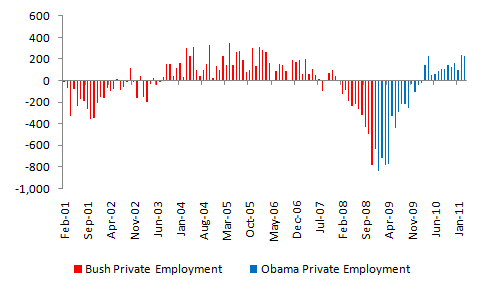
Change in Total Private Employment (in thousands), Source: U.S. Bureau of Labor Statistics

In contrast, under President Obama’s administration, the private sector lost a net 3.25 million private sector jobs.

The point of this argument is not to assess blame on either administration’s policy. It simply puts the left’s claims in perspective.

For every job that the private sector created under George W. Bush, the private sector eliminated 17.3 jobs under Barack Obama. While the private sector job outlook has certainly improved, the economy still must create 3.25 million private sector jobs to break even. Until then, it is disingenuous for the left to claim that President Obama’s economic policies are a resounding success.

Posted in Business, Finance and Economics, Policy, Politics | Tagged , , , | 76 Comments

Falling for the Lipstick and Missing the Pig: Obama’s Energy Policy

Well, it turns out that I failed to read the fine print yesterday before I published an article praising Obama’s new energy policy. I read the President’s speech and agreed with many of the proposals he recommended, but I also warned that the devil was in the details.

Upon reviewing the administration’s more detailed, Blueprint for a Secure Energy Future, it turns out there was more than just one devil. It also leads me to believe that some in the administration probably thought no serious conservatives would bother to read the President’s plan.

In this context, the President’s speech appears to be more about improving his reelection prospects than making an actual bipartisan effort to support sensible energy independence measures.

My post today on Big Peace provides the specifics of why the President’s policy will likely not do what he claims it will do.

Posted in Clean Energy, Clean Tech, Climate Change, Defense, Energy Security, Finance and Economics, International Security, Middle East, Nuclear Power, Policy, Politics, Solar, Wind | Tagged , , | 2 Comments
