Battle of the Crater: Fascinating Tale of a Little-Known Battle

©2011 Reflections of a Rational Republican

Battle of the Crater is Newt Gingrich’s and William R. Forstchen’s fascinating historical  novel about this infamous battle, in which the Union Ninth Corps attempted to end the siege of Petersburg, Virginia (Click here to listen to an excerpt from the audiobook courtesy of Macmillan Audio). To breach the seemingly impenetrable Confederate fortifications, Union sappers tunnelled under the Confederate front lines and rigged explosive charges. The book deftly describes how petty politics can derail the best-laid plans. I highly recommend this book for history enthusiasts, war buffs, and people who are interested in organizational theory.  It should also be required reading for every soldier, sailor, airman, and Marine who is, or expects to be, stationed on the Korean Peninsula (more on this point later).   Continue reading

Posted in Book Reviews, California, Central Asia, China, Climate Change, Defense, Energy Security, Finance and Economics, Food Security, International Security, Mathematics, Media, Middle East, Policy, Politics, Science, Technology, War | Tagged , , , , , | 6 Comments

Republicans Should Beware Obama’s Advantage on National Defense

With the unemployment rate above 8% for the last 33 consecutive months, it is little surprise that the President’s job approval is only at 43%. An early October Gallup poll found 46% of respondents would vote for a generic GOP candidate vs. 38% who would re-elect President Obama. Currently, Americans are laser-focused on the economy, and their commander-in-chief is not living up to their expectations. In fact, registered voters in 12 swing states favor a GOP candidate by 16 percentage points over Obama on handling the federal budget deficit and debt. They also prefer a Republican candidate by seven percentage points on reversing high unemployment.

The only area where President Obama showed a modest advantage was an unlikely one for a Democratic candidate – defense. The same Gallup poll showed respondents favored the President by a percentage point in an area that has traditionally been a Republican strength.

As a Republican, it is painful to admit that Obama’s record on defense has been strong, but one must concede that the President has had an unbroken string of operational military victories. Absent a weak economy, these successes would make it difficult for any Republican candidate to dislodge the President from the White House.

The President’s first major national security test came when Somali pirates hijacked the U.S.-flagged Maersk Alabama container ship. The President’s initial response seemed tepid, tentative, and weak, as the stand-off stretched on for five days. However, the President ultimately provided the military with the wherewithal to deal with the pirates appropriately. Navy snipers resolved the crisis by killing three Somali pirates and successfully freeing the ship’s captain. Not only was the action a tactical success, but also it sent a message to future pirates that seizing American ships is not likely to be a profitable enterprise.

Since President Obama took office, the United States has dramatically expanded the use of unmanned aerial vehicles (UAVs) or drones, killing more than 1,500 suspected militants in Pakistan. In 2010, the President expanded the CIA’s UAV program over the tribal areas of Pakistan to 14 drone orbits, each of which usually includes three drones. Furthermore, the President delegated to the CIA the decision authority to target militants. The President now receives notification after strikes, not beforehand. In an action no Republican President could ever take without provoking an ACLU lawsuit, President Obama also used these drones to assassinate an American citizen accused of inciting violence against other Americans – a particularly gutsy move.

Many of Obama’s opponents criticized his Libya intervention as not being in America’s strategic interest, and his execution of the mission as “leading from behind.” Yet the mission was a textbook “economy of force” operation, where the United States used a minimum of force to achieve maximum effort. America’s role in destroying Libya’s air defense system, “provid[ing] more than 70 percent of the surveillance, intelligence and reconnaissance capabilities,” and executing “70 percent of refueling missions” was critical to the mission’s success. The mission also provided a post-Iraq template for future American military operations that are essential for key allies, but not in vital American strategic interests.

President Obama’s crowning operational achievement was his daring decision to send a covert team into Pakistan to kill Osama bin Laden. Then-Defense Secretary Gates described it as “one of the most courageous calls – decisions – that I think I’ve ever seen a president make.” The President could have taken a more risk-averse approach and bombed bin Laden’s dwelling with 32 2,000-pound bombs. An operational failure of the covert raid could have turned horribly wrong — but it didn’t.

Even President Obama’s phased withdrawal of American forces from Iraq has been relatively orderly. According to a senior Baghdad adviser, Iraq now averages between “zero and seven security incidents a day nationwide — compared with 180 per day four years ago.”

President Obama also deserves credit for foiling an alleged Iranian assassination plot against the Saudi ambassador on American soil at a time when the Iranians have been unusually aggressive. For example, Iran is also believed to have sponsored the “murder of a Saudi diplomat in Karachi in May.” The President’s timing in releasing the details of this plot also appears to have been very strategic, as the IAEA is about to publish a report this week detailing what many believe are Iran’s efforts to weaponize its nuclear program.

Many of the President’s national security victories will likely go unacknowledged. For instance, many speculate that the U.S. government may have been involved in unleashing the mysterious Stuxnet worm that potentially damaged or disabled a fifth to one half of Iran’s nuclear centrifuges, and delayed Iran’s nuclear weapons program for several years. If true, President Obama would have either had to initiate the program or acquiesced in its continuation from the Bush Administration.

That said, the long-term effects of President Obama’s policies remain to be seen. Many defense commentators, myself included, have warned that Obama’s actions against Qaddafi may have scuttled any future hope of convincing dictators to end their WMD programs voluntarily, and could eventually result in a Middle Eastern nuclear proliferation spiral. However, these long-term effects are nothing more than hypothetical today, and will likely remain so between now and election day. Until then, the President’s security record will remain an impressive one.


Posted in Defense, International Security, Leadership, Middle East, Nuclear proliferation, Policy, Politics, Technology, Terrorism, War | Tagged , , , , , , , , , , , , , , , , | 14 Comments

War with Iran?

Yesterday, New York Times columnist David Sanger published an intriguing piece on “America’s Deadly Dynamics With Iran.” For those who have been following this blog from the beginning, many of you may remember I did my Master’s thesis on Plan B for Iran’s nuclear program. My thesis outlined potential alternatives for preventing Iran from pursuing a nuclear program, or living with a nuclear Iran and containing it. In the end, I advocated that the United States conduct a precision strike on Iran’s nuclear facilities.

I wrote my thesis in 2006; as of this writing, the United States has not conducted a precision strike, and the Iranians still do not have an operational nuclear weapon. That said, I still believe that Iran’s possession of nuclear capability could still trigger a proliferation spiral in the region, making the threat of regional nuclear war rise dramatically.

Given Iran’s recent plot to kill the Saudi ambassador on American soil- in a restaurant frequented by senators and other senior American political leaders, no less — tension between the United States and Iran is at a hair-trigger. Previous covert actions of unknown origin such as the Stuxnet computer virus and the assassinations of Iranian nuclear scientists have succeeded in pushing back Iran’s nuclear programs by one or two years. At this point, serious policy-makers are openly discussing the potential of an American strike on Iran’s nuclear program.

This week, some experts believe the IAEA might release evidence that the Iranians have been attempting to weaponize their nuclear program. Furthermore, as the United States cuts back forces in Iraq, Iranian forces have fewer targets to retaliate against in the event of an American strike on their nuclear facilities.

I believe that an American strike on Iran’s nuclear infrastructure is a real possibility over the next twelve months. The probability of an Israeli or American air strike on Iran by December 2012 spiked at the end of October from about 7.5% to 40+% before settling at 20% today on Intrade. I think the probability is somewhat higher than that, but the IAEA’s report should provide more information about exactly how far the Iranians have progressed with their nuclear weaponization program.

Either way, I have included a brief poll to see what this blog’s readers think will happen with regards to Iran by election day.

Posted in Defense, Energy Security, International Security, Middle East, Nuclear Power, Nuclear proliferation, Peak Oil, Policy, Politics, Predictions, Terrorism, War | Tagged , , , , , , , , | 15 Comments

ROARR’s Guiding Principles (Part III): Equality of Opportunity Does Not Imply Equality of Outcomes

In Part I of this series, I argued a fundamental reason our government is broken is the political selection process favoring ideological warriors over pragmatic problem solvers. I introduced my “Funnel of Futility” theory: as ideology becomes increasingly important in one’s decision-making process, the more futile working with an ideological opposite becomes. In contrast, as more data-intensive decision-makers interact, the partisan gap narrows, and government becomes more useful and efficient.

In Part II of this series, I argued government has overshot its equilibrium position in the modern U.S. economy, and Americans ought to make every effort to rein it in. That said, I suggested this site does not advocate a wide-ranging dismantling of every government department. As such, I advocated that the scalpel is always preferable to the hack saw when rolling back government overreach.

Today, I will introduce the third official guiding principle of Reflections of a Rational Republican — equality of opportunity does not imply equality of outcomes. Continue reading

Posted in Blogging, Business, Clean Energy, Clean Tech, Climate Change, Defense, Education, Energy Security, Finance and Economics, Food Security, Healthcare, International Security, Leadership, Mathematics, Media, Peak Oil, Policy, Politics, Socialism, Taxes, Technology, Writing | Tagged , , , , , | 7 Comments

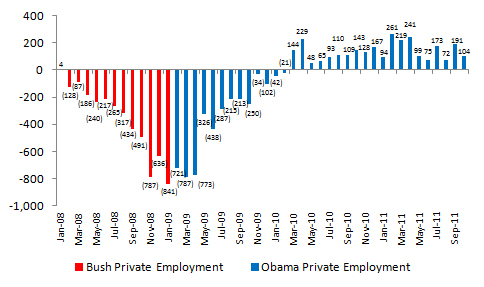
Bush vs. Obama: Unemployment (October 2011 Jobs Data)

Change in Total Private Employment (in thousands), Source: U.S. Bureau of Labor Statistics

Update: Click here for the most recent jobs statistics.

On the first Friday of every month, I update the unemployment numbers so that I can compare the unemployment rate under President George W. Bush with the unemployment rate under President Obama at that time. The genesis of this ritual began when I felt compelled to respond to some left-leaning sites that were comparing Obama’s first two years and four months in office with Bush’s last and worst economic year (the above chart shows the most recent incarnation of this narrative).

Continue reading

Posted in Business, Finance and Economics, Media, Policy, Politics | Tagged , , , | 30 Comments

Profiles in Incompetence: Mayor Jean Quan of Oakland

Sometimes the decisions and actions of a single individual can lead to disaster. It does not happen often, because most good leaders surround themselves with people who help them compensate for their blind spots.

Mayor Jean Quan is not one of those people. Continue reading

Posted in Business, California, Crime, Finance and Economics, Leadership, Media, Policy, Politics, Socialism, Taxes, Unions | Tagged , , , , , | 6 Comments

Blue vs. Red State Inequality

Today, David Brooks published an intriguing opinion editorial about the difference between Blue and Red State inequality. Brooks’ definitions of Blue and Red State inequality are necessarily fuzzy. You might be able to evaluate the issue from a quantitative standpoint, for instance; however, that is not the approach Brooks chooses.

Instead, he evokes more of a feeling about what these two distinct types of inequality entail. From someone who has experienced both of these environments, I was extremely impressed by Mr. Brooks’ penetrating insight.

He begins his post with the following contention:

“We live in a polarizing society, so perhaps it’s inevitable that our experience of inequality should be polarized, too.” Continue reading

Posted in Business, Education, Finance and Economics, Leadership, Policy, Politics | Tagged , , , , | 12 Comments

The Selfish Generation

Earlier this month, AARP released the video above, which typifies every stereotype many members of my generation hold about Baby Boomers.

Namely that they lived it up in the sixties, led extremely comfortable and self-indulgent lives built on the backs of the Greatest Generation’s sacrifices, and are demanding benefits to which they feel entitled, even though it may ultimately bankrupt this country.

Now most Baby Boomers are probably not this selfish, but this ad certainly makes them appear that way.

My message to the 50 million is that you are wealthier on average than the rest of us, and it is not right for you to take more out of the system than you put in. We all need to make sacrifices in order to keep this country financially solvent.

This threatening, arrogant, and greedy advertisement does not suit you.

Posted in Finance and Economics, Healthcare, Media, Policy, Politics, Social Security, Socialism, Taxes | Tagged , | 10 Comments

ROARR’s Guiding Principles (Part II): Small, but Not Minimal, Government Is Best

In Part I of this series, I argued that a fundamental reason our government is broken is the political selection process favoring ideological warriors over pragmatic problem solvers. I introduced my “Funnel of Futility” theory: as ideology becomes increasingly important in one’s decision-making process, the more futile working with an ideological opposite becomes. In contrast, as more data-intensive decision-makers interact, the partisan gap narrows, and government becomes more useful and efficient.

Today, I will introduce the second official guiding principle of Reflections of a Rational Republican — small, but not minimal, government is best.

Small, but Not Minimal, Government Is Best

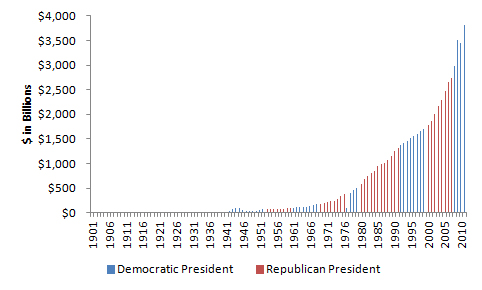
Since 1901, federal government expenditures have grown exponentially. They have ballooned in recent years so much that one can no longer see pre-1940s values on the chart below. Furthermore, the chart also color-codes each year by the political party occupying the White House. It soon becomes abundantly clear that government has expanded regardless of the party controlling the executive branch.

Federal Government Expenditures (1901-2011E), Source: OMB

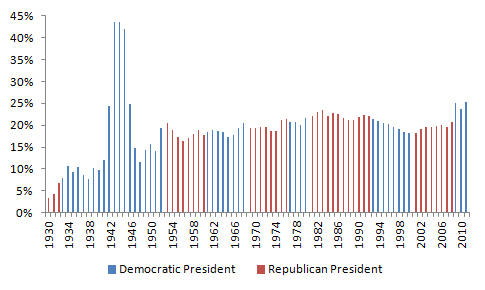
Of course, American real GDP growth and inflation accounted for most of this effect, so it is more instructive to couch the expansion of government in more relative terms. The chart below illustrates federal government expenditures as a share of U.S. GDP.

Federal Government Expenditures Share of GDP (1930-2011E), Source: OMB

From 1930 to 2011, federal government expenditures have averaged about 19% of U.S. GDP. However, if one excludes the last thirty years, that number declines to about 18%, on average. Additionally and despite popular opinion, there is little difference in this percentage between Republican and Democratic administrations. Under Republican presidents, federal government expenditures averaged about 19.0% of GDP, while under Democratic ones it averaged 19.1%. In terms of 2010 GDP, electing a Republican president might only save the country about $11.4 billion, which is roughly equivalent to cutting ethanol subsidies for about two years. Continue reading

Posted in Blogging, Business, Clean Energy, Clean Tech, Climate Change, Defense, Education, Energy Security, Finance and Economics, Food Security, Healthcare, International Security, Leadership, Mathematics, Media, Peak Oil, Policy, Politics, Socialism, Taxes, Technology, Writing | Tagged , , , | 10 Comments

ROARR’s Guiding Principles (Part I): Data-Driven Decision-Making Produces Pragmatic Public Policy

Since starting this blog almost ten months ago, I intended to post this site’s guiding principles. Yet ten months into this experiment, I still haven’t done so. So without further ado, here is the first of seven principles that embody the philosophies underlying Reflections of a Rational Republican.

Data-Driven Decision-Making Produces Pragmatic Public Policy

One of the fundamental reasons our government is broken is that the political selection process favors ideological warriors over pragmatic problem solvers. For instance, each party’s primary process rewards candidates who toe the party line, and punishes those who sometimes favor practical solutions over partisan mandates.

Another major problem with our political system is that it is dominated by lawyers. According to Fox News, 203 of the 541 members of Congress are attorneys, and 218 have JD degrees. In other words, 40% of Congress has legal training, and 39% have practiced law at some point in their careers versus 0.3% in the overall U.S. population.

The problem with legal training is that it is focused on advocacy. Lawyers are imbued with a sense that they must provide their clients with the strongest possible defense. As such, they focus ruthlessly on the strengths of their clients’ cases, while downplaying the weaknesses. The American legal system is by nature highly adversarial. As a consequence, lawyers have a tendency to focus on winning their arguments rather than problem-solving.

In contrast, most first-time members of China’s political leadership were not lawyers, but engineers and administrators. In China’s 17th Politburo, 76% of members had experience as provincial leaders. Until several years ago, all nine members of the Politburo’s Standing Committee were engineers by training.

The contrast between the two countries today could not be clearer. The Chinese government has focused on problem-solving. After all, the pressure to create over 24 million jobs a year to stave off social instability is a very real motivator. The country’s economy continues to grow at well above 8% a year, and, as of October 29, 2011,  it has accumulated massive foreign exchange reserves of $3.2 trillion. In contrast, the United States continues to be mired in partisan political bickering that nearly triggered a default on its federal debt in August 2011. It is then no surprise that America’s economic growth is expected to remain below 2% for the foreseeable future.

The only way to reconcile political differences is to find common ground. The easiest way to do that is to use data to drive decision-making. I believe that people generally fall into four buckets. They are either liberal or conservative, and they favor either ideology or data in policy developement. I believe every sound government should have some ideologically driven leaders from both political parties to inspire us. That said, I believe the government that governs best is one populated predominantly by data-driven decision-makers. For these individuals, ideology is important, but data is supreme. The problem today is that America’s government is dominated by data-fudging ideologues who care more for party than for problem-solving.

Source: ©2011 Reflections of a Rational Republican

The figure above provides a useful framework to illustrate this problem, and is the primary reason I created this site. I call the funnel in the chart, the “Funnel of Futility.” The more ideological a decision-maker is, the wider the gap between him and his ideologically equivalent counterpart. As ideology becomes increasingly important in one’s decision-making process, the more futile working with an ideological opposite becomes. In contrast, as more data-intensive decision-makers interact, the partisan gap narrows, and government becomes more useful and efficient.

As such, the purpose of this site is to confront the facts, create a dialogue centered around data, and engage in problem-solving rather than political bickering.

Posted in Blogging, Business, Clean Energy, Clean Tech, Climate Change, Defense, Education, Energy Security, Finance and Economics, Food Security, Healthcare, International Security, Leadership, Mathematics, Media, Peak Oil, Policy, Politics, Socialism, Taxes, Technology, Writing | Tagged , , , | 12 Comments